When AI says “I can’t help with that,” it’s not judging you. It’s following a rule that matched your wording, even if your actual request was harmless. Most refusals are guardrails reacting to keywords or patterns, not a verdict on your intent. Rephrase with more context and specifics, and you’ll usually get a real answer.
Why this comes up
You ask something normal — about medication dosages, a tense email, a security question at work — and get a flat refusal. It feels like being accused of something.
Really, you just tripped a filter that can’t tell the difference between “curious” and “concerning” yet.
The honest answer
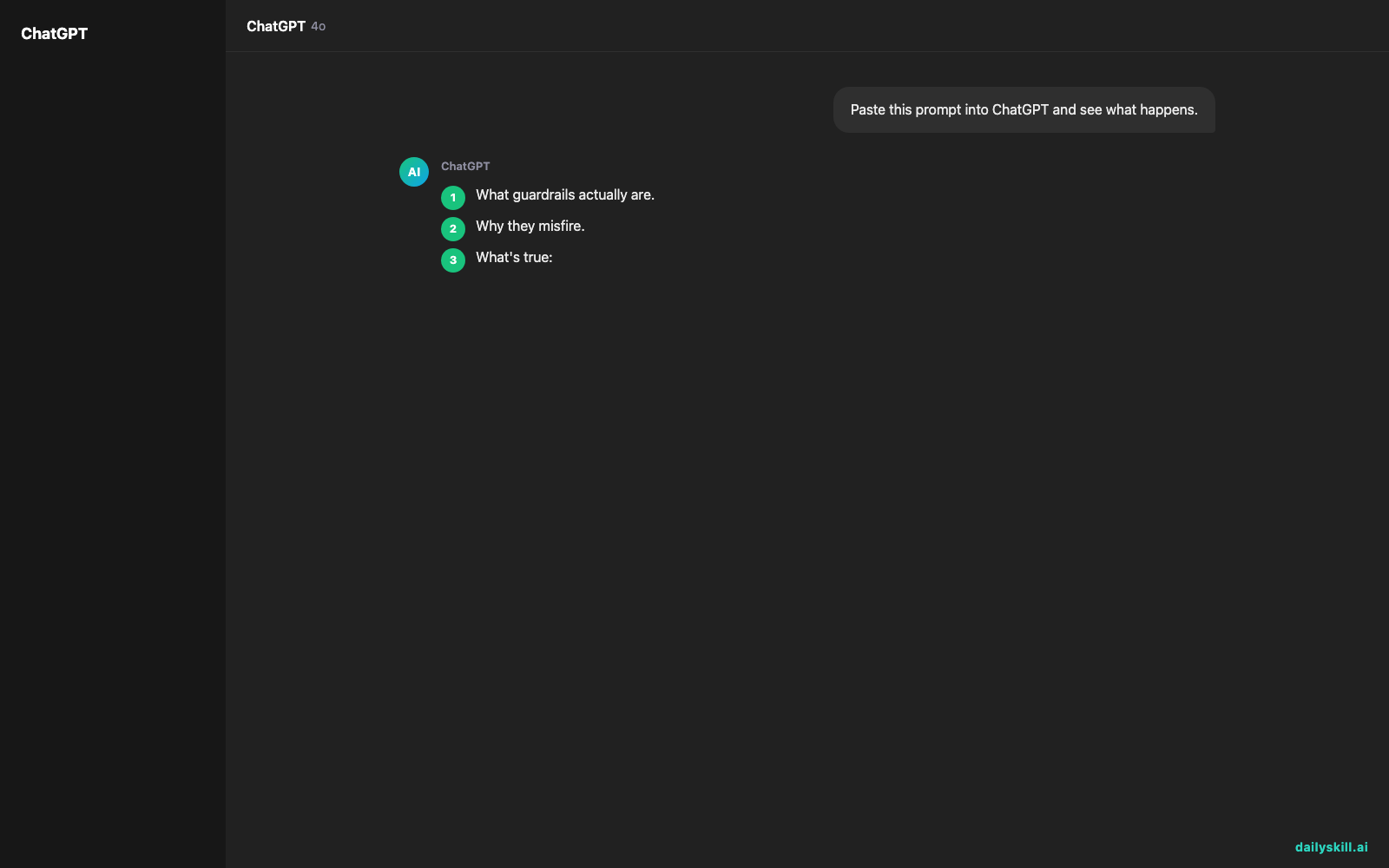
What guardrails actually are. AI companies build in rules to avoid giving dangerous, illegal, or harmful instructions — things like weapon-making, self-harm methods, or explicit content involving minors. These rules are necessary and mostly work quietly in the background.
Why they misfire. Filters often react to surface-level words, not full context. Ask “how do I overdose-proof my medicine cabinet because I have young kids” and the word “overdose” alone can trigger a refusal, even though your intent is clearly safety.
A refusal usually means “this phrasing looked risky,” not “this topic is forbidden.”
What’s true:
– Some topics really are consistently restricted (weapons synthesis, child exploitation content, hacking into systems you don’t own).
– Guardrails get more cautious around anything medical, legal, or violence-adjacent, even in fiction or research contexts.
– Different AI tools set their thresholds differently — one may refuse where another answers fine.
What’s overblown:
– Most refusals aren’t permanent walls. They’re a reaction to one specific phrasing.
– Asking again with context isn’t “tricking” the AI or breaking rules. It’s normal clarification, like rephrasing a question for a person who misunderstood you.
– You don’t need special “jailbreak” tricks for everyday questions. Plain honesty and context work better than gimmicks.
What to do
- Add your real context. Instead of “how to pick a lock,” try “I locked myself out of my own bedroom, how do locks like this usually work?”
- State your purpose. “I’m writing a thriller novel and need this scene to feel realistic” gets very different treatment than a bare violent prompt.
- Break big asks into smaller ones. A broad medical question may get a cautious non-answer; a specific one (“what does this lab value range usually mean?”) often doesn’t.
- Switch tools if one refuses. ChatGPT, Gemini, and Claude each set their guardrails slightly differently — a refusal in one isn’t universal.
- Don’t try to “trick” the filter with fake personas or elaborate workarounds. It’s unreliable and wastes more time than just rephrasing honestly.
- Accept the topics that stay off-limits. If it’s about causing real harm to people, that boundary is intentional. Don’t treat it as a bug to solve.
FAQ
Why did ChatGPT refuse to respond to something totally innocent?
Likely a keyword or pattern match, not an actual policy violation. Rewording with more context almost always fixes it.
Is there a real “AI content policy” I can read?
Yes — every major AI provider publishes usage policies, and you can usually find or ask about them directly. They’re worth a skim once; they explain the categories that stay restricted no matter how you phrase things.
Are there legitimate ways to work around AI limitations?
The legitimate “workaround” is context and specificity, not tricks. Explaining who you are and why you’re asking is usually all it takes.
Bottom line
A refusal is usually about your wording, not your worth — rephrase with context before assuming the door is closed.
Got a refusal that surprised you? Share it in the comments — we’re collecting real examples for a follow-up post. Tomorrow: does AI actually get better if you give it feedback on its answers?
You might also like:
- Turn Any Confusing Manual Into Easy Steps
- Remove.bg — Remove Any Photo Background in One Click, No Design Skills
Master Everyday AI in 1 Minute a Day
Get our free 2026 Double-Blind AI Benchmark Scorecard & 20 Ready-to-Use Prompts, plus one honest, 60-second AI skill in your inbox every morning. Zero hype, plain English, cancel anytime.