AI sometimes makes up facts — wrong dates, fake sources, invented quotes — and says them with the same confident tone it uses for things that are true. This is called “hallucination.” It happens because AI is built to predict a good-sounding answer, not to know things the way you do. It’s not lying on purpose — it just doesn’t have a built-in “I’m not sure” alarm. The fix isn’t to distrust every answer; it’s to verify the ones that matter, using a quick two-step check you can do in under a minute.
Why this comes up
You ask AI a question, get a smooth, specific-sounding answer, and it turns out to be false — a made-up statistic, a book that doesn’t exist, a wrong date. It’s unsettling because there was no hesitation, no “I think” — just flat-out confidence.
That gap between how certain it sounds and how wrong it can be is the real worry.
The honest answer
What’s actually happening (hallucination, explained simply)
AI language models generate text by predicting the most likely next word based on patterns in huge amounts of writing. That’s how they write emails, explain concepts, and answer questions so fluently.
But it also means they can produce a very plausible-sounding sentence that is simply false — because “plausible” and “true” are not the same thing to the model.
AI isn’t trying to deceive you. It’s filling in a gap the same confident way whether it knows the answer or not.
This is why AI gives wrong answers confidently instead of hedging. It doesn’t have a strong internal sense of “I don’t actually know this” the way a person does when they’re guessing.
When AI is most likely to make things up
- Obscure or very specific facts — exact statistics, niche history, small details about lesser-known people or events.
- Fast-moving topics — even tools that can search the web live can still misread a page or summarize it wrong.
- Fake citations — asking for “a source” can produce a very real-looking but nonexistent link, study, or quote.
- Math and precise numbers — it can describe the right method and still botch the final calculation.
What’s overblown
Today’s AI tools are noticeably better at admitting uncertainty than earlier versions, and many now show the sources or web pages they pulled an answer from. AI isn’t broken or untrustworthy across the board.
It’s just unreliable specifically on precise facts, dates, numbers, and citations — and genuinely useful for brainstorming, summarizing, drafting, and explaining concepts you can sanity-check yourself.
What to do — the two-step verification method
Use this on any AI answer that matters (a fact you’ll repeat, a number you’ll use, a quote you’ll cite):
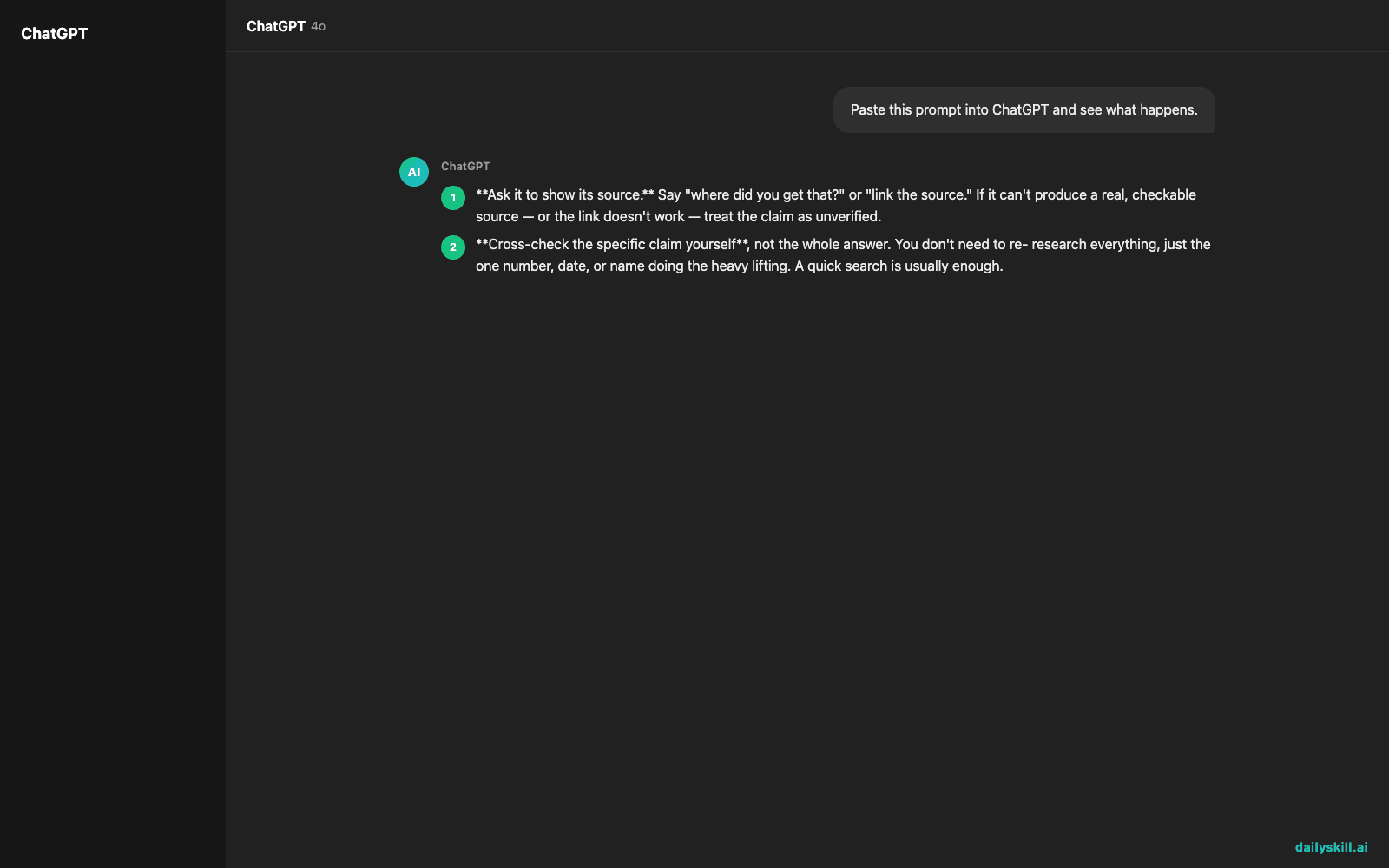
- Ask it to show its source. Say “where did you get that?” or “link the source.” If it can’t produce a real, checkable source — or the link doesn’t work — treat the claim as unverified.
- Cross-check the specific claim yourself, not the whole answer. You don’t need to re-research everything, just the one number, date, or name doing the heavy lifting. A quick search is usually enough.
Other good habits:
- Do ask AI to rate its own confidence (“how sure are you about this?”). It’s not perfect, but it often flags shaky answers.
- Do be extra cautious with dates, statistics, legal or medical specifics, and quotes — these are hallucination hot spots.
- Do ask it to search the web and show sources when accuracy matters — this cuts down errors a lot.
- Don’t trust a citation just because it looks formatted correctly (title, author, year). That formatting can be entirely fabricated.
- Don’t assume confidence equals accuracy. Tone tells you nothing about truth.
FAQ
Does this mean AI is unreliable overall?
No — it’s unreliable specifically for precise facts and citations. For writing help, brainstorming, and explaining ideas, it’s generally solid.
Do newer AI tools hallucinate less?
Yes, they’ve improved a lot, and many now cite live sources you can click through. But the habit of double-checking specific facts is still worth keeping — no tool is at zero.
Is there a way to make AI more accurate on facts?
Ask it to search the web for current information and show its sources. Then still spot-check the one detail that matters most — that’s the habit that never goes out of date.
Bottom line
AI sounds sure of itself even when it’s wrong — so borrow the confidence, but verify the specifics yourself.
What’s the most confidently-wrong thing AI has ever told you? Share it in the comments — tomorrow we tackle: how do I use AI to improve my writing without letting it write for me?
You might also like:
- Get a Custom 15-Minute Workout Plan Built Just for You
- Shuffll — Turn One Photo Into a Talking, Moving Video Story
Master Everyday AI in 1 Minute a Day
Get our free 2026 Double-Blind AI Benchmark Scorecard & 20 Ready-to-Use Prompts, plus one honest, 60-second AI skill in your inbox every morning. Zero hype, plain English, cancel anytime.