
You have an interview Friday, and “Tell me about a time you failed” is already keeping you up. Here’s the good news. The job post you applied to reveals most of what they’ll ask.
Paste it into Claude, and in about a minute you’ll get 10 tough behavioral questions for that exact role. Each one comes with a sample answer in the STAR method, so you see how a strong answer sounds.
Sound familiar?
You land an interview. Then you search “common interview questions.”
You get a list of 50 generic questions. None of them feel like this job. When you try to practice out loud, your mind goes blank.
Here’s the fix. The job description already tells you what the company cares about. Claude can read it and turn it into the questions you’re most likely to face.
The 60-second fix
First, a quick note on STAR. It’s a simple framework for answering interview questions. It has four parts:
- Situation: Set the scene in one or two sentences.
- Task: Say what you were responsible for.
- Action: Explain what you did, step by step.
- Result: Share the outcome, with numbers if you have them.
Behavioral questions usually start with “Tell me about a time when…”. STAR keeps your answer clear and focused.
Step 1: Copy the job description
Open the job post and copy the whole thing. Responsibilities, requirements, and the “about us” section are all useful.
Step 2: Paste it into Claude with this prompt
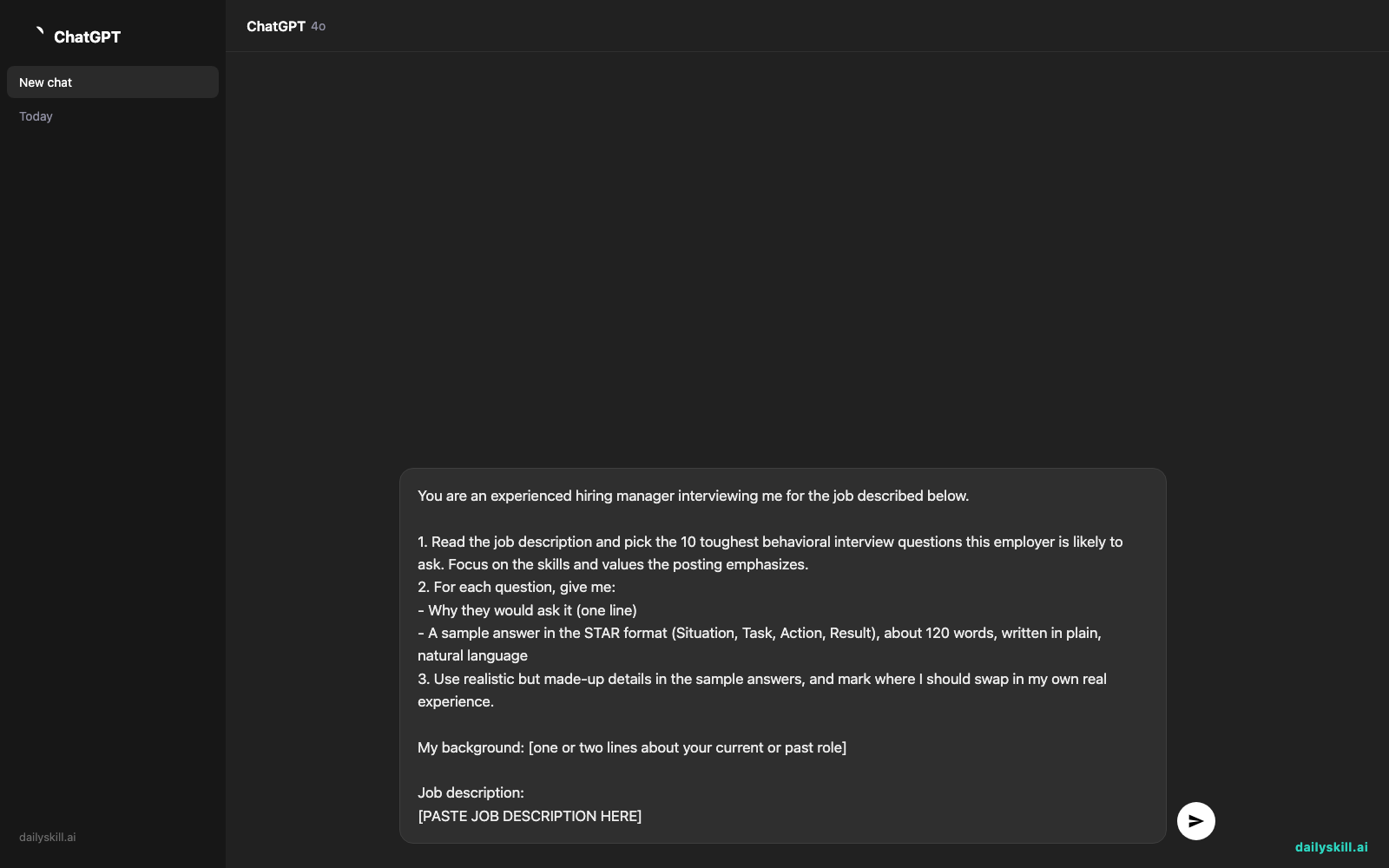
Open Claude and paste the prompt below. Then add a line about your background and paste the job description where it says so.
You are an experienced hiring manager interviewing me for the job described below.

1. Read the job description and pick the 10 toughest behavioral interview questions this employer is likely to ask. Focus on the skills and values the posting emphasizes.
2. For each question, give me:
   - Why they would ask it (one line)
   - A sample answer in the STAR format (Situation, Task, Action, Result), about 120 words, written in plain, natural language
3. Use realistic but made-up details in the sample answers, and mark where I should swap in my own real experience.

My background: [one or two lines about your current or past role]

Job description:
[PASTE JOB DESCRIPTION HERE]
Step 3: Swap in your own story
The sample answers are a model, not a script. Pick your three favorite questions. Rewrite each answer using a real moment from your own work.
Then say each one out loud once. Speaking it is what makes it stick.
Real example
Say you paste in a job post for a Customer Support Team Lead. It mentions “handling escalations,” “coaching new hires,” and “improving response times.” You add: “My background: 3 years as a support agent at an online furniture store.”
Claude might give you something like this:
Question 3: Tell me about a time you handled an angry customer who demanded to speak to a manager.
Why they ask: The role involves escalations, so they want to see whether you stay calm and solve problems.
Sample STAR answer:
Situation: A customer’s table arrived scratched for the second time, and they were furious.
Task: I needed to calm things down and find a fix before they cancelled their order and left a public review.
Action: I let them explain without interrupting and apologized for the repeat problem. Then I offered a free replacement with express shipping and flagged the packaging issue to our warehouse team.
Result: The customer kept the order, and the warehouse added corner guards to their packing process. Damage complaints dropped over the next month.(Swap in your own real example here.)
Notice how the question matches the “escalations” line in the job post. That’s why this beats a generic list.
Level up
- Get feedback. Type your own answer into the chat. Then ask: “Score my answer against STAR and tell me what’s missing.”
- Practice follow-ups. Ask: “Now act as the interviewer and ask me one follow-up question after each answer, one at a time.”
- Find your gaps. Ask: “Based on my background, which skills in this job description am I weakest on? Give me 3 questions to prepare for.”
FAQ
What is the STAR method in an interview?
STAR stands for Situation, Task, Action, Result. It’s a way to answer behavioral questions by telling a short, structured story. It keeps you on topic and shows what you actually did.
Can AI help me prepare for behavioral interview questions?
Yes. Claude can tailor questions to the exact job posting. It can also play the interviewer and give you feedback on your answers. You still need to use your own real experiences.
Should I memorize the sample STAR answers?
No. Use them as a model for structure and length. Interviewers can tell when an answer is rehearsed or isn’t yours. Your real stories are stronger.
Today’s check-in
Try the prompt on a real job post, or one you’d love to have someday. Then share in the comments: which question was the toughest for you?
Tomorrow (Day 156): you’ll turn the ingredients already in your pantry into a balanced daily meal plan with AI. No shopping trip needed.
You might also like:
- Can AI help me compare credit card benefits and points rewards?
- Perplexity Pages — Turn Research Into a Shareable Article
Master Everyday AI in 1 Minute a Day
Get our free 2026 Double-Blind AI Benchmark Scorecard & 20 Ready-to-Use Prompts, plus one honest, 60-second AI skill in your inbox every morning. Zero hype, plain English, cancel anytime.