Just ask directly. Say “explain this like I’m 12” or “use everyday examples” or “break it into bullet points.” AI tools are built to adjust their language when you ask — you don’t need special skills or magic words. It usually takes one or two follow-ups to get an answer that actually makes sense to you.
Why this comes up
You ask AI a question, get an answer full of jargon, and feel like you did something wrong. You didn’t — the AI just guessed wrong about what you already know.
This is one of the most common frustrations beginners hit, and it has a simple fix.
The honest answer
AI doesn’t know your background. When you ask a question, it guesses how much detail and technical language to use. Sometimes it guesses “expert,” when you wanted “explain to a friend.”
Simplifying is a normal, expected request. You’re not bothering the AI or admitting defeat. Asking for a plainer explanation is one of the most common things people do — it’s built for this.
Exact phrases that work
Try these, word for word:
- “Explain this like I’m 12.”
- “Break it into simple bullet points.”
- “Use an everyday example, not a technical one.”
- “Say that again, but simpler.”
- “What’s the one-sentence version?”
- “Explain it like you’re talking to someone who’s never heard of this.”
What actually happens when you ask
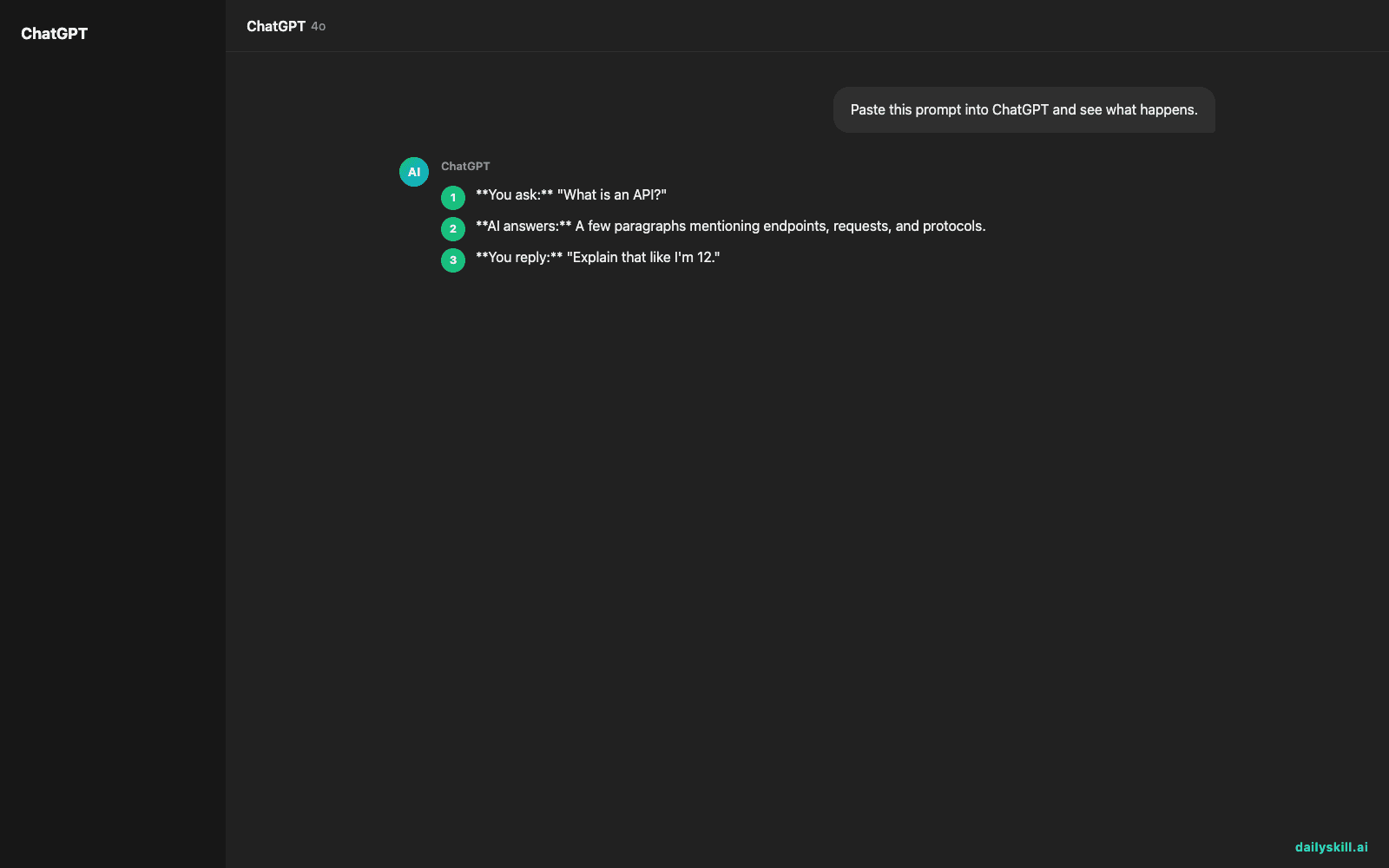
Here’s a typical exchange:
- You ask: “What is an API?”
- AI answers: A few paragraphs mentioning endpoints, requests, and protocols.
- You reply: “Explain that like I’m 12.”
- AI answers: “It’s like a waiter. You tell the waiter what you want, the waiter goes to the kitchen, and brings back your food. You don’t need to know how the kitchen works.”
That’s it. Two exchanges, and the confusing version becomes a simple one.
What’s overblown
You don’t need a “perfect prompt” or a course to make AI answers clearer. People sometimes treat prompt-writing like a technical skill you must master.
It’s not. Plain English requests work fine — that’s the whole point of asking AI to explain things more simply.
The fastest way to simplify AI explanations is to just ask — plainly, directly, without overthinking the wording.
What to do
- Do ask again if the first answer is confusing — that’s normal, not annoying.
- Do name your level: “I’m a total beginner” or “explain like I’m 12” works well.
- Do ask for a specific format: bullet points, a short paragraph, or a one-line summary.
- Do ask for an everyday comparison: “explain it using something from daily life.”
- Don’t assume the first answer is the only answer — treat it as a rough draft.
- Don’t apologize for asking twice. Simplifying is a normal part of the conversation.
- Don’t over-engineer your request with long instructions — short and direct works best.
FAQ
Does asking for a simpler answer make it less accurate?
No. Simplifying usually means fewer technical words and shorter sentences, not wrong information. If you want to double-check, ask “is this still accurate, just simpler?”
What if the simpler version is still confusing?
Ask again with a different angle: “use a cooking analogy” or “explain it in three bullet points.” Different framings unlock different explanations.
Can I ask for both a simple and detailed version?
Yes. Try: “Give me the simple version first, then the detailed version below it.” Most AI tools will happily do both in one reply.
Bottom line
Getting a clear, simple AI answer is one short follow-up away — just ask plainly. What’s your go-to phrase for getting AI to simplify things? Share it with the community. Tomorrow: what does it mean when AI says it cannot answer?
You might also like:
- Turn Any Voice Memo Into Clean Meeting Minutes
- Copysmith — Turn One Product Into a Ready-to-Post Listing in Minutes
Master Everyday AI in 1 Minute a Day
Get our free 2026 Double-Blind AI Benchmark Scorecard & 20 Ready-to-Use Prompts, plus one honest, 60-second AI skill in your inbox every morning. Zero hype, plain English, cancel anytime.