
How many habit trackers have you abandoned by Thursday? Here’s exactly how to build one that works around your actual evenings, your energy, and the thing that always derails you. It takes about a minute.
You’ll get: a one-page weekly tracker for 3 habits, a “tiny version” of each for bad days, and a 30-day plan. All you need is ChatGPT (or any AI assistant you like).
Sound familiar?
You start with big plans. Exercise, read, drink more water, sleep earlier, all at once.
Then you find a template online. It has twelve columns, color codes, and a “weekly reflection” box. By Thursday, it feels like homework. By next week, it’s gone.
The problem usually isn’t you. Most trackers are built for a generic person, not for your mornings, your job, or the way you really feel at 8 p.m.
The 60-second fix
Starting small works best, and three habits is plenty. Let’s build a system around them.
Step 1: Name your 3 habits (and one honest detail)
Pick three habits. For each, add one real-life detail: when are you free, and what usually gets in the way?
Example: “Walk 15 minutes (I’m free after dinner).”
Step 2: Paste this prompt into ChatGPT
Swap the brackets for your own answers.
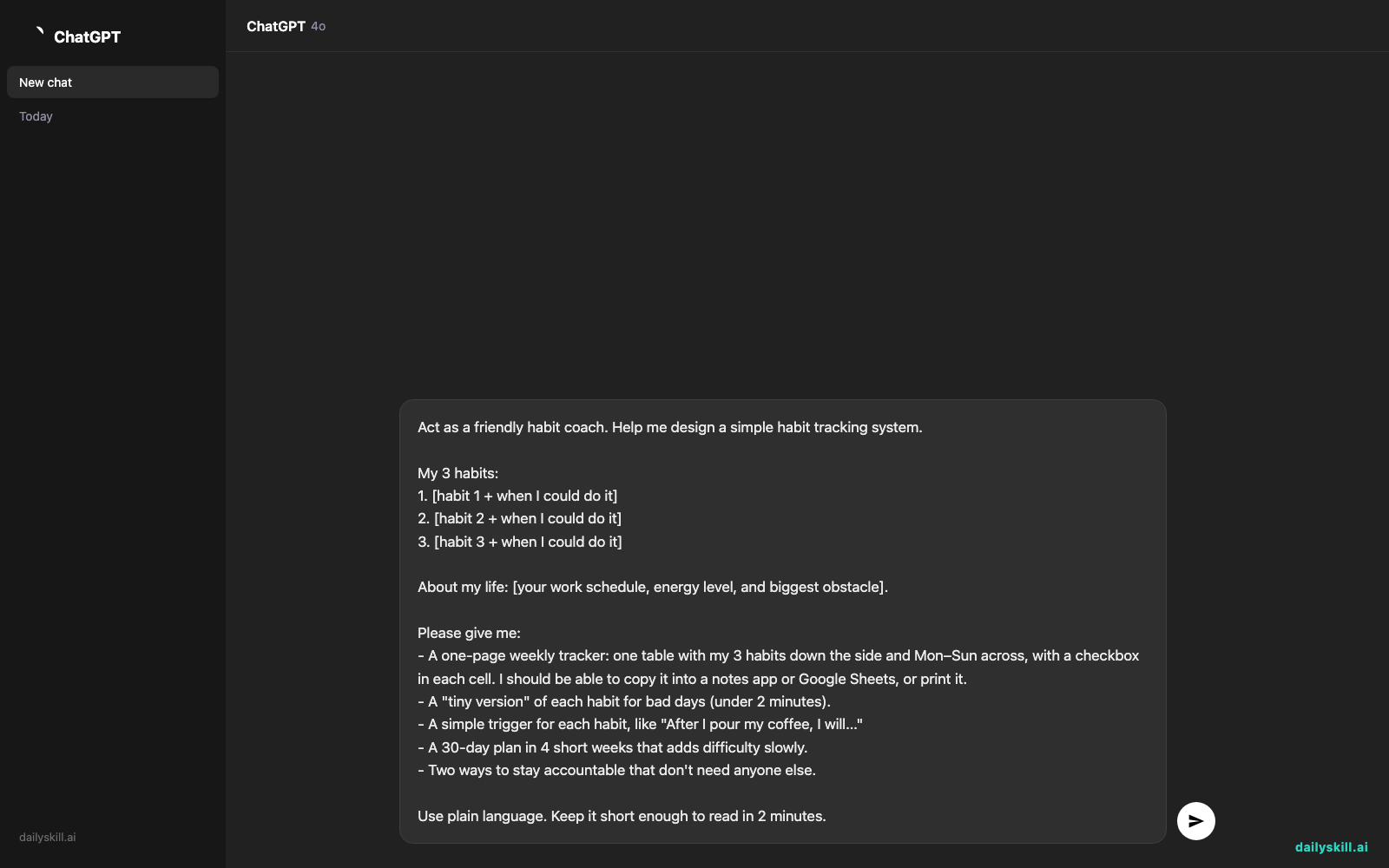
Act as a friendly habit coach. Help me design a simple habit tracking system.

My 3 habits:
1. [habit 1 + when I could do it]
2. [habit 2 + when I could do it]
3. [habit 3 + when I could do it]

About my life: [your work schedule, energy level, and biggest obstacle].

Please give me:
- A one-page weekly tracker: one table with my 3 habits down the side and Mon–Sun across, with a checkbox in each cell. I should be able to copy it into a notes app or Google Sheets, or print it.
- A "tiny version" of each habit for bad days (under 2 minutes).
- A simple trigger for each habit, like "After I pour my coffee, I will..."
- A 30-day plan in 4 short weeks that adds difficulty slowly.
- Two ways to stay accountable that don't need anyone else.

Use plain language. Keep it short enough to read in 2 minutes.
Step 3: Copy it, use it, tweak it tomorrow
Copy the table into your notes app or a spreadsheet, or print it. Then reply with: “Make it simpler.”
Say that as often as you like. A tracker you’ll actually open beats a perfect one you won’t.
Real example
What one reader typed in:
- Walk 15 minutes (after dinner)
- Read 10 pages (before bed)
- Drink a glass of water (first thing in the morning)
About my life: I work 9–5, I’m tired by evening, and I scroll my phone in bed until midnight.
A snippet of what ChatGPT might give back:
Your tiny versions (bad-day mode)
– Walk: Step outside and walk to the end of the street and back.
– Read: One page. Just one.
– Water: One glass, done.Your triggers
– After I put my plate in the sink → I put on my walking shoes.
– After I plug my phone in across the room → I pick up my book.
– After I turn off my alarm → I drink a glass of water.
Week 1 Mon Tue Wed Thu Fri Sat Sun Walk ☐ ☐ ☐ ☐ ☐ ☐ ☐ Read ☐ ☐ ☐ ☐ ☐ ☐ ☐ Water ☐ ☐ ☐ ☐ ☐ ☐ ☐ Week 1 goal: Just show up. Tiny versions count as a win.
Week 2: Walk 5 minutes, read 3 pages.
Week 3: Walk 10 minutes, read 5 pages.
Week 4: Full habits: 15-minute walk, 10 pages.
Notice what it did. It caught the phone-in-bed problem and moved your phone across the room, so your book becomes the easy option. That’s the “tailored to your life” part.
Level up
- Add a rescue plan: Ask, “What should I do if I miss two days in a row?” A plan for slips keeps one bad day from becoming a quit.
- Build a check-in routine: Ask, “Write me a 30-second Sunday review with 3 questions.” It’s accountability with no one else needed.
- Change the format: Ask for a printable layout, a plain checklist, or a version you can paste straight into Google Sheets.
- Stack your habits: Ask the AI to link all 3 into one short morning or evening routine.
FAQ
What’s the best habit tracker template that’s free?
The best one is the one you’ll use. A one-page table with your 3 habits and 7 boxes each is enough. An AI assistant can make it in seconds, and you can paste it into any notes app or spreadsheet at no cost.
How many habits should a beginner track?
Start with three, at most. Fewer habits mean fewer things to forget. Once those feel automatic, add one more.
How can AI help me create an accountability system?
Ask it to be your coach. It can write daily reminders, a weekly review, and a “what went wrong?” check-in. You can also ask it for ways to share your progress with a friend, if you want that.
Today’s check-in
Name your 3 habits and run the prompt. Then tell us in the comments: which habit did you pick first, and what’s your “tiny version” for bad days?
Tomorrow (Day 129): you’ll learn how to pull clear, actionable feedback out of customer complaints with AI, so a pile of angry messages turns into a short list of fixes.
Master Everyday AI in 1 Minute a Day
Get our free 2026 Double-Blind AI Benchmark Scorecard & 20 Ready-to-Use Prompts, plus one honest, 60-second AI skill in your inbox every morning. Zero hype, plain English, cancel anytime.