Yes. You just have to ask for it. Most AI chat tools default to lecture mode — you ask, it answers. But if you tell it “quiz me” or “ask me what I think first,” it switches into Socratic mode: asking questions, waiting for your answer, then correcting or building on it. This works today in ChatGPT, Gemini, Claude, and most other AI assistants, and it takes one sentence to turn on.
Why this comes up
You’ve probably noticed that reading an AI’s explanation feels productive in the moment but doesn’t always stick. The real worry: is AI making you a passive reader instead of an active learner?
It’s a fair concern — but it’s about how you prompt it, not a limit of the tool.
The honest answer
Passive reading is genuinely weak for memory. Answering questions, guessing, and getting corrected — called active recall — is one of the best-studied ways to actually retain information.
AI can run that loop with you on demand, for any topic, with no scheduling and no judgment.
What’s true:
– An AI tutor asking questions back can quiz you, wait for your real answer, then explain the gap — just like a good study partner.
– You can control the difficulty, pace, and topic instantly: “make it harder,” “go back to basics,” “only ask true/false.”
– It works for anything with right/wrong answers (grammar, math, history dates) and reasonably well for open-ended stuff too (essay arguments, ethics, strategy).
What’s overblown:
– It’s not magic — if you skim its follow-up questions instead of really trying to answer, you lose most of the benefit.
– It can occasionally accept a shaky answer as “close enough” or explain something incorrectly. Cross-check facts that matter, especially numbers and dates.
– It’s not a replacement for a real teacher on nuanced or graded material — great for practice, not for grading yourself on a final exam.
Try it right now (under 2 minutes)
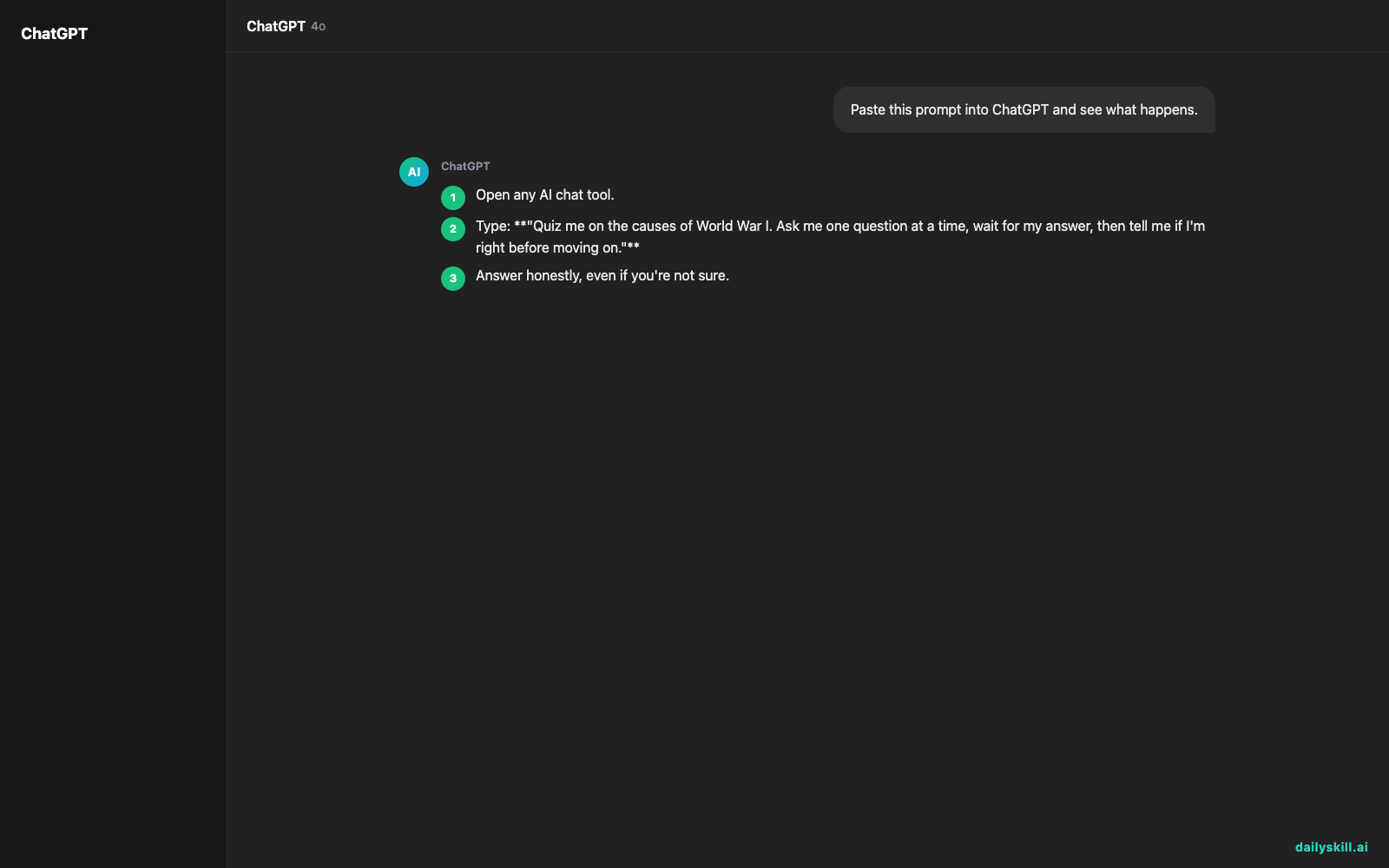
- Open any AI chat tool.
- Type: “Quiz me on the causes of World War I. Ask me one question at a time, wait for my answer, then tell me if I’m right before moving on.”
- Answer honestly, even if you’re not sure.
- Watch it correct or confirm you — then ask a follow-up.
Or flip it the other way:
“Before you explain photosynthesis, ask me what I think happens first.”
That one line is the whole Socratic method trick. You’re just asking the AI to hold the answer back until you’ve tried.
What to do
- Do say exactly what you want: “quiz me,” “ask me first,” “one question at a time.” Vague requests get vague behavior.
- Do set the format: multiple choice, short answer, or “explain it back to me in your own words.”
- Do ask it to adjust difficulty as you go — “that was too easy, go harder.”
- Don’t just read the questions and move on without answering — that skips the whole point.
- Don’t trust interactive AI learning sessions blindly for high-stakes facts; verify anything you’ll be tested or graded on elsewhere.
- Don’t use quiz mode for topics you’ve never touched before — get a quick overview first, then quiz yourself on it.
FAQ
Does this work for languages, not just facts?
Yes — ask it to quiz your vocabulary, correct your sentences, or roleplay a conversation and only correct you at the end.
What if it keeps giving me the answer anyway?
Repeat the instruction more firmly: “Do not explain anything until I’ve answered. Ask, then wait.” Most tools follow this well once stated clearly.
Can I turn this into a habit, not a one-off?
Yes — start each study session with “quiz me mode on [topic], one question at a time” as your opening line every time.
Bottom line
The AI doesn’t have to just tell you things — ask it to ask you things, and you’ll remember more.
What’s a topic you’d want an AI tutor to quiz you on? Tell us in the comments. Tomorrow: why do different AI tools give me different answers to the same question?
You might also like:
- Turn “I have nothing to wear” into a full week of outfits, using clothes you already own
- Cleanup.pictures — Erase Anything From a Photo Without Photoshop
Master Everyday AI in 1 Minute a Day
Get our free 2026 Double-Blind AI Benchmark Scorecard & 20 Ready-to-Use Prompts, plus one honest, 60-second AI skill in your inbox every morning. Zero hype, plain English, cancel anytime.