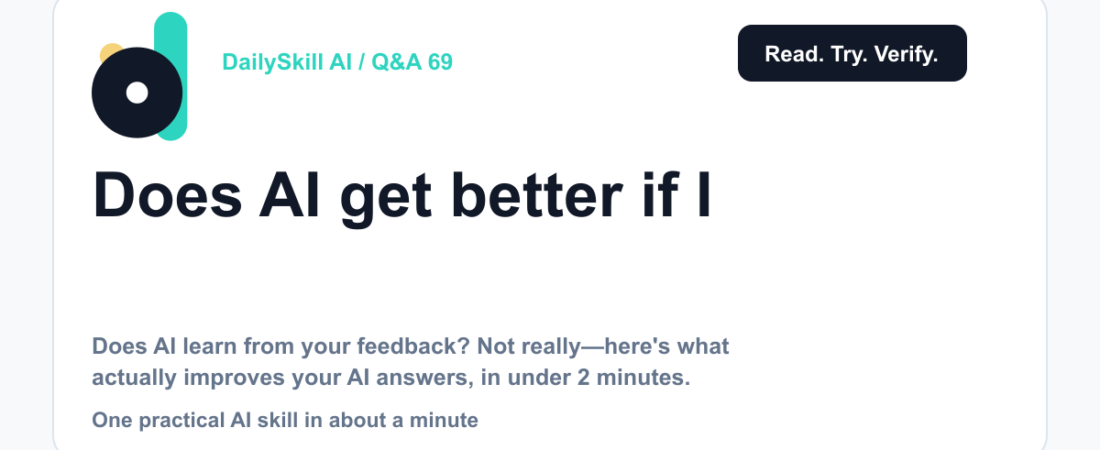
No — the underlying AI model almost never learns from your feedback in real time. When you give feedback, you’re not training the AI; you’re training yourself to ask better questions. The good news: that skill, called iteration, works just as well, and you can build it in about two minutes per conversation.
Why this comes up
You give a thumbs down, or type “that’s wrong, try again,” and you hope the AI is quietly getting smarter for next time. It feels like you’re teaching it. Underneath that hope is a real question: is my effort actually going anywhere?
The honest answer
Does AI learn from my feedback? Mostly no, not instantly.
Your thumbs up/down and your “actually, I meant X” comments don’t rewire the model mid-chat. Some companies use aggregated feedback, much later, to help train future versions. That process is slow, filtered, and not personal to you — the model you’re talking to right now isn’t being edited by your one conversation.
What actually happens: you’re building a feedback loop, not “training” it.
Within a single conversation, the AI does use your corrections as new context. Say “shorter, no bullet points, write like a text message” — it adjusts, because you just gave it clearer instructions, not because it learned anything permanent.
Close the chat and start fresh, and that adjustment is gone. Some tools now offer a memory feature that carries facts across chats, but that’s a saved-notes system, not the model getting smarter.
This is actually good news.
It means you don’t need to “trick” or “teach” the AI. You need to get better at giving it clear input up front, then refine as you go. This is called improving AI responses through iteration — the real skill behind everyone who seems to “get” AI.
The AI isn’t learning about you. You’re learning how to talk to it.
How to get better answers — the 2-minute habit:
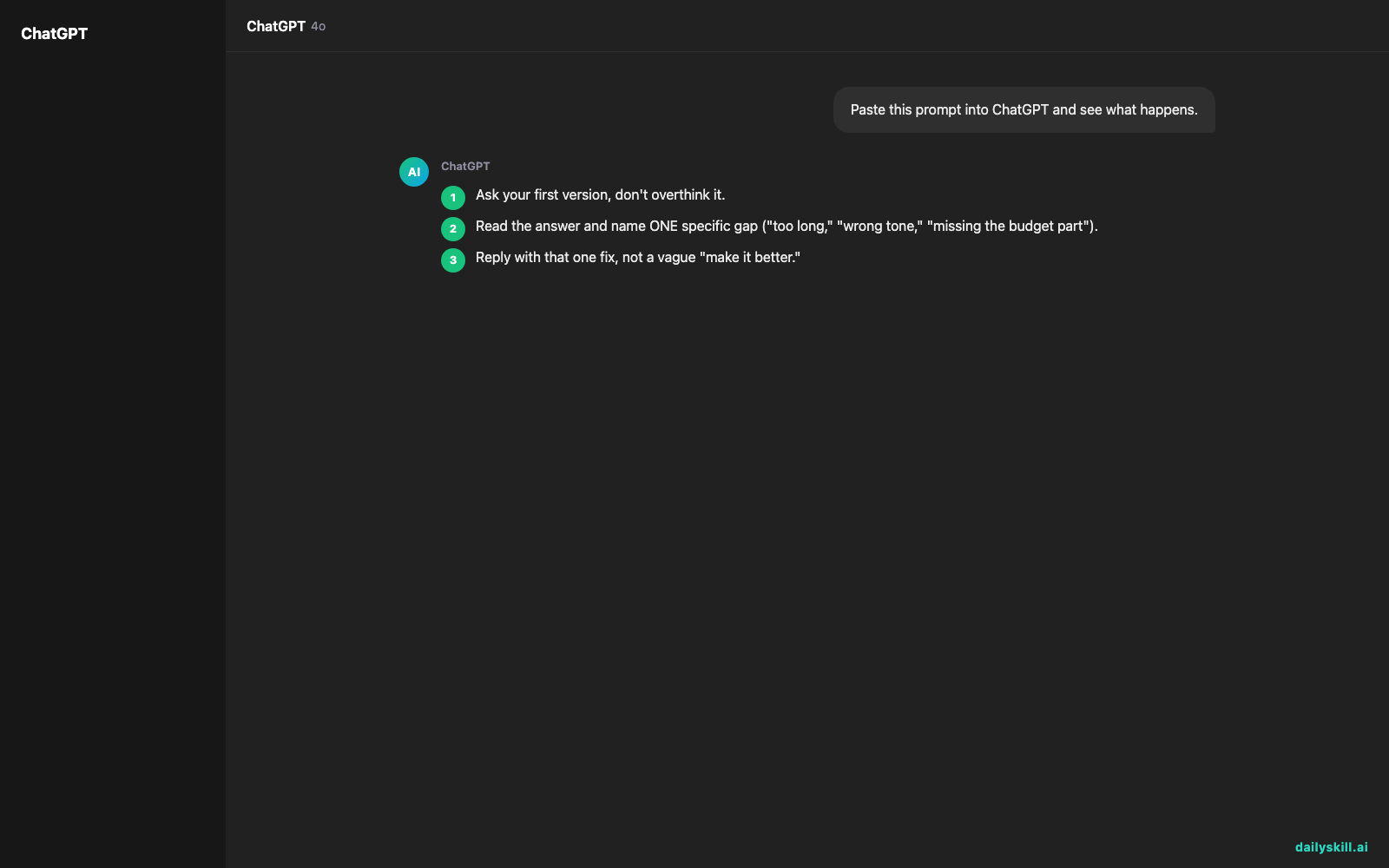
1. Ask your first version, don’t overthink it.
2. Read the answer and name ONE specific gap (“too long,” “wrong tone,” “missing the budget part”).
3. Reply with that one fix, not a vague “make it better.”
4. Repeat once or twice, max. If it’s still off after 3 rounds, your original prompt was probably missing key info — add that instead.
5. Save the final prompt that worked. Reuse it next time you need something similar.
That loop — ask, spot the gap, fix it — is the entire skill. No settings to change, no special training mode to find.
What to do
- Do treat feedback as steering, not teaching — it shapes this answer, not future ones.
- Do be specific: “cut it to 3 sentences” beats “make it shorter and better.”
- Do save prompts that worked well; build your own personal template library.
- Do check if your tool has a memory setting if you want it to remember facts about you across chats — that’s separate from “learning.”
- Don’t assume the thumbs up/down buttons personalize your future chats in any big way.
- Don’t re-explain your whole situation every time — refine what’s already on screen instead.
- Don’t give up after one bad answer; two rounds of iteration fixes most problems.
FAQ
If AI doesn’t learn from me, why do the thumbs up/down buttons exist?
They feed into the company’s broader review process for improving future model versions — slow, aggregated, and not tied to your account personally.
Does the AI remember my feedback in a new conversation?
Only if you’ve turned on a memory feature, which saves facts about you across chats. That’s different from the model “learning” — it’s more like a notes file it checks, not a smarter brain underneath.
Is iteration the same as prompt engineering?
Basically, yes, just less intimidating. Prompt engineering is the fancy name; iteration is just asking, checking, and adjusting.
Bottom line
You can’t train the AI, but you can train yourself — and that’s the skill that actually pays off every time you open a chat.
What’s one prompt you’ve refined until it finally worked? Share it with the DailySkill community — someone else is probably stuck on the same thing.
Tomorrow: your AI is thinking too slow and you’re in a hurry — here’s how to actually speed up AI responses.
You might also like:
- Build a Subscription Comparison Chart in 60 Seconds
- Soundraw — Generate Royalty-Free Background Music Without Hiring a Composer