Trust it as a smart second opinion, not the final word. AI is genuinely good at catching typos, awkward phrasing, math slips, and logic gaps. But it can also miss things or confidently state something wrong.
The safe move is a 3-point check: AI review, your own logic pass, and one trusted human. Use all three for anything that’s graded, published, or sent to a client.
Why this comes up
You want to catch mistakes before someone else does, but you’re not sure if leaning on AI is “cheating” or just risky. The real worry: what if the AI is wrong and you don’t notice?
That’s a fair worry. AI tools sound confident even when they’re mistaken — they don’t say “I’m not sure” as often as they should.
The honest answer
What’s true:
– Using AI to check homework or drafts works well for grammar, spelling, clarity, and basic math or code errors.
– Is AI good for proofreading? Yes — it’s often faster and more thorough than a tired human eye for surface-level issues.
– Most current AI assistants can search the web for up-to-date facts instead of relying only on memory, which makes basic fact-checking more reliable than it used to be.
– AI is great at explaining why something is wrong, which helps you actually learn, not just fix it.
What’s overblown:
– AI review isn’t the same as expert judgment. It can miss context only a teacher, editor, or manager would catch.
– It can sound very sure of a wrong answer. Confidence isn’t accuracy.
– Can you rely on AI feedback alone for anything with real stakes — a grade, a legal document, a diagnosis? No. Not for the final call.
Treat AI feedback like a helpful classmate’s opinion — worth hearing, not worth submitting blind.
The 3-point verification method
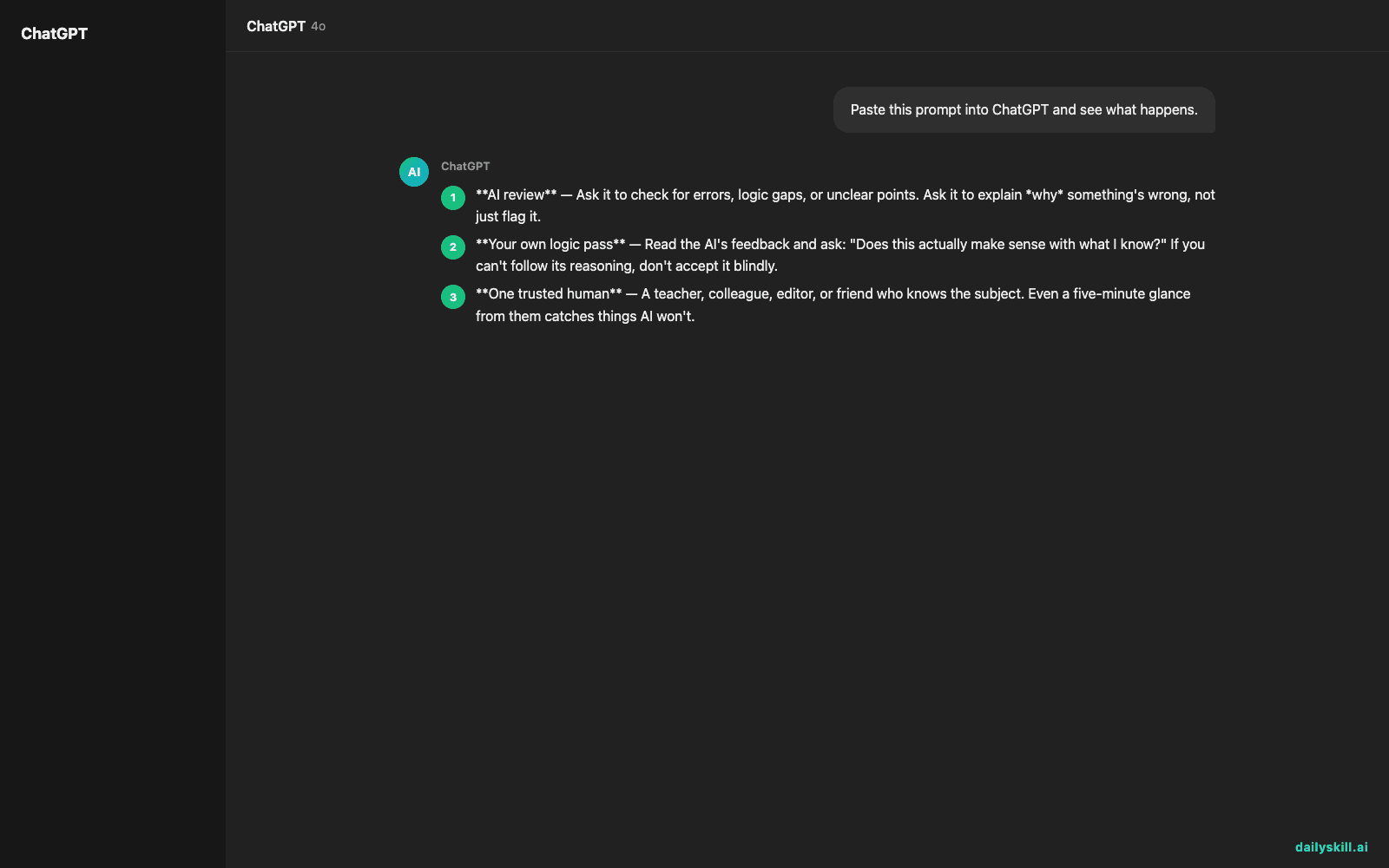
- AI review — Ask it to check for errors, logic gaps, or unclear points. Ask it to explain why something’s wrong, not just flag it.
- Your own logic pass — Read the AI’s feedback and ask: “Does this actually make sense with what I know?” If you can’t follow its reasoning, don’t accept it blindly.
- One trusted human — A teacher, colleague, editor, or friend who knows the subject. Even a five-minute glance from them catches things AI won’t.
What to do
- ✅ Use AI as your first-pass editor — catch the easy stuff before a human ever sees it.
- ✅ Ask AI to show its reasoning (“why is this wrong?”) so you can judge if it’s sound.
- ✅ Cross-check any factual claim, date, or citation AI gives you — especially for schoolwork or reports.
- ✅ Get a human check on anything graded, published, or legally/financially binding.
- 🚫 Don’t submit AI-generated corrections without reading and understanding them.
- 🚫 Don’t assume “AI said so” is proof — treat it as a lead, not a verdict.
- 🚫 Don’t skip the human step just because the AI sounded confident.
FAQ
Is AI good for proofreading essays and reports?
Yes, especially for grammar, structure, and clarity. It’s weaker at judging tone, originality, and subject-specific accuracy — that’s where a human still matters.
Can I rely on AI feedback for professional documents like contracts or reports?
Use it to tighten language and catch errors, but always have a qualified person review anything with legal, financial, or safety consequences.
Does AI fact-checking actually work now?
Better than before — most AI tools can pull current information instead of relying on memory alone. Still, verify important facts independently, especially numbers, dates, and citations.
Bottom line
AI is a fast, useful second opinion — but the final “yes, this is right” should always have a human signature on it too.
What’s your rule of thumb for trusting AI feedback? Drop it in the comments — tomorrow we’re answering: “What AI tool should I use for my specific job?”
You might also find these helpful:
- AI News: Cheaper AI Work, Newsroom Tools, Better Weather
- Get a Custom 15-Minute Workout Plan Built Just for You
- Can AI Actually Help You Make Money? (Realistic Ways That Work in 2026)
Master Everyday AI in 1 Minute a Day
Get our free 2026 Double-Blind AI Benchmark Scorecard & 20 Ready-to-Use Prompts, plus one honest, 60-second AI skill in your inbox every morning. Zero hype, plain English, cancel anytime.