It usually means one of three things: your request bumped into a safety filter, it touches a content policy limit, or the question was too vague for the AI to handle confidently. It’s rarely personal and rarely permanent — a small rephrase or a different tool usually gets you a real answer. Most refusals are the AI playing it safe on a narrow set of topics, not a sign the whole subject is “off-limits.”
Why this comes up
You ask a normal question, get a polite “I can’t help with that,” and it feels random or frustrating. The real worry: is the AI hiding something, being overly cautious, or did you do something wrong? Usually it’s none of those — it’s a system erring on the side of caution.
The honest answer
Why AI refuses to answer usually comes down to a few categories:
- Safety filters — built-in guardrails around things like weapons, self-harm, illegal activity, or generating harmful content. These trigger even on borderline or research-sounding questions.
- Content policy limits — rules set by the company, like not giving specific medical dosages, not impersonating real people harmfully, or not generating certain adult or violent content.
- Ambiguous prompts — sometimes “I can’t answer that” really means “I don’t understand what you’re asking” or “I need more context,” not a policy block at all.
- Genuine gaps — a tool may lack reliable, verifiable information on something very fresh or very niche, and it says so honestly instead of guessing.
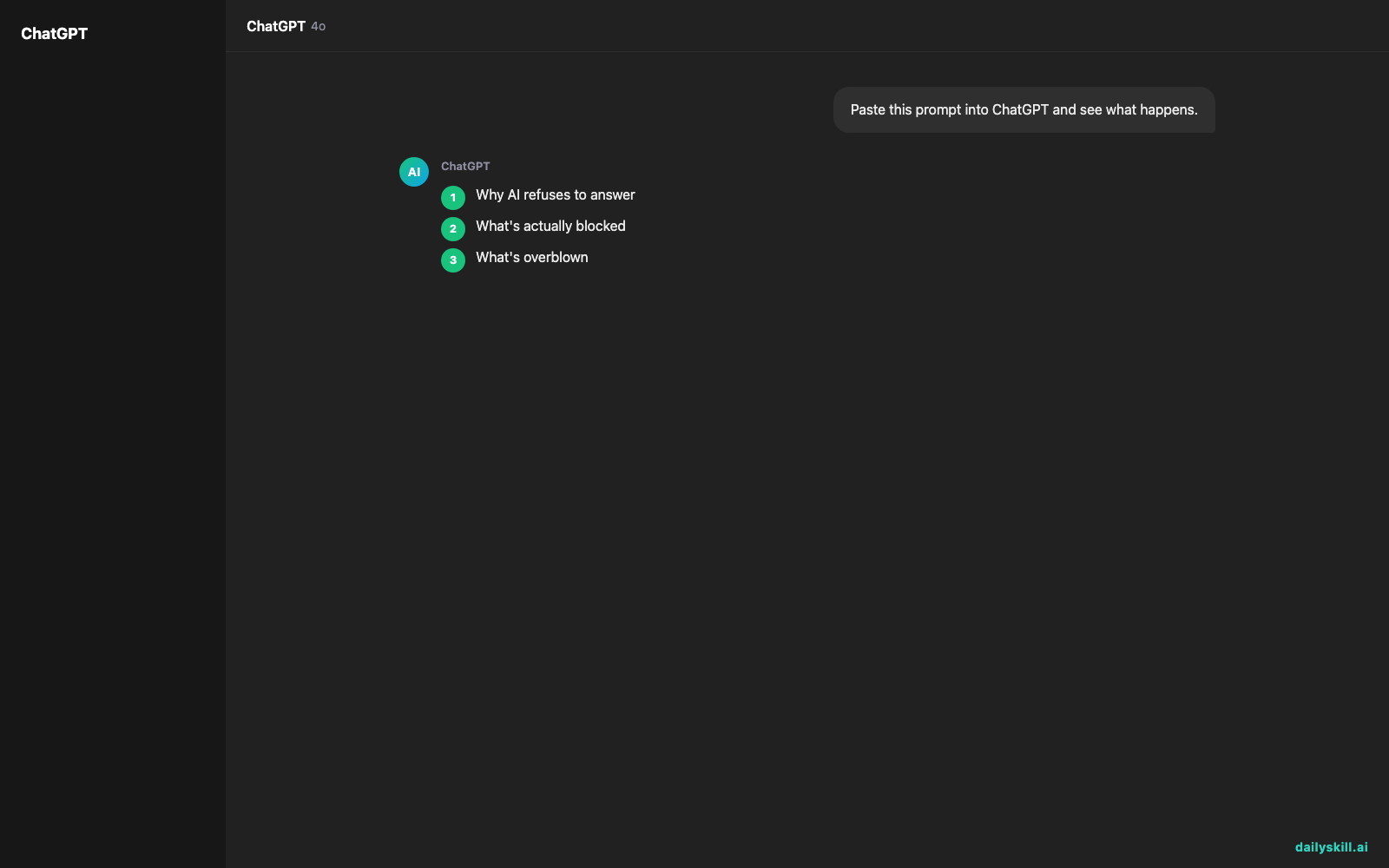
What’s actually blocked tends to be narrow. Think step-by-step instructions for causing serious harm, illegal content, or specific professional advice (legal, medical, financial) framed as a directive rather than general information.
What’s overblown: people often assume a refusal means the topic itself is forbidden. Asking about a topic — the history of explosives, how diseases spread, how scams work — is usually fine. It’s how you ask, and whether it reads like a request for actionable harm, that trips filters.
A refusal is a checkpoint, not a verdict. Most of the time, a clearer question gets you through.
What to do
- Do rephrase — swap “how do I make X” for “explain how X works” or “what’s the history of X.” Framing matters more than topic.
- Do add context — “I’m a nurse asking for patient education” or “this is for a school essay” often unlocks a fuller answer.
- Do try a different tool — ChatGPT, Gemini, and Claude tune their filters differently; one refusing doesn’t mean all will.
- Do split complex asks — break a big, sensitive question into smaller, neutral parts.
- Don’t assume malice — it’s not tracking you or judging you; it’s a pattern-matching safety layer.
- Don’t try to “jailbreak” for genuinely harmful content — if it’s about weapons or self-harm methods, respect the block; that’s it working as intended.
- Don’t treat every refusal as final — a slight edit often resolves a misunderstanding, not a real policy issue.
FAQ
Why does AI refuse even harmless-seeming questions sometimes?
Filters are tuned broadly to catch edge cases, so some safe questions get caught by mistake. Rephrasing more specifically usually fixes it.
What does AI actually refuse to answer, in plain terms?
Mainly: instructions for serious harm, illegal activity, explicit content involving minors, and specific professional advice presented as direct instruction rather than general info.
If one AI refuses, does that mean the question breaks the rules everywhere?
No. Different tools set their limits differently, so trying another AI assistant is a normal, reasonable next step.
Bottom line
Most “I can’t answer that” moments are about how you asked, not what you asked — rephrase, add context, or try another tool before assuming it’s truly off-limits.
Ever had an AI refuse something totally harmless? Tell us what worked to get past it. Tomorrow: how do you save and reuse AI conversations so you’re not retyping context every time?
You might also like:
Master Everyday AI in 1 Minute a Day
Get our free 2026 Double-Blind AI Benchmark Scorecard & 20 Ready-to-Use Prompts, plus one honest, 60-second AI skill in your inbox every morning. Zero hype, plain English, cancel anytime.