Using AI for work or school isn’t automatically cheating — but it can be, depending on how you use it and what the rules say. The honest answer lives in the gap between using AI as a thinking tool and using it to fake work that’s supposed to be yours.
Why this comes up
You’ve probably used an AI assistant to draft an email, polish a paragraph, or look something up — and then felt a small twinge of “wait, is this okay?” That feeling is worth paying attention to. The real worry isn’t the tool itself; it’s whether you’re misrepresenting your effort, your thinking, or your learning to someone who trusts you.
The honest answer
Where AI is clearly fine
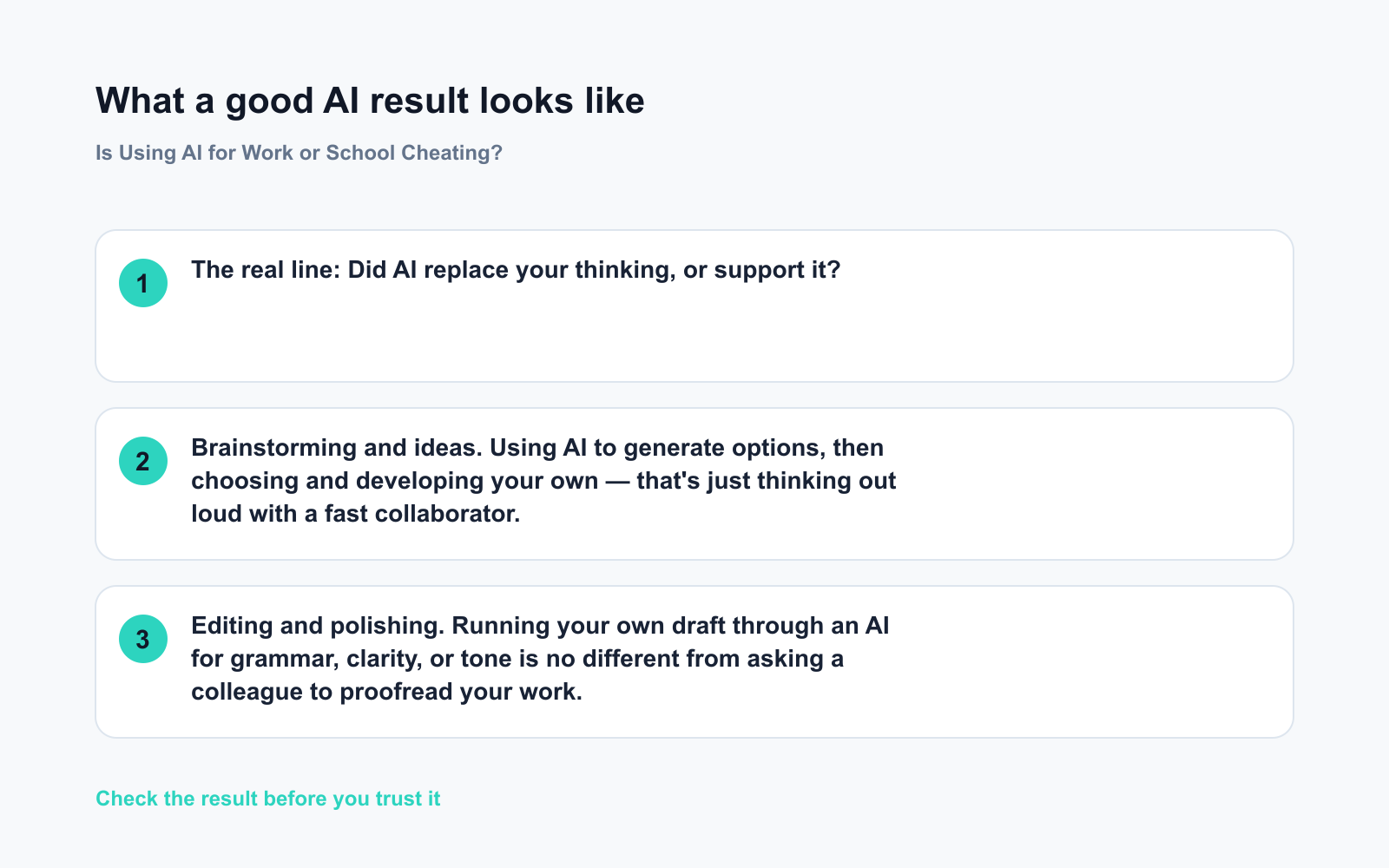
- Brainstorming and ideas. Using AI to generate options, then choosing and developing your own — that’s just thinking out loud with a fast collaborator.
- Editing and polishing. Running your own draft through an AI for grammar, clarity, or tone is no different from asking a colleague to proofread your work.
- Research starting points. Using AI to get oriented on a topic, then verifying and going deeper yourself, is smart workflow.
- Repetitive work tasks. Automating formatting, summarizing meeting notes, or drafting routine emails — most workplaces actively encourage this now.
Where it genuinely crosses a line
- Submitting AI output as your own assessed work when the assignment is meant to test your understanding. A teacher grading your essay is grading your thinking, not the AI’s.
- Hiding AI use when disclosure is required. Many schools and employers now have explicit policies. Ignoring them isn’t a gray area — it’s a policy violation.
- Using AI to skip skills you’re supposed to be building. If you’re in a coding bootcamp and AI writes every line, you don’t learn to code. You’re cheating yourself most of all.
- Passing off AI-generated work in high-stakes professional contexts — legal filings, medical advice, financial reports — where accuracy and personal accountability are non-negotiable.
The part that’s genuinely overblown
The idea that any AI use is dishonest is already outdated. Spell-check was once controversial. Search engines were once called “cheating.” AI assistants are now standard tools in most professional environments.
The ethical question isn’t “did you use AI?” — it’s “did you represent the work honestly and deliver what was actually expected of you?”
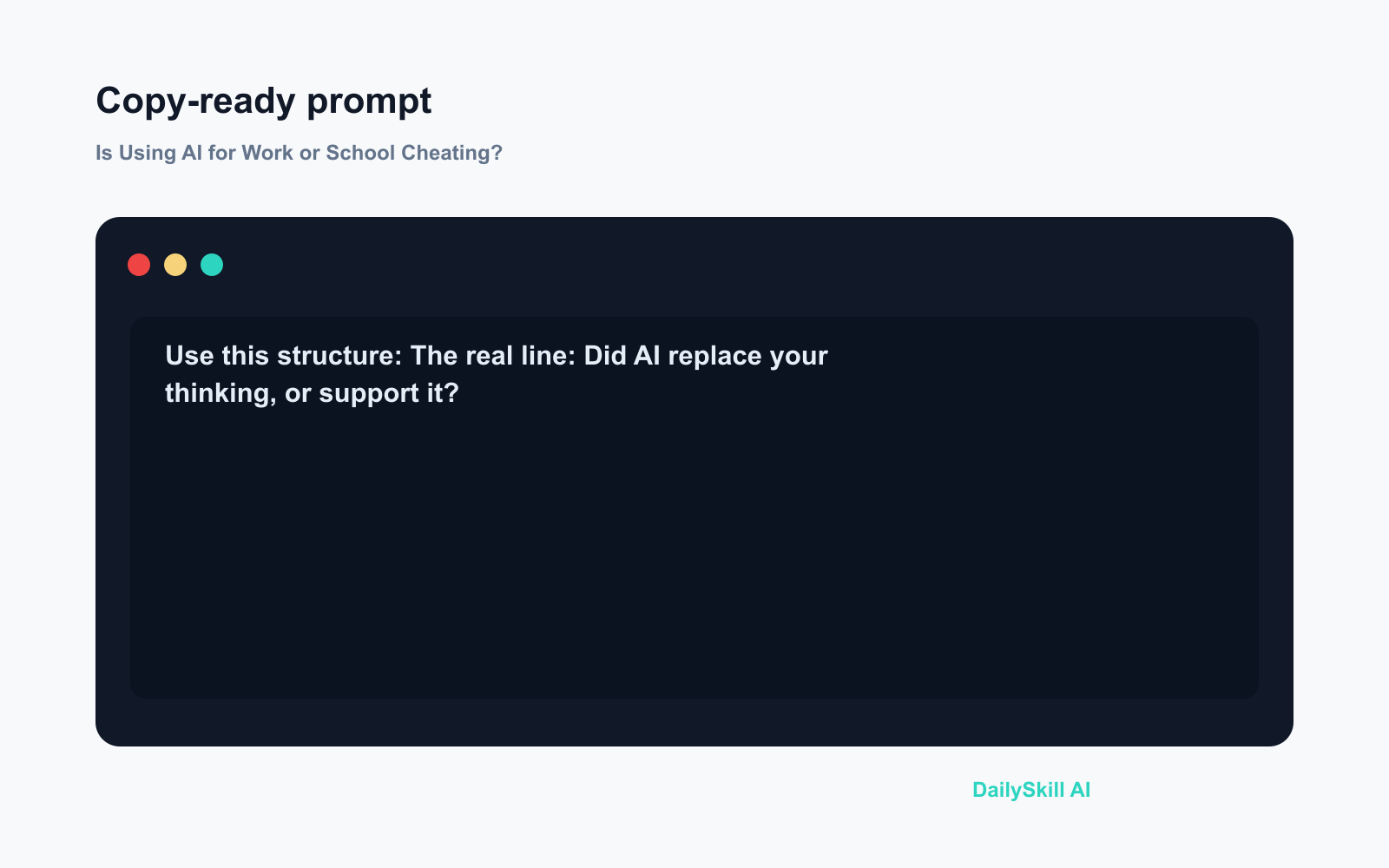
The real line: Did AI replace your thinking, or support it?
What to do
Do:
– ✅ Check your school’s or employer’s current AI policy before using it on formal work
– ✅ Disclose AI use when asked — or when in doubt; a brief note costs nothing
– ✅ Use AI to draft, then rewrite in your own words and verify every claim
– ✅ Treat AI output as a starting point, not a finished product you can hand in
Don’t:
– ❌ Submit unedited AI text for graded assignments meant to assess your own knowledge
– ❌ Assume silence in a policy means permission — ask if it’s unclear
– ❌ Use AI to skip learning something you’ll genuinely need to know later
– ❌ Paste AI answers into professional documents without reading and checking them yourself
FAQ
Does using AI for homework always count as plagiarism?
Not automatically. Plagiarism means passing off someone else’s work as yours. AI policy is a separate question, and schools treat it differently — some ban it for certain tasks, others require disclosure, others allow it freely as a tool. Check the specific rules for each class or assignment.
Do companies actually enforce AI ethics policies yet?
Yes, and increasingly so. Most large organizations have published formal AI use guidelines, and more are rolling them out. Using AI transparently and accurately is quickly becoming a baseline professional expectation, not an edge case.
What if I used AI and I’m not sure whether I should have?
Ask yourself: could you explain this work confidently without the AI? If yes, you probably used it responsibly. If the answer is “not really” — that’s your signal to revisit how you’re using it.
Bottom line
Responsible AI use means the work still represents you — your thinking, your judgment, your honesty about what help you got.
What’s your take — does your school or workplace have the AI rules right yet? Drop your experience in the comments. We read every one.
Tomorrow: Will AI take my job — and what should you actually do about it? The answer is more nuanced (and more actionable) than the headlines suggest.
You might also like:
- Day 6 — Summarize Any YouTube Video Into 3 Key Points (AI 1-Minute Challenge)
- Canva Magic Studio — Design Something Share-Worthy in 5 Minutes
⭐ Want every prompt in one place?
All 136 tested prompts from our daily skills are free on
GitHub — DailySkill Prompt Library.
Star it to get new prompts as we publish.
More on AI Safety, Privacy & Cost:
- Are Free AI Tools Good Enough, or Will I Eventually Have to Pay?
- Can AI Help Me Understand a Legal Document? (What’s Safe, What’s Not)
- Can AI Help With My Taxes or Finances? (What’s Safe and What Isn’t)
Master Everyday AI in 1 Minute a Day
Get our free 2026 Double-Blind AI Benchmark Scorecard & 20 Ready-to-Use Prompts, plus one honest, 60-second AI skill in your inbox every morning. Zero hype, plain English, cancel anytime.