Imagine walking into your interview and already having practiced the kind of questions that fit that job at that company. Here’s exactly how to do it tonight.
In about a minute, you’ll have 20 realistic practice questions built from your actual job posting, plus a simple way to start practicing them.
Sound familiar?
You got the interview. You’re excited. Then the nerves kick in.
You search “common interview questions” and get the same generic list everywhere. “Tell me about yourself.” “What’s your greatest weakness?” Useful, sure, but none of it feels like your interview.
So you lie awake guessing what this particular team cares about. Let’s fix that.
The 60-second fix
You don’t need a special app. Any AI assistant (ChatGPT, Gemini, or Claude) can do this if you give it the right details. The more specific you are, the more tailored your questions will be.
Step 1: Grab three details from the job posting
- The job title (for example, “Customer Success Manager”)
- The company name and what it does, in one line
- 2-3 key duties or requirements from the posting
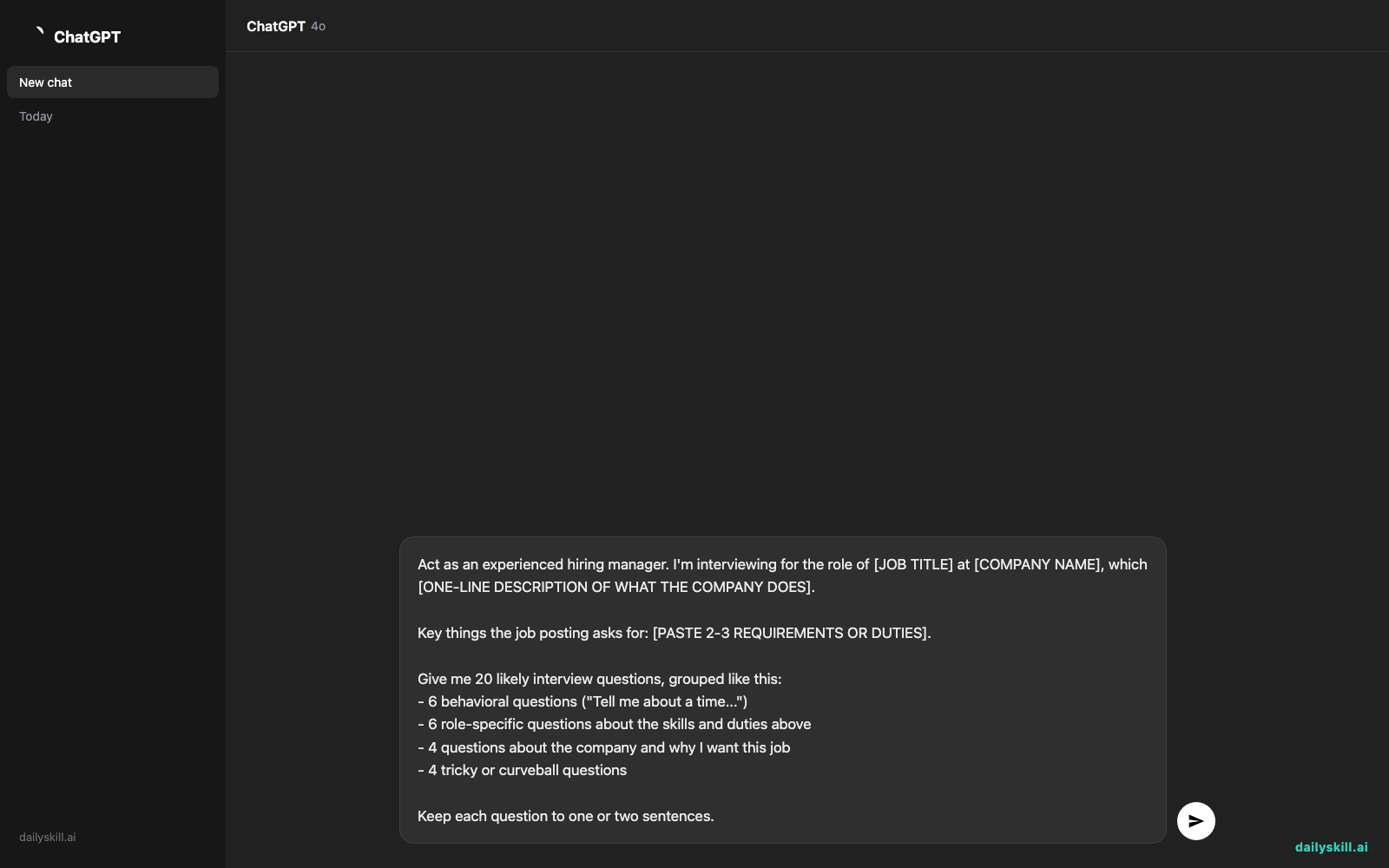
Step 2: Paste this prompt into your AI assistant
Replace the brackets with your details:
Act as an experienced hiring manager. I'm interviewing for the role of [JOB TITLE] at [COMPANY NAME], which [ONE-LINE DESCRIPTION OF WHAT THE COMPANY DOES].

Key things the job posting asks for: [PASTE 2-3 REQUIREMENTS OR DUTIES].

Give me 20 likely interview questions, grouped like this:
- 6 behavioral questions ("Tell me about a time...")
- 6 role-specific questions about the skills and duties above
- 4 questions about the company and why I want this job
- 4 tricky or curveball questions

Keep each question to one or two sentences.
Step 3: Star the scary ones and save the list
Read through all 20. Star the 5 that make your stomach drop. Those are where your practice time goes first.
Then copy the list into your notes app so you can come back to it before the big day.
Real example
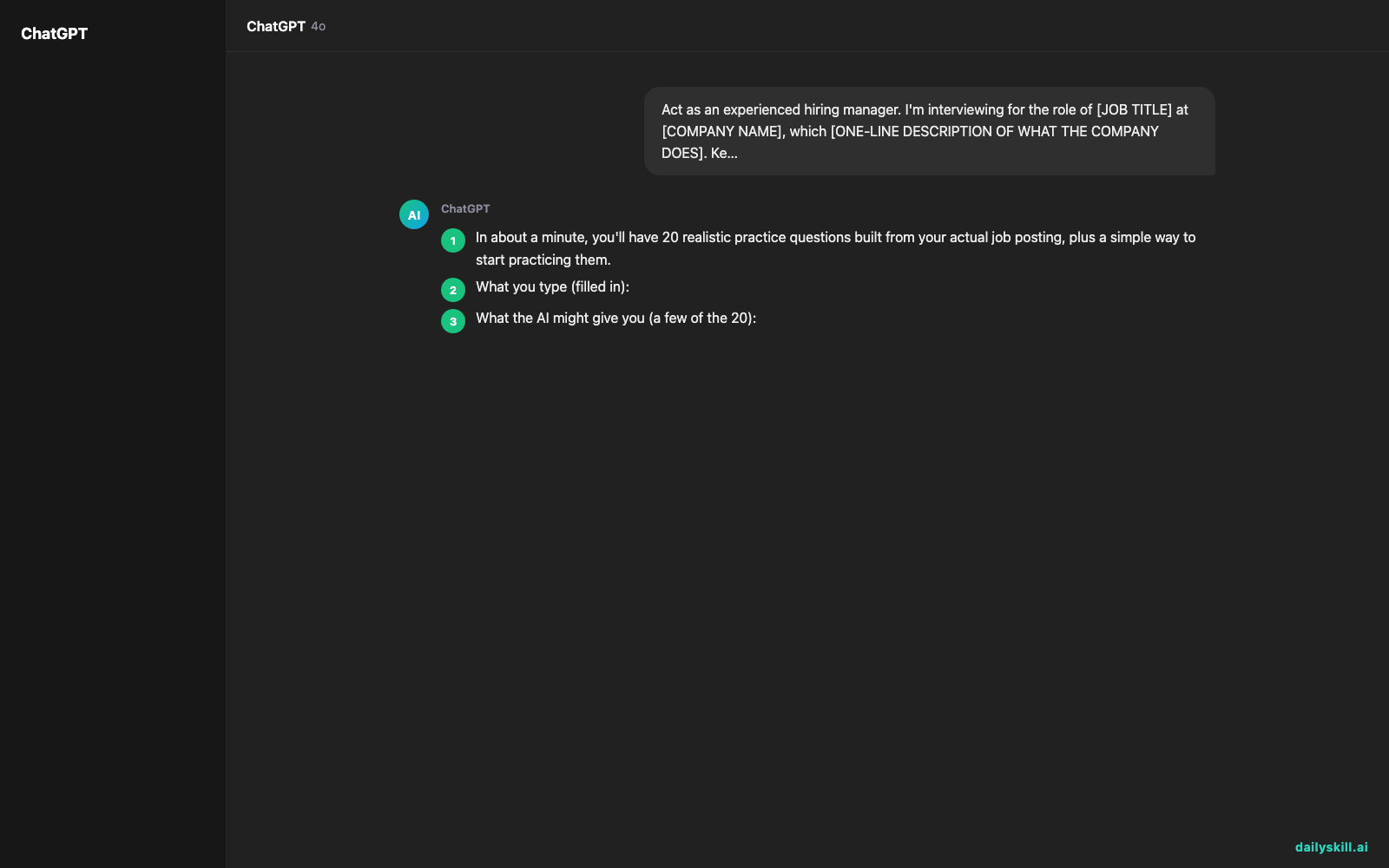
What you type (filled in):
Act as an experienced hiring manager. I'm interviewing for the role of Customer Success Manager at BrightLoop, which makes scheduling software for dental clinics.

Key things the job posting asks for: handling upset customers, onboarding new clinics, and working with the product team on customer feedback.

Give me 20 likely interview questions, grouped like this:
- 6 behavioral questions ("Tell me about a time...")
- 6 role-specific questions about the skills and duties above
- 4 questions about the company and why I want this job
- 4 tricky or curveball questions

Keep each question to one or two sentences.
What the AI might give you (a few of the 20):
Behavioral: Tell me about a time a customer was very unhappy with you or your team. What did you do, and how did it end?
Behavioral: Describe a time you passed customer feedback to another team. Did anything change because of it?
Role-specific: A new dental office has never used scheduling software. How would you guide them through their first week?
Role-specific: How do you decide which customer complaints to escalate to the product team?
Company: Why do you want to work with healthcare clinics specifically?
Curveball: A customer demands a feature we don’t have and won’t build. How do you respond?
Notice how specific that is. A generic list would never mention dental offices or first-week onboarding. Now you can practice answers that actually fit the job.
Level up
- Practice out loud. Follow up with: “Ask me these questions one at a time. After each answer I type, give me feedback and a stronger version.”
- Use the STAR method. Ask: “Help me turn my story about [situation] into a clear answer: Situation, Task, Action, Result.”
- Prep your own questions. Ask: “Give me 5 smart questions I can ask the interviewer about this role.”
FAQ
How do I prepare for a job interview with AI?
Give the AI your job title, the company, and a few details from the posting. Ask for likely questions, then practice answering them out loud. You can also ask it to play the interviewer and give you feedback after each answer.
Will the AI know exactly what I’ll be asked?
No. It can’t read the interviewer’s mind. But it can spot the themes a role like yours usually brings up, which gives you a strong head start. Treat it as practice, not a prediction.
How should I practice the questions once I have them?
Say your top 5 hardest answers out loud, not just in your head. Use real stories from your own work. Don’t memorize word for word. Aim to sound natural.
Today’s check-in
Run the prompt for a real job you want (or one you’re just curious about). Then tell us in the comments: which question made you think, “Oh no, I’d struggle with that one”?
Spotting your weak spot early is a win. 🎉
Tomorrow (Day 134): We’ll use AI to pull the key insights out of a podcast episode, so you get the good parts without listening to the whole thing.
Master Everyday AI in 1 Minute a Day
Get our free 2026 Double-Blind AI Benchmark Scorecard & 20 Ready-to-Use Prompts, plus one honest, 60-second AI skill in your inbox every morning. Zero hype, plain English, cancel anytime.