
You’ve said “off” about 400 times, and your dog still launches at every guest who walks in. Sound about right?
Here’s the fix: tell an AI assistant like ChatGPT about your pet, and it writes a dog training plan you can follow in 10 minutes a day. You get one small goal per day, exact steps, and what to do when things go wrong. The same trick works for cats, rabbits, and other pets.
Sound familiar?
You search “how to stop my dog from jumping” and get ten articles that all disagree. One says ignore it. One says use treats. One says buy a gadget.
Or you start training with great energy, forget what you did yesterday, and by Friday the whole thing has quietly fizzled out.
The problem isn’t your pet. Pet behavior training works best as a plan: small steps, in order, repeated daily. Most advice online is just a pile of tips, not a plan.
The 60-second fix
Step 1: Gather 5 quick details
Before you type anything, think about:
- Your pet: type, breed (or best guess), age
- The target behavior: one specific thing you want to teach or fix
- What you’ve tried: even if it didn’t work
- Your time: how many minutes a day you realistically have
- Their favorite treat: this becomes the reward in the plan
The more specific you are, the better the plan. “Be good” is vague. “Stop pulling on the leash” is perfect.
Step 2: Copy and paste this prompt
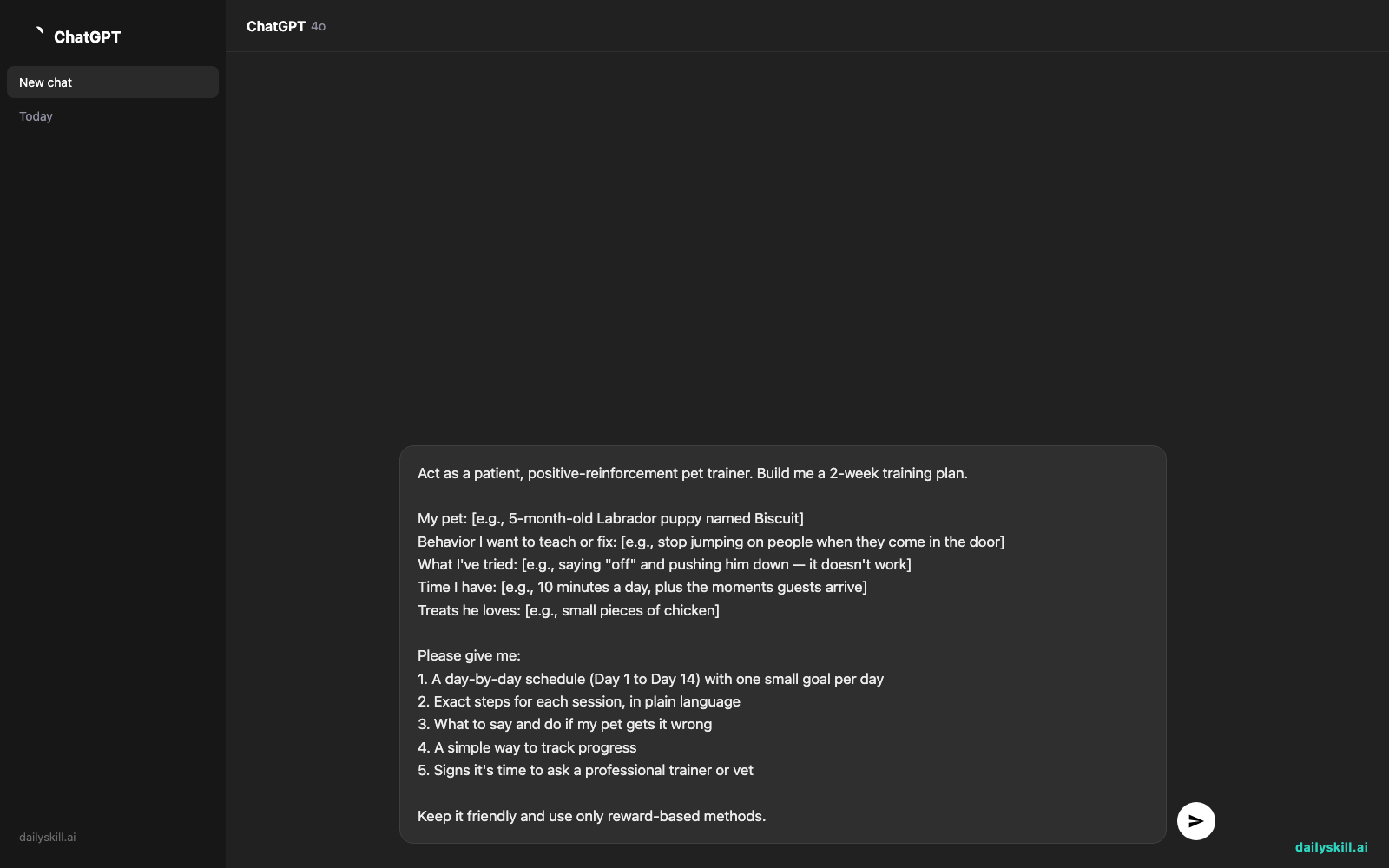
Open ChatGPT (or your favorite AI assistant), paste this in, and swap the brackets for your details:
Act as a patient, positive-reinforcement pet trainer. Build me a 2-week training plan.

My pet: [e.g., 5-month-old Labrador puppy named Biscuit]
Behavior I want to teach or fix: [e.g., stop jumping on people when they come in the door]
What I've tried: [e.g., saying "off" and pushing him down — it doesn't work]
Time I have: [e.g., 10 minutes a day, plus the moments guests arrive]
Treats he loves: [e.g., small pieces of chicken]

Please give me:
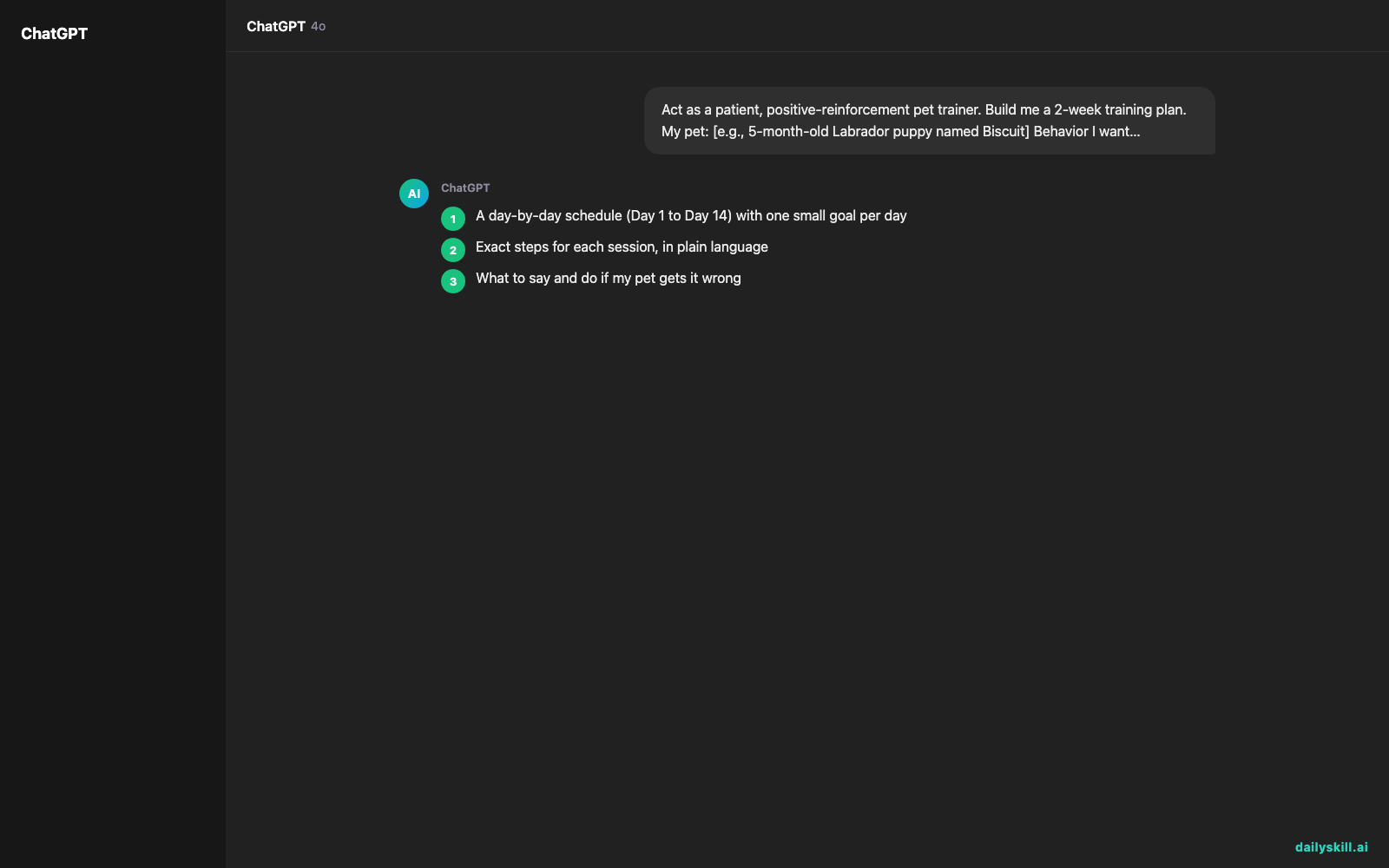
1. A day-by-day schedule (Day 1 to Day 14) with one small goal per day
2. Exact steps for each session, in plain language
3. What to say and do if my pet gets it wrong
4. A simple way to track progress
5. Signs it's time to ask a professional trainer or vet

Keep it friendly and use only reward-based methods.
Step 3: Ask one follow-up to make it yours
Read the plan, then reply with something like:
“Turn Week 1 into a printable checklist, and make the sessions shorter. Biscuit loses focus after about 5 minutes.”
That’s it. You now have a plan built around your pet and your schedule.
Real example
What you typed:
My pet: 5-month-old Labrador puppy named Biscuit. Behavior: stop jumping on people at the door. Tried: saying “off” and pushing him down. Time: 10 minutes a day. Treats: small pieces of chicken.
What the AI gave back (shortened):
Why it’s happening: Biscuit jumps because it gets him attention, even when that attention is you pushing him away. We’ll teach him that four paws on the floor is what earns the reward.
Days 1-3: Build the “sit” habit
Hold a chicken piece at his nose, lift it slowly over his head, and say “sit” the moment his bottom touches the floor. Reward right away. Do 5 short rounds, twice a day.Days 4-6: Add the doorway
Practice “sit” near the front door with no guests. Reward calm behavior. Say “good!” the instant he sits.Days 7-10: Add a helper
Ask a family member to walk in. If Biscuit jumps, they calmly turn away. When all four paws are down, they turn back and he gets a treat.Days 11-14: Try a real visitor
Ask a friend to ring the bell. Have Biscuit sit before the door opens. Reward him with the guest standing there, then let them say hello.If he gets it wrong: Don’t scold. Just reset and make the step easier.
Progress tracker: Mark each day: Success / Close / Tough day.
Notice how it explains the why first, then breaks the goal into tiny steps. That’s what turns “I should train my dog” into something you actually do.
Level up
- Build a puppy training schedule. Ask: “Make me a daily routine for an 8-week-old puppy covering feeding, potty breaks, naps, play, and 3 short training sessions.”
- Create a pet obedience guide. Ask: “Rank the 5 most useful basic commands for a new dog owner, and give me the order to teach them.”
- Troubleshoot a stuck plan. Tell the AI: “Day 5 isn’t working, and here’s what happened.” Ask it to adjust the plan.
- Get the whole family on the same page. Ask for a simple script so everyone uses the same cue words.
FAQ
Can ChatGPT really make a good dog training plan?
It’s a very good starting point. It can organize steps, explain the reasoning, and adapt to your schedule. Think of it as a helpful coach’s outline. For serious issues like aggression or severe anxiety, work with a qualified trainer or your vet.
How long should each training session be?
Short is better, especially for puppies. Many trainers suggest a few minutes at a time, a couple of times a day. You can ask the AI to match the plan to your pet’s age and attention span.
Does this work for cats and other pets?
Yes. Swap in your pet’s details, like “3-year-old indoor cat” and “stop scratching the sofa.” Ask for reward-based methods and the plan will fit that animal.
Today’s check-in
Pick one behavior you’d like to improve, run the prompt, and share it with us. Tell us your pet’s name and the behavior you chose. Even a one-line “Biscuit, door jumping!” counts. We’d love to cheer you both on.
Tomorrow (Day 139): Do you keep writing the same kind of email over and over? We’ll use AI to create reusable email templates for work, so you write them once and use them all week.
You might also like:
- How do I get AI to format messy data into clean tables or CSVs?
- Magic Eraser (Google Photos) — Erase Unwanted Objects From Any Photo in One Tap
Master Everyday AI in 1 Minute a Day
Get our free 2026 Double-Blind AI Benchmark Scorecard & 20 Ready-to-Use Prompts, plus one honest, 60-second AI skill in your inbox every morning. Zero hype, plain English, cancel anytime.