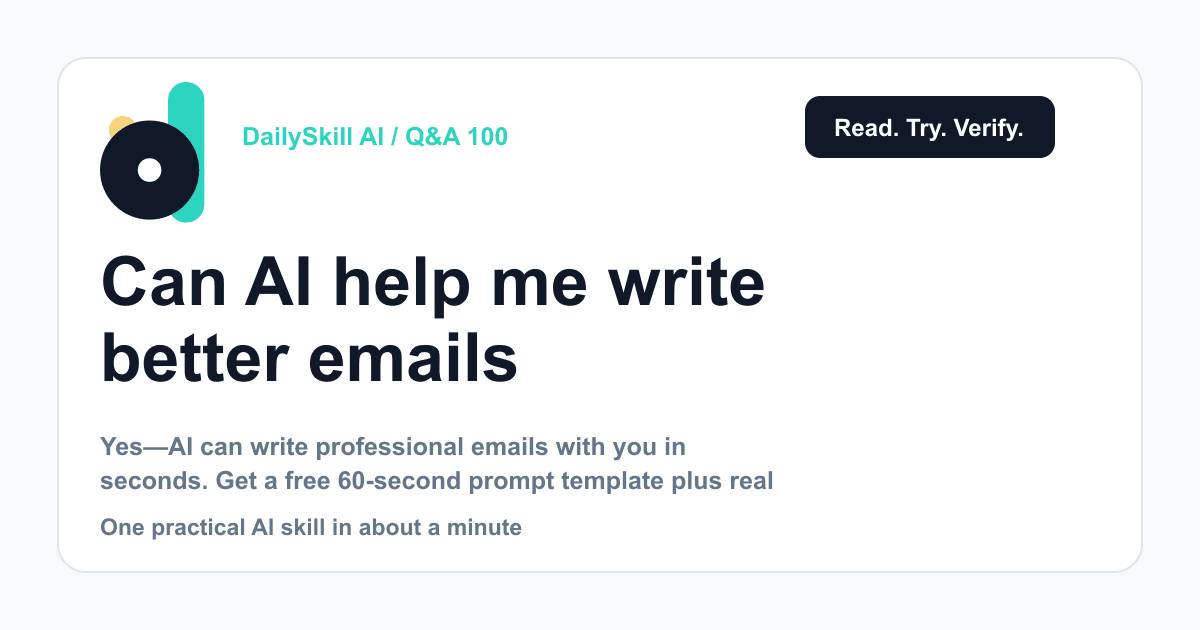
Yes. AI is genuinely good at writing professional emails — it’s one of the easiest, lowest-risk ways to use AI for work. Give it the situation, the key points, and the tone you want, and it’ll draft something clear in seconds. You still read it, fix any details, and hit send. The blank-page problem is gone.
Why this comes up
Most people don’t struggle with typing. They struggle with staring at a blank email, deciding how to say something awkward, formal, or urgent. AI takes that first-draft pressure off.
The worry underneath: “will it sound fake, or will my boss/client know I used AI?” Short answer: not if you edit it.
The honest answer
What AI is genuinely good at:
– Turning messy thoughts into a clear, organized email
– Matching a tone (friendly, formal, firm, apologetic)
– Shortening a rambling draft into something scannable
– Handling awkward messages: declining a meeting, chasing a late payment, saying no nicely
What’s overblown:
– It won’t magically know your company’s politics or history with a client — you have to tell it
– It can sound generic if you don’t give it specifics (names, numbers, context)
– It’s not going to replace judgment — you still decide what to say and whether to send it
The AI drafts. You decide. That’s the whole relationship.
Free tools that work fine for this: ChatGPT, Gemini, and Claude all handle email drafting well for free, and Gmail/Outlook have built-in AI drafting too. You don’t need a paid plan to start.
What to do — a 60-second email prompt template
Copy this, fill in the brackets, paste into any AI chat:
Write a [tone: friendly/formal/firm] email to [who: my manager/a client/a coworker]
about [topic]. Key points to include: [point 1, point 2, point 3].
Keep it under [X] sentences. Sign off as [your name].

Example filled in:
“Write a friendly but firm email to a client about a delayed invoice. Key points: the invoice was due 10 days ago, I need payment by Friday, I’m happy to discuss if there’s an issue. Keep it under 5 sentences. Sign off as Priya.”
Do:
– Give real details (names, dates, numbers) — vague input makes vague emails
– Ask for 2-3 versions if the first one feels off (“make it warmer” or “make it shorter”)
– Read it out loud before sending — does it sound like you?
Don’t:
– Paste in confidential info (salary details, client data) unless you trust the tool’s privacy setup
– Send it word-for-word without checking names, dates, and facts
– Use it for anything that needs real empathy without adding your own personal touch first
FAQ
Will people know I used AI to write my email?
Not if you edit it. Add a personal detail, tweak the phrasing, cut anything that sounds stiff. That’s usually enough.
Is there a free email writing assistant I can just use, no setup?
Yes — ChatGPT, Gemini, and Claude are all free to use in a browser or app. Gmail and Outlook also have AI drafting built in.
Can AI help with tricky emails, like giving bad news?
Yes, this is where it shines. Give it the facts and ask for a “kind but clear” tone. It’s often better at softening bad news than a rushed first draft you’d write yourself.
Bottom line
AI won’t write your emails for you — it’ll write them with you, faster. Try the template above on your next tricky email and see how much time it saves.
What’s the most awkward email AI has helped you write? Tell us — we read every reply.
Tomorrow: How do you use AI to quickly summarize a long document or article? See you then.

You might also like:
- Turn a Product Complaint Into a Word-for-Word Refund Script
- Perplexity AI — Get Answers With Sources, Not a Pile of Links
Master Everyday AI in 1 Minute a Day
Get our free 2026 Double-Blind AI Benchmark Scorecard & 20 Ready-to-Use Prompts, plus one honest, 60-second AI skill in your inbox every morning. Zero hype, plain English, cancel anytime.