Your family is split on getting a dog, and everyone has an opinion but nobody has a reason. Here’s exactly how to fix that in about a minute.
You’ll get one copy-paste prompt that turns Claude into your personal debate coach. You type the topic. You get the four strongest arguments for each side, the best comeback each side would use, and a question to help you decide.
Sound familiar?
Your team is debating a four-day work week. Your book club picked a topic that gets everyone fired up. Or you have to argue a side in class, and you don’t even agree with it.
You want to understand both sides, not just the one you already believe. But staring at a blank page, you can only think of two or three points. And your brain keeps circling back to your own opinion.
That’s where AI helps. It can lay out a whole argument map in seconds, so you can think, decide, and speak with confidence.
The 60-second fix
Step 1: Open Claude and name your topic
Pick a clear, specific question. “Should our town ban cars downtown?” works much better than just “cars.”
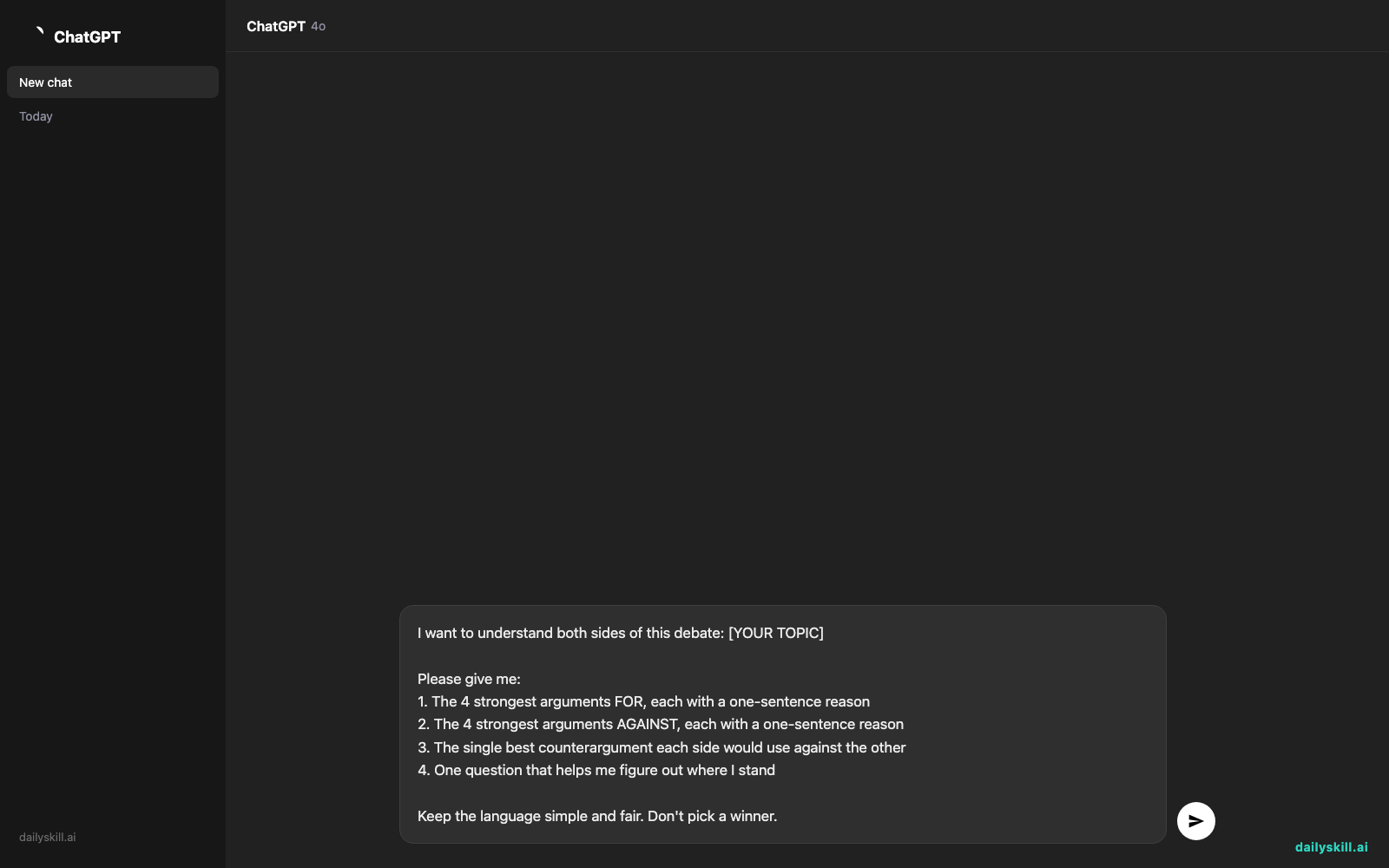
Step 2: Paste this prompt
Swap the bracketed part for your topic.
I want to understand both sides of this debate: [YOUR TOPIC]

Please give me:
1. The 4 strongest arguments FOR, each with a one-sentence reason
2. The 4 strongest arguments AGAINST, each with a one-sentence reason
3. The single best counterargument each side would use against the other
4. One question that helps me figure out where I stand

Keep the language simple and fair. Don't pick a winner.
Step 3: Ask for a follow-up
Once you have the list, push it further. Try one of these:
- “Make the ‘against’ side even stronger.”
- “Turn the top 3 points on each side into persuasive talking points I can say out loud.”
- “Which of these arguments depend on facts I should double-check?”
That last one is a smart habit. AI gives you a great starting point, but if you plan to quote a fact or number in a real debate, verify it first.
Real example
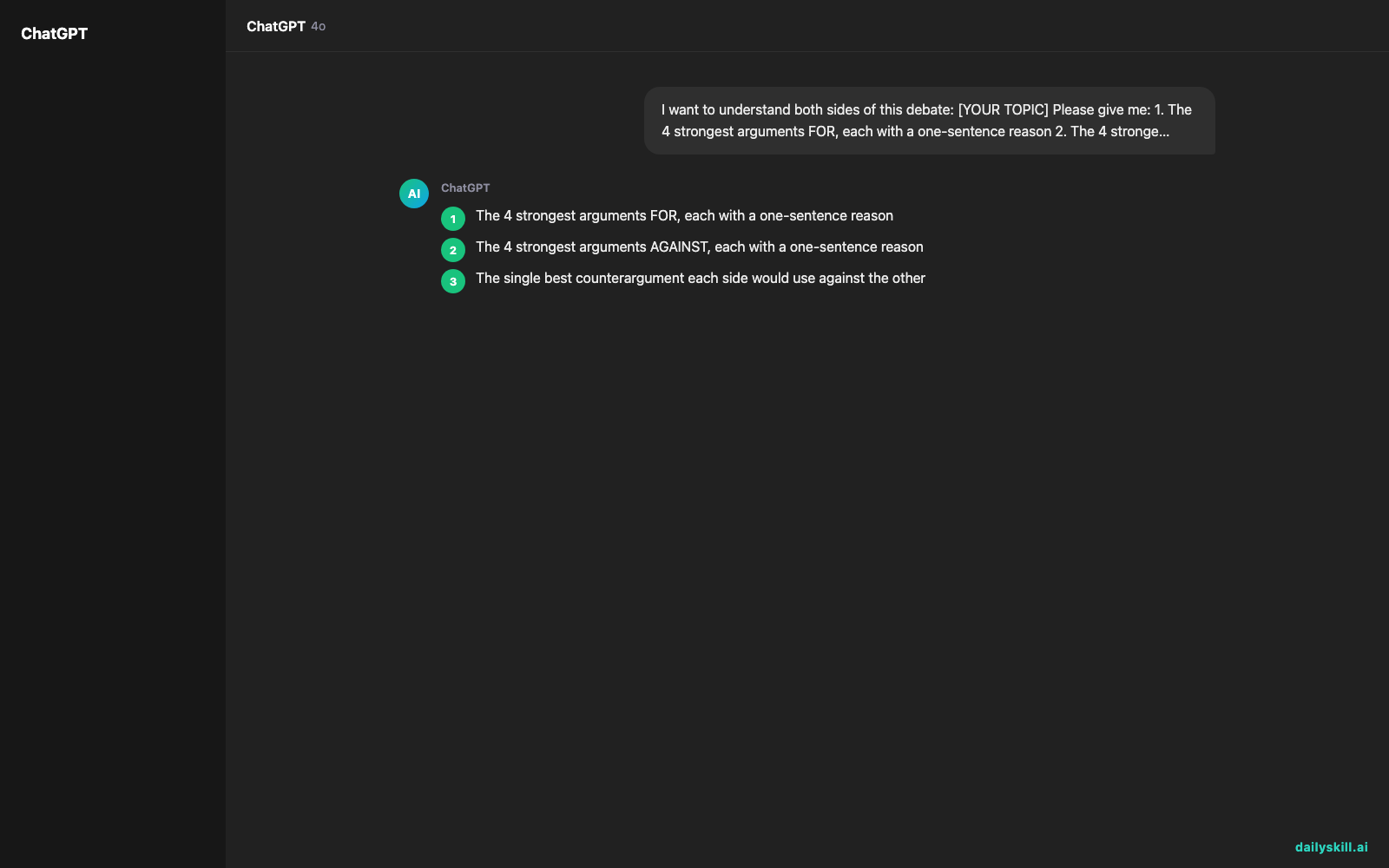
What you typed:
I want to understand both sides of this debate: Should kids under 14 have smartphones?
What Claude gave back (shortened):
For:
– Safety: Parents can reach their child and check their location anytime.
– Learning: Phones open the door to educational apps and homework help.
– Social connection: Many friendships and weekend plans now happen through group chats.
– Digital skills: Starting early, with guidance, builds healthy habits before the stakes get higher.Against:
– Distraction: Phones can pull attention away from homework, sleep, and playing outside.
– Online risks: A 12-year-old may not be ready to handle strangers or harmful content.
– Social pressure: Social media can make comparison and bullying worse.
– Alternatives exist: A basic phone with calls and texts covers safety without the extras.Best counterargument from each side:
– For → Against: “Rules and parental controls can reduce the risks.”
– Against → For: “Safety needs can be met without a full smartphone.”Question for you: Which matters more to your family right now: staying constantly connected, or protecting focus and sleep?
Notice what just happened. You went from “I don’t know” to a clear map of the whole conversation, plus one question that points you toward your own answer.
Level up
- Pick a setting. Add “I’m preparing for a school debate” or “I’m presenting this in a team meeting” so the tone fits your audience.
- Practice live. Say “Argue the ‘against’ side and I’ll respond. Push back on my points.” Now you have a sparring partner.
- Make a cheat sheet. Ask: “Turn this into a one-page pro and con list I can print.”
FAQ
Can AI really give fair arguments for both sides?
Usually, yes, especially when you ask it directly to stay balanced and not pick a winner. Still, read the results with a critical eye. If one side feels weaker, tell Claude, “Make this side stronger.”
How do I use this for persuasive talking points?
After you get the list, ask: “Turn the strongest three arguments for my side into short persuasive talking points.” Then ask for the best counterarguments, so you’re ready for pushback.
Should I trust every fact it gives me?
Treat the arguments as a strong starting framework, not final proof. If you plan to quote a statistic or a claim, check it against a reliable source first.
Today’s check-in
Pick one topic you’ve wondered about this week and run the prompt. Then tell us: which topic did you try, and did the “against” side surprise you?
Tomorrow, Day 138: we’ll build a structured training plan for your pet with AI. Your dog (or cat!) is about to get a schedule.
Master Everyday AI in 1 Minute a Day
Get our free 2026 Double-Blind AI Benchmark Scorecard & 20 Ready-to-Use Prompts, plus one honest, 60-second AI skill in your inbox every morning. Zero hype, plain English, cancel anytime.