Yes, and it’s one of the better everyday uses for it. Give an AI assistant your typical monthly spending by category. It can run the math across several cards, subtract annual fees, and show which one earns the most real value. It won’t replace the card’s official terms, so treat its answer as a well-organized first draft and confirm the details before you apply.
Why this comes up
Credit card offers are confusing on purpose. One card says “5x points,” another says “2% back,” and a third has a $95 annual fee and a big sign-up bonus.
You want the best rewards card for your spending without losing a weekend to spreadsheets. You also worry the AI might get a number wrong and cost you money. That’s a fair worry, and it’s easy to manage.
The honest answer
AI is good at the tedious part: the arithmetic and the side-by-side comparison. It’s weaker where details change: current rates, bonus offers, and fine print.
What AI does well
– Turns your spending into a yearly rewards estimate for each card.
– Subtracts annual fees so you see net value, not just headline rates.
– Explains points vs cash back in plain language, and shows when each wins.
– Spots trade-offs, like a no-fee card that beats a fee card at your spending level.
What to double-check
– Current terms. Rewards rates, caps, and bonuses change often. Many assistants can look things up live, but always confirm on the card issuer’s own page.
– Point values. Points are worth only what you can redeem them for. A “1.5 cents per point” estimate assumes you use travel portals or transfer partners. If you’ll take statement credits, the value may be lower.
– Category rules. Cards define “dining,” “groceries,” and “gas” differently. Warehouse clubs and some superstores often don’t count.
– Your own numbers. The result is only as good as what you type in.
What’s overblown
The fear that AI will “secretly steer you” to a bad card is mostly a non-issue when you ask it to show its math. You can read every step and check it yourself.
The real risk is simpler: a stale number or a skipped fee. Both are easy to catch if you look.
The AI does the math. You verify the terms and make the call.
What to do
Do
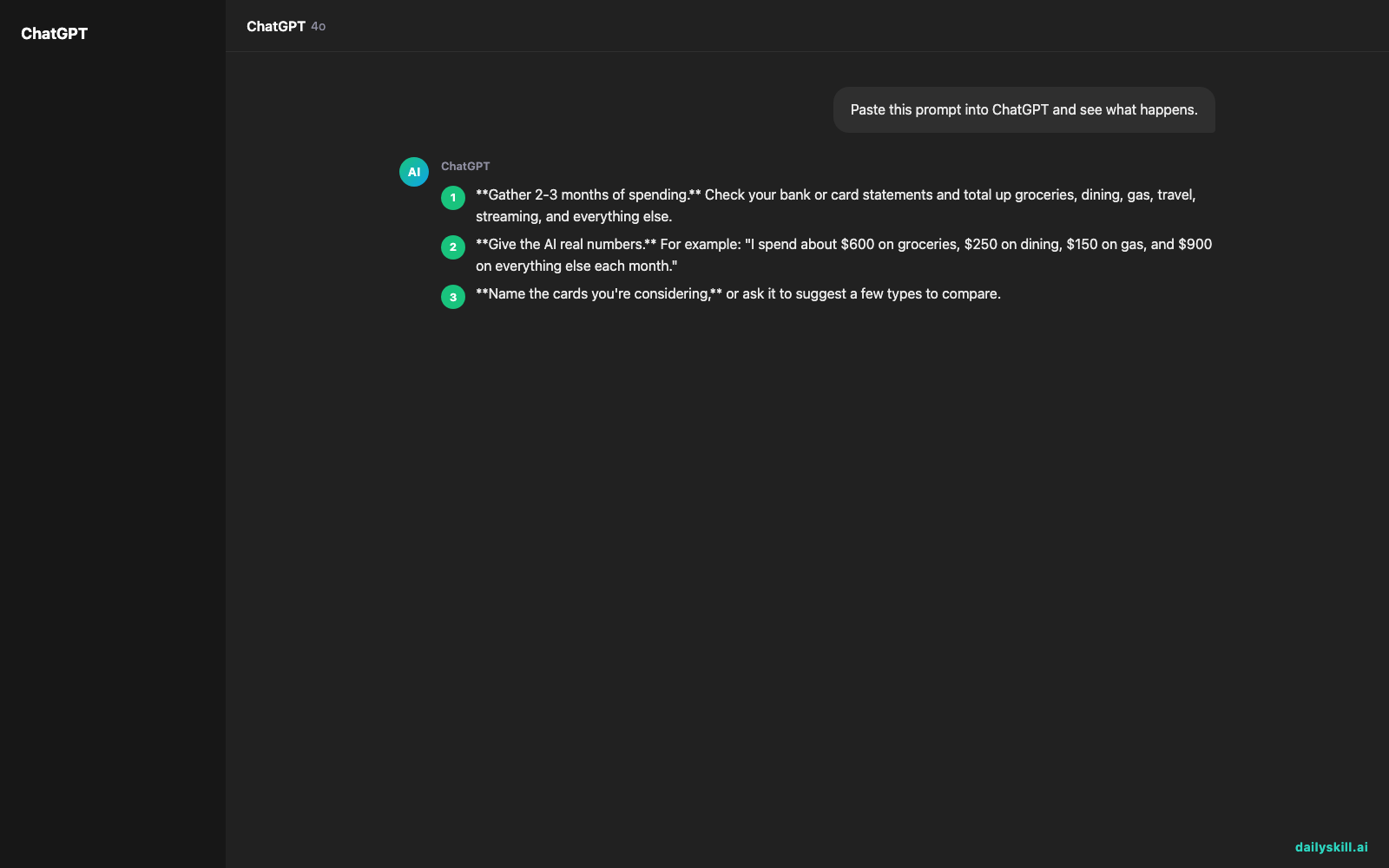
1. Gather 2-3 months of spending. Check your bank or card statements and total up groceries, dining, gas, travel, streaming, and everything else.
2. Give the AI real numbers. For example: “I spend about $600 on groceries, $250 on dining, $150 on gas, and $900 on everything else each month.”
3. Name the cards you’re considering, or ask it to suggest a few types to compare.
4. Ask for a net-value table. Try: “Compare these cards by yearly rewards minus the annual fee. Show your math.”
5. Compare points vs cash back. Ask: “How much would I earn if I redeem points for cash only, and how much if I use travel?”
6. Ask for the fine print. Request caps, rotating categories, minimum spend for bonuses, and foreign transaction fees.
7. Verify on the issuer’s site before you apply.
Don’t
– Don’t paste your card numbers, Social Security number, account logins, or full statements. Category totals are enough.
– Don’t chase a sign-up bonus that makes you spend more than you normally would.
– Don’t pick a card with a fee unless the table shows it clearly beats a no-fee option.
– Don’t carry a balance to earn rewards. Interest usually costs more than the rewards pay.
A starter prompt you can copy
“Here is my monthly spending by category: [list]. Compare [Card A], [Card B], and [Card C] for yearly rewards, subtract annual fees, and show the math. Then compare points vs cash back if I’d rather keep it simple. Flag anything I should verify.”
FAQ
Will AI know the newest card offers?
Many assistants can search the web, so often yes. Still, bonuses and rates change quickly. Ask for sources, then check the issuer’s page.
Is it safe to share my spending with an AI?
Share category totals, not identifying details. Check the privacy settings of the tool you use, and skip anything you wouldn’t want stored.
Does it matter if I have only one card?
Not at all. Ask AI whether your current card is still the best fit, or whether its annual fee is worth it for what you spend.
Bottom line
AI can quickly show which card earns you the most after fees, but the final check on terms is yours.
What’s your take? Have you used AI to compare cards, and did the numbers hold up? Share your experience with the community below.
Tomorrow’s question: How do I get AI to give me constructive feedback on my presentation slides? We’ll cover how to ask for honest, useful critique instead of empty praise.

You might also like:
- Turn a 20-Minute YouTube Video into 5 Lines You Can Actually Use
- Perplexity Pages — Turn Research Into a Shareable Article
Master Everyday AI in 1 Minute a Day
Get our free 2026 Double-Blind AI Benchmark Scorecard & 20 Ready-to-Use Prompts, plus one honest, 60-second AI skill in your inbox every morning. Zero hype, plain English, cancel anytime.