
Someone asks, “So, what do you do?” and two minutes later you’re still explaining. Then you trail off with “…it’s hard to explain.”
Here’s exactly how to fix it. In about a minute, you’ll turn a messy brain-dump into a clean 30-second elevator pitch with Claude. It has three parts: the problem, your solution, and the payoff.
Sound familiar?
You know your work inside and out. But when you try to explain it, you start with the background. Then you add three side details and lose the thread.
That’s not a you problem. When you know something well, everything feels important. A good pitch needs someone else to do the cutting, and AI is very good at that.
The 60-second fix
You don’t need to write anything neat. Messy is actually better.
Step 1: Dump your details
Open Claude. Type out how you’d explain your job or project to a friend.
Typos, half-sentences, and tangents are all fine. Two or three minutes of rambling gives it plenty to work with.
Step 2: Paste this prompt above your dump
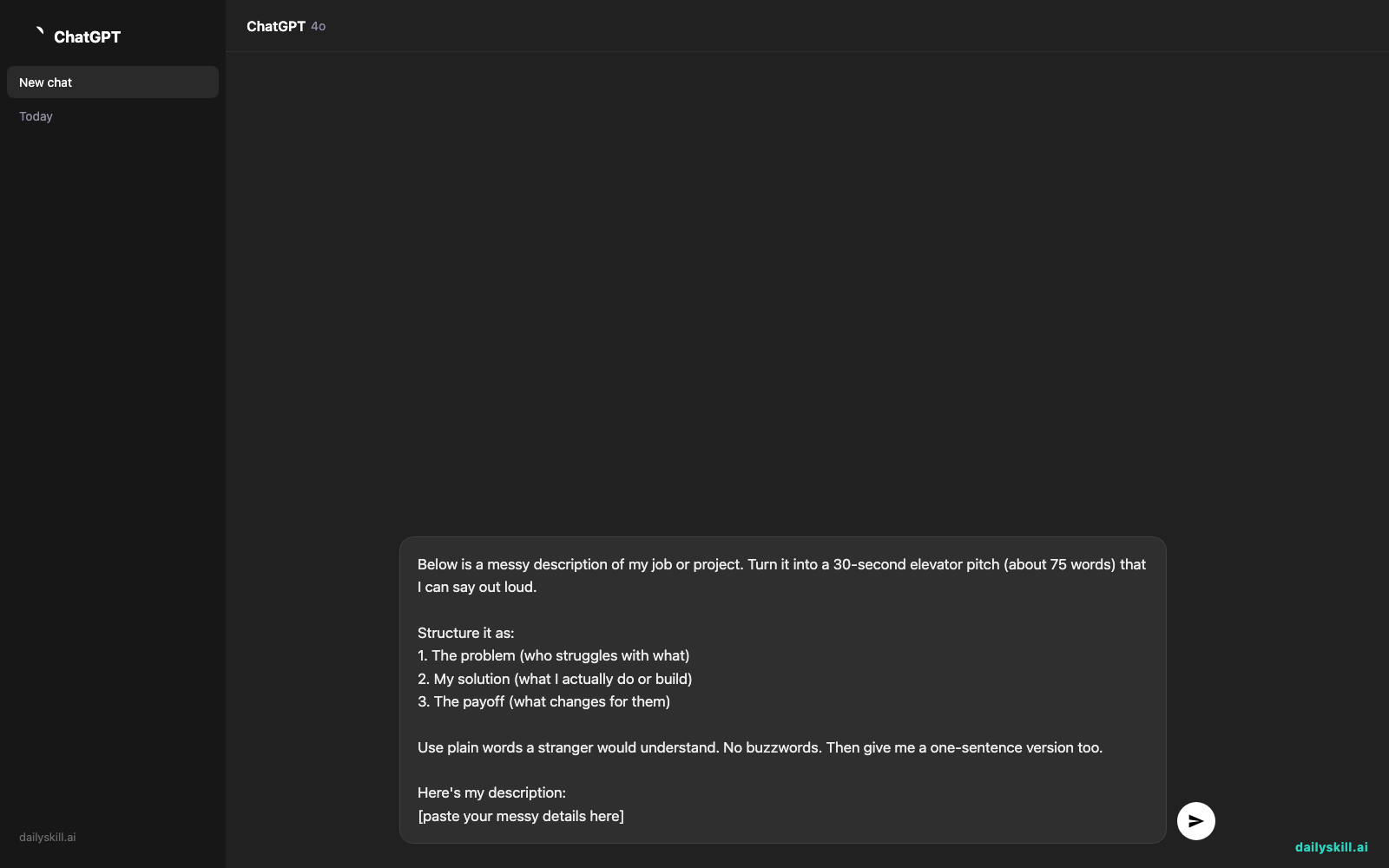
Below is a messy description of my job or project. Turn it into a 30-second elevator pitch (about 75 words) that I can say out loud.

Structure it as:
1. The problem (who struggles with what)
2. My solution (what I actually do or build)
3. The payoff (what changes for them)

Use plain words a stranger would understand. No buzzwords. Then give me a one-sentence version too.

Here's my description:
[paste your messy details here]
Step 3: Read it out loud and tweak
Set a timer and read it aloud. If it feels stiff, reply with “Make it sound more casual” or “Shorten it to 20 seconds.”
Repeat until it sounds like something you’d actually say.
Real example
What you type (messy input):
I run a small bakery with my sister. We do custom cakes mostly, birthdays, weddings. People always complain that ordering a cake is a hassle, they have to call, wait for a callback, and half the time the design isn’t what they imagined. We started using a simple online form with photo uploads so people can show us exactly what they want. Orders went smoother and we waste less time on the phone.
What Claude gives you:
“Ordering a custom cake usually means phone tag and guessing what the baker has in mind. At our bakery, you upload a photo of the cake you imagine, fill out a quick form, and we confirm the design with you before we bake. You get the cake you pictured, and we spend our time baking instead of playing phone tag.”
One-sentence version: “We make ordering a custom cake easy: show us a photo, and we bake exactly that.”
Look at what happened. Five rambling sentences became three clear beats: the problem, the fix, and the payoff. That’s the whole trick.
Level up
- Change the audience: Add “Pitch this to a potential investor” or “Explain it to my grandmother,” then compare the versions.
- Make it conversational: Ask for a version that opens with a question, so it sounds natural at a networking event.
- Get three options: Add “Give me three versions with different tones: confident, friendly, and funny,” then pick your favorite.
FAQ
What is a 30-second elevator pitch?
It’s a short, spoken summary of what you do or what your project is. A stranger should understand it in about the length of an elevator ride. It covers the problem, your solution, and why it matters.
How many words is a 30-second elevator speech?
Roughly 70 to 80 words at a natural speaking pace. The prompt above asks for about 75 words, so you land in the right range.
Can I use this to explain my job simply, even if I’m not in business?
Yes. It works for any job, side project, volunteer effort, or career change. If you’ve ever struggled to explain what you do at a family dinner, this prompt is for you.
Today’s check-in
Try the prompt with your own job or project. Then share your one-sentence version in the community. We’d love to see how you describe what you do.
Tomorrow (Day 152): You’ll learn how to summarize a 20-minute YouTube video from its transcript in 30 seconds with AI.
You might also like:
- How do I use AI to brainstorm gift ideas based on someone’s exact hobbies?
- Phind: Paste an Error Code, Get a Fix You Can Actually Follow
Master Everyday AI in 1 Minute a Day
Get our free 2026 Double-Blind AI Benchmark Scorecard & 20 Ready-to-Use Prompts, plus one honest, 60-second AI skill in your inbox every morning. Zero hype, plain English, cancel anytime.