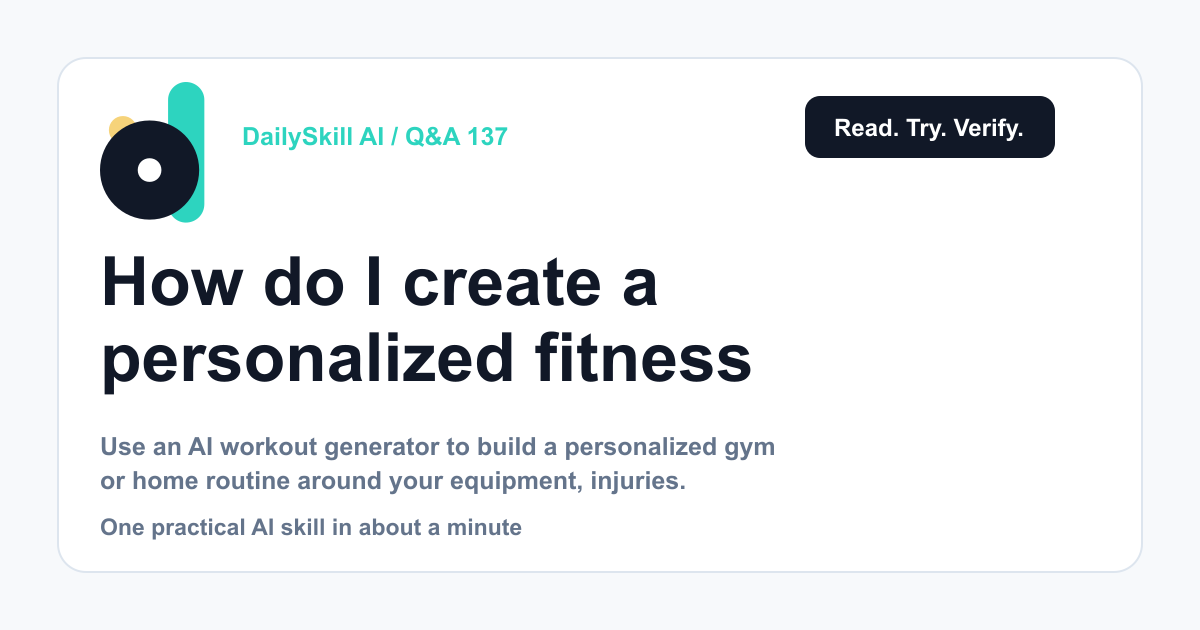
Give an AI assistant five facts: your goal, your schedule, your equipment, your injuries, and your experience level. It will build a weekly plan from them in about two minutes, and the free versions of the major assistants can do this. The plan is only as good as the details you give it. Treat the first draft as a starting point, not a final answer.
Why this comes up
Most people don’t lack motivation. They lack a plan that fits their life. Generic programs assume a full gym, six free days, and a body with no sore knees.
You may worry that an AI plan will be just as generic, or that it could push you into an injury. Both worries are fair, and both are fixable. The fix is a better prompt and a few safety habits.
The honest answer
What AI does well
- It builds a weekly structure fast: which muscles to train on which days, and how to balance push, pull, and legs.
- It adapts to your constraints. Dumbbells only, 30 minutes, a small apartment, three days a week? It can work with all of that.
- It rewrites the plan on request. Missed a week or got a new piece of equipment? Just tell it.
- It explains the “why” behind each choice, so you learn as you go.
What’s overblown
- AI is not a magic trainer. It can’t stand next to you, spot a lift, or correct your form in the moment.
- A plan is not better because it’s longer or fancier. Simple, repeatable plans win.
- You don’t need a paid app. A free AI chat covers most beginners’ needs.
Where to be careful
- Injuries and medical conditions. AI can suggest gentler alternatives, but it doesn’t replace a doctor or physical therapist.
- Weights and progression. AI can suggest loads or jumps that are too ambitious for you. Start lighter than you think you need to.
The best workout plan is the one you can actually repeat next week.
What to do
Copy this prompt and fill in the brackets:
Act as a certified personal trainer. Build me a [3/4/5]-day weekly workout split. My goal is [lose fat / build muscle / get stronger / general fitness]. I’m a [beginner/intermediate] with [X months] of training experience. I have [list your equipment: e.g., two dumbbells, a pull-up bar, a full gym, or no equipment]. I can train on [days] for about [30/45/60] minutes. My limitations are [e.g., sore lower back, bad left knee, none]. For each day, list exercises, sets, reps, and rest time. Include a warm-up, a simple way to progress each week, and easier swaps for any exercise that might aggravate my limitations. Keep it realistic for a beginner. If anything I’ve told you is unclear, ask me before you build the plan.
Then follow these steps:
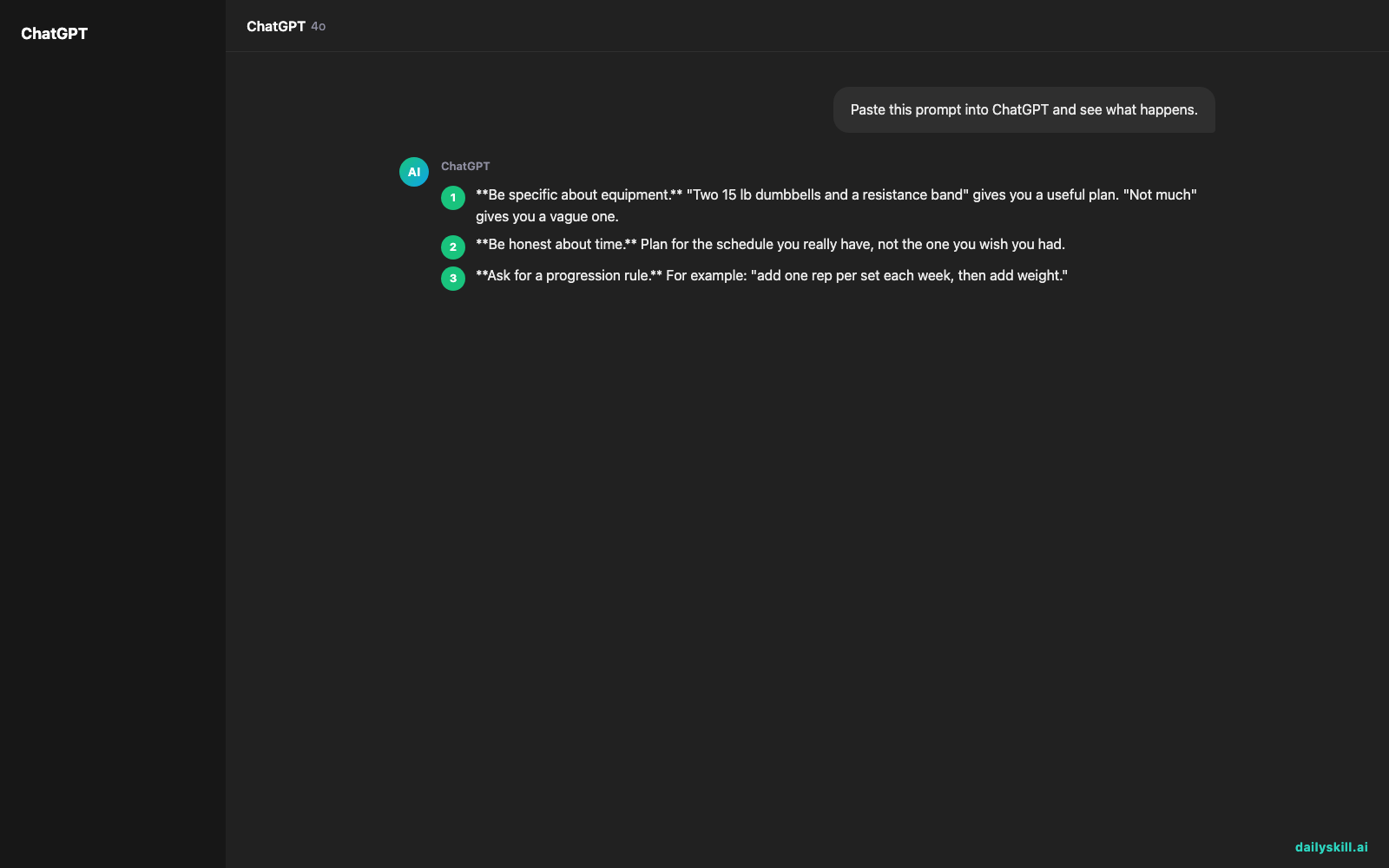
- Be specific about equipment. “Two 15 lb dumbbells and a resistance band” gives you a useful plan. “Not much” gives you a vague one.
- Be honest about time. Plan for the schedule you really have, not the one you wish you had.
- Ask for a progression rule. For example: “add one rep per set each week, then add weight.”
- Try week one and report back. Tell the AI what felt too hard, too easy, or painful, and ask it to adjust.
- Ask for form cues. Request a short description of how to do each unfamiliar move, then check a reputable video before you try it.
Do:
- Warm up before every session.
- Keep a simple log of weights and reps.
- Take at least one or two full rest days each week.
- Ask a doctor first if you have a medical condition or a recent injury.
Don’t:
- Push through sharp or lasting pain.
- Copy a plan meant for someone else’s body or goals.
- Change everything every week. Give a plan at least four to six weeks.
FAQ
What’s the best split for a beginner?
Usually a full-body routine three days a week, or an upper/lower split four days a week. Ask the AI to compare both for your schedule, then pick the one you’ll actually stick to.
Can AI make a plan with no equipment?
Yes. Say “bodyweight only” and describe your space. It can build push-ups, squats, lunges, planks, and harder variations as you improve.
Should I trust the AI’s advice about injuries?
Use it for ideas, such as gentler exercise swaps, but not for diagnosis. If something hurts or you have a known condition, check with a doctor or physical therapist first.
Bottom line
AI can turn your goal, schedule, and equipment into a realistic workout plan in minutes. Be honest with it, start gently, and adjust as you go.
Your turn: What does your current workout setup look like, and what’s the biggest thing stopping you? Share your take in the comments. We read every one.
Tomorrow’s question: Can AI help me audit my monthly subscriptions and find hidden charges? We’ll show you how to spot the forgotten ones.
You might also like:
- Turn Messy Travel Notes into a Day-by-Day Itinerary
- Magic Eraser (Google Photos) — Erase Unwanted Objects From Any Photo in One Tap
Master Everyday AI in 1 Minute a Day
Get our free 2026 Double-Blind AI Benchmark Scorecard & 20 Ready-to-Use Prompts, plus one honest, 60-second AI skill in your inbox every morning. Zero hype, plain English, cancel anytime.