You just read twelve pages, closed the book, and five minutes later you can’t tell a friend a single thing that happened in it.
Here’s the fix: paste that chapter into ChatGPT, and in about 60 seconds you’ll get back 5-8 flashcard-ready notes — a term, a one-line definition, and a quiz question for each — ready to paste straight into your notes app or flashcard deck.
Sound familiar?
You highlight half the page because everything feels important. Later, you reread your highlights and they mean nothing without the context around them. Rewriting your own study guide from scratch eats twenty minutes you don’t have.
The 60-second fix
Step 1: Copy your text
Grab a chapter, an excerpt, or even your own rough summary of what you just read. A few paragraphs to a couple pages works great.
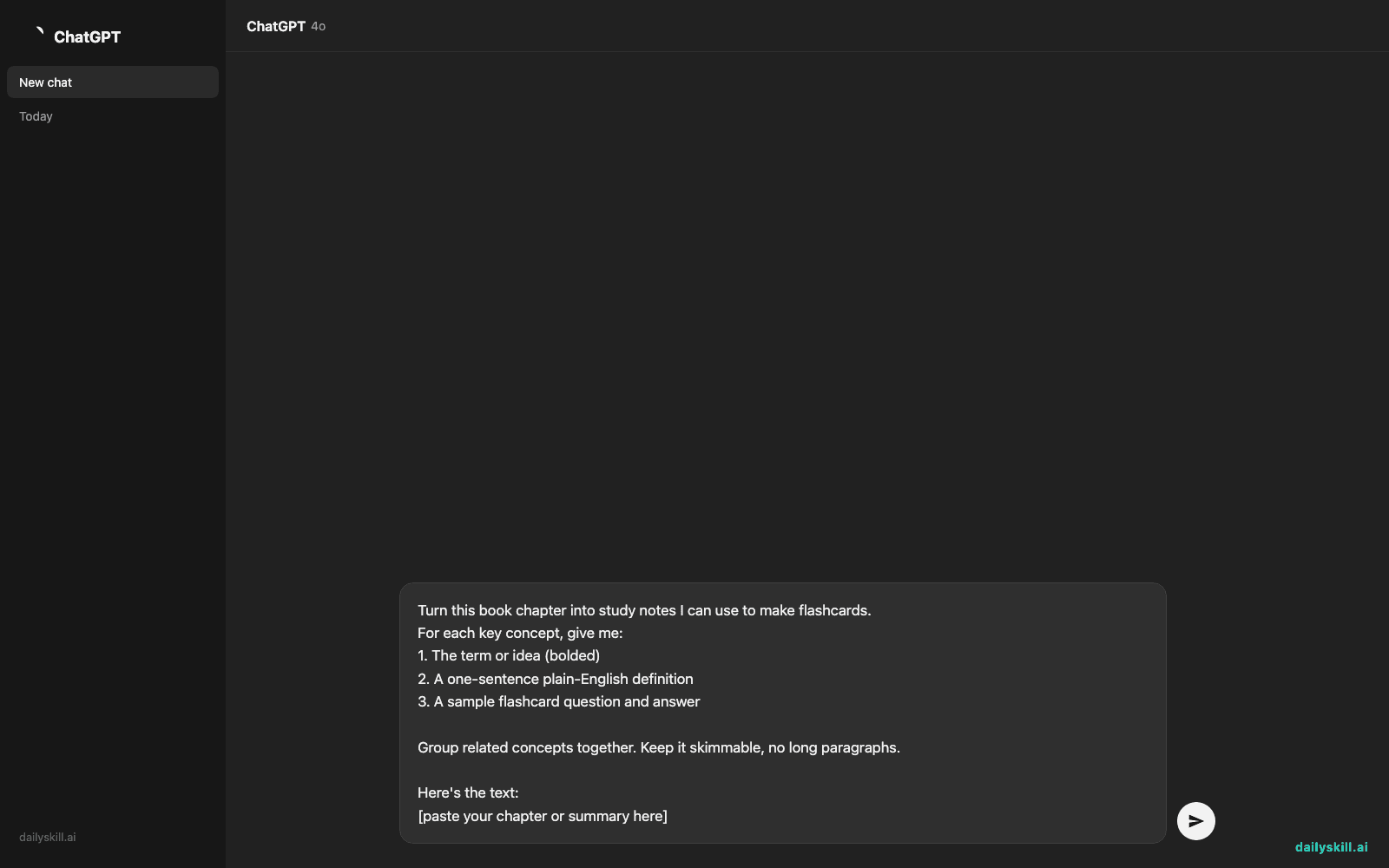
Step 2: Paste this prompt into ChatGPT
Turn this book chapter into study notes I can use to make flashcards.
For each key concept, give me:
1. The term or idea (bolded)
2. A one-sentence plain-English definition
3. A sample flashcard question and answer

Group related concepts together. Keep it skimmable, no long paragraphs.

Here's the text:
[paste your chapter or summary here]
Step 3: Skim, then save
Read through what it gives you. Delete anything you already know cold, and paste the rest into your notes app or flashcard app of choice.
Result: instead of a wall of highlighted text, you get a tight, numbered list you could hand to a friend and say “quiz me.”
Real example
Input (a short excerpt about a history chapter on the printing press):
“The invention of the movable-type printing press by Johannes Gutenberg around 1440 dramatically reduced the cost of producing books. Before this, books were copied by hand, a slow process limited to monks and scribes. Gutenberg’s press made mass literacy possible for the first time, fueling the spread of the Reformation and scientific ideas across Europe.”
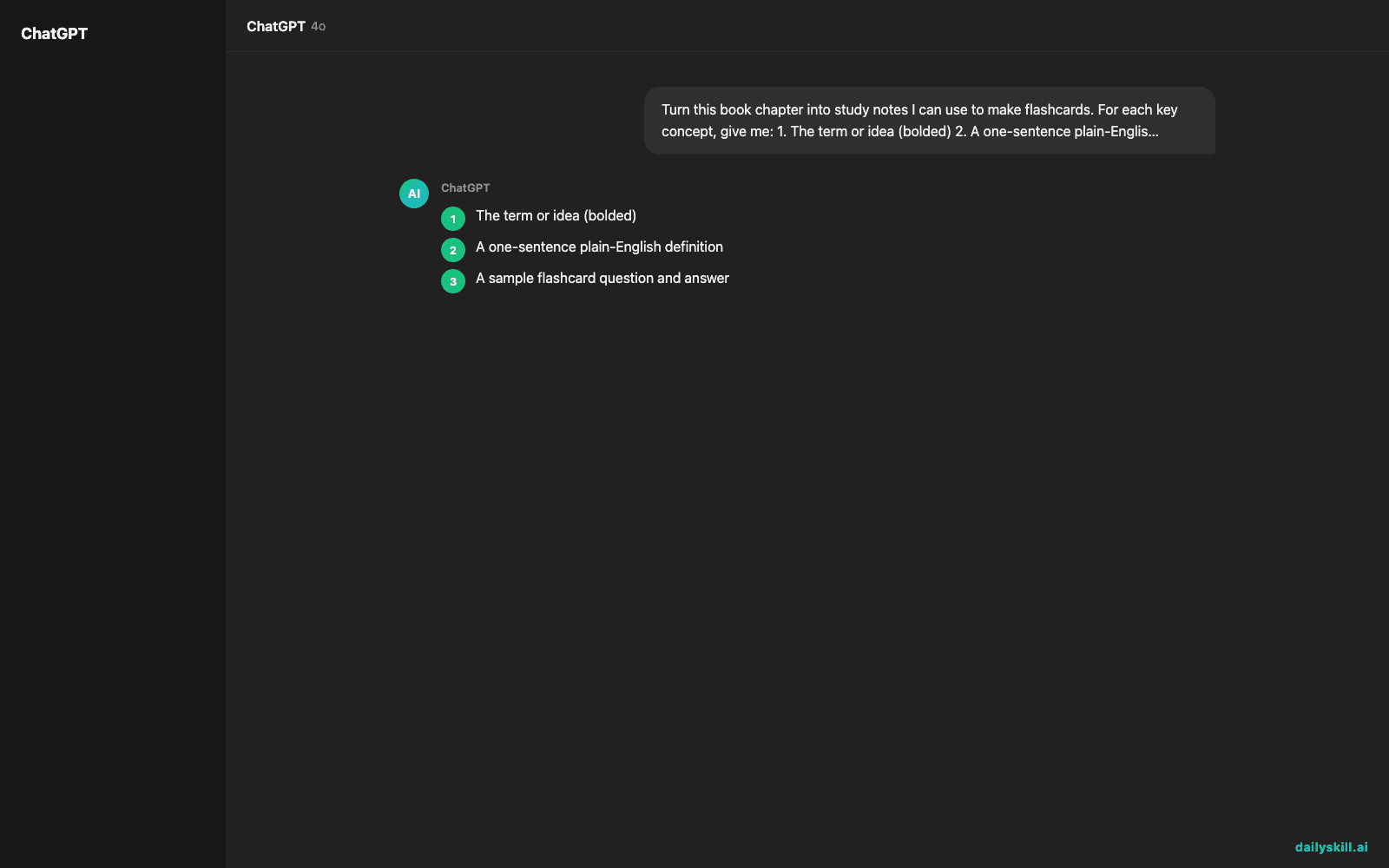
ChatGPT’s output:
1. Movable-type printing press
Definition: A printing method using reusable letter blocks, invented by Gutenberg around 1440, that made books much cheaper to produce.
Flashcard Q: Who invented the movable-type printing press, and roughly when?
Flashcard A: Johannes Gutenberg, around 1440.2. Effect on literacy
Definition: Cheaper books meant more people could learn to read, ending the days when only monks and scribes had access to written texts.
Flashcard Q: Why did the printing press help spread literacy?
Flashcard A: It made books far cheaper and faster to produce than hand-copying.3. Ripple effects
Definition: Wider access to books helped spread the Reformation and new scientific ideas across Europe.
Flashcard Q: Name two major movements the printing press helped spread.
Flashcard A: The Reformation and the scientific revolution.
Three concepts, three clean flashcards — straight from one paragraph, in about the time it took you to read this section.
Level up
- Ask it to sort notes by difficulty: “Mark which concepts are basic vs. which are likely to trip me up on a test.”
- Studying for a specific class? Add: “Format these as Quizlet-style term/definition pairs I can copy directly.”
- Working through a whole book? Paste one chapter at a time and ask ChatGPT to keep a running list so your notes build into a full study guide.
FAQ
Can I use this to make flashcards from a textbook, not just a novel?
Yes — this works even better with textbooks, since they’re already packed with distinct concepts and terms.
Do I need a special app for the flashcards?
No. Copy the Q&A pairs straight into any note or flashcard app, or just quiz yourself off the list ChatGPT gives you.
What if the chapter is too long to paste all at once?
Break it into sections and repeat the prompt for each one, or paste a summary instead of the full text — the trick still works.
Today’s check-in
Try it on whatever you’re reading right now and drop your favorite flashcard question in the community — we’d love to see what you’re learning. Tomorrow: we’ll use AI to generate genuinely thoughtful gift ideas based on someone’s actual interests, not generic “best gifts for…” lists.
You might also like:
- How do I use AI to brainstorm names for a project or business?
- Codeium — Free AI Code Completion That Writes the Next Line With You
Master Everyday AI in 1 Minute a Day
Get our free 2026 Double-Blind AI Benchmark Scorecard & 20 Ready-to-Use Prompts, plus one honest, 60-second AI skill in your inbox every morning. Zero hype, plain English, cancel anytime.