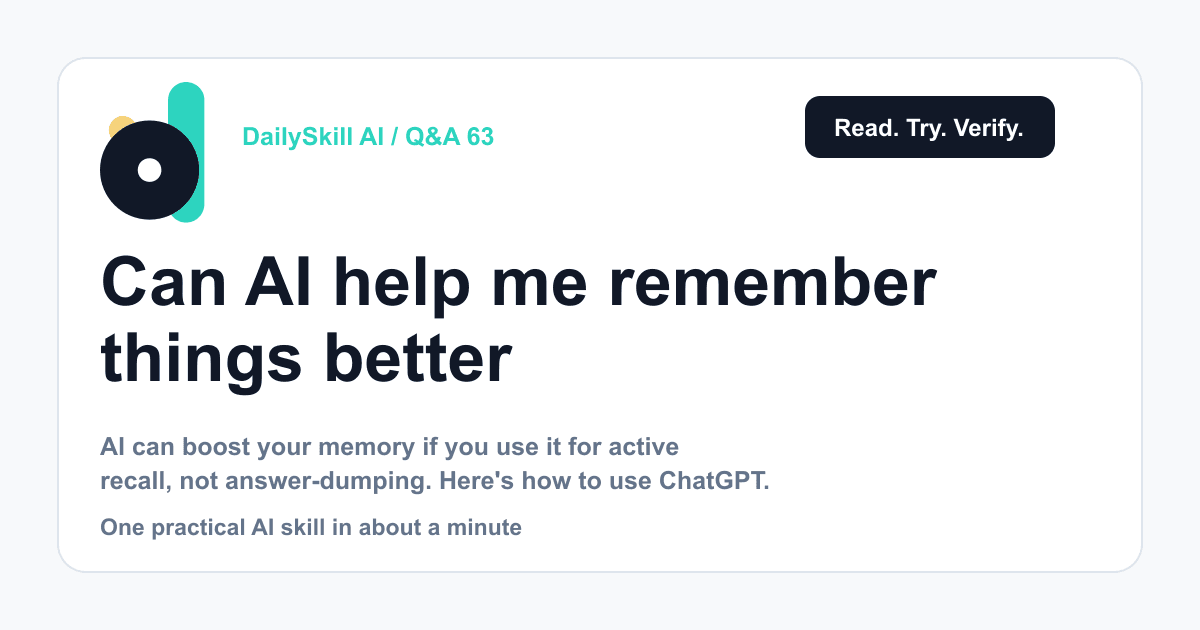
Used the right way, AI can genuinely strengthen your memory. It depends on whether you use it to think for you or to think with you. Ask it to hand you finished answers, and your recall gets weaker over time. Ask it to quiz you, space out your review, and organize your notes, and your memory actually improves. The tool isn’t the problem — how you use it is.
Why this comes up
You’ve probably noticed how easy it is to ask AI a question and just move on, without the answer really sticking. That’s a fair worry — it feels like outsourcing your brain.
The good news: the same tool that enables that shortcut can also be turned into a serious memory trainer, if you flip how you use it.
The honest answer
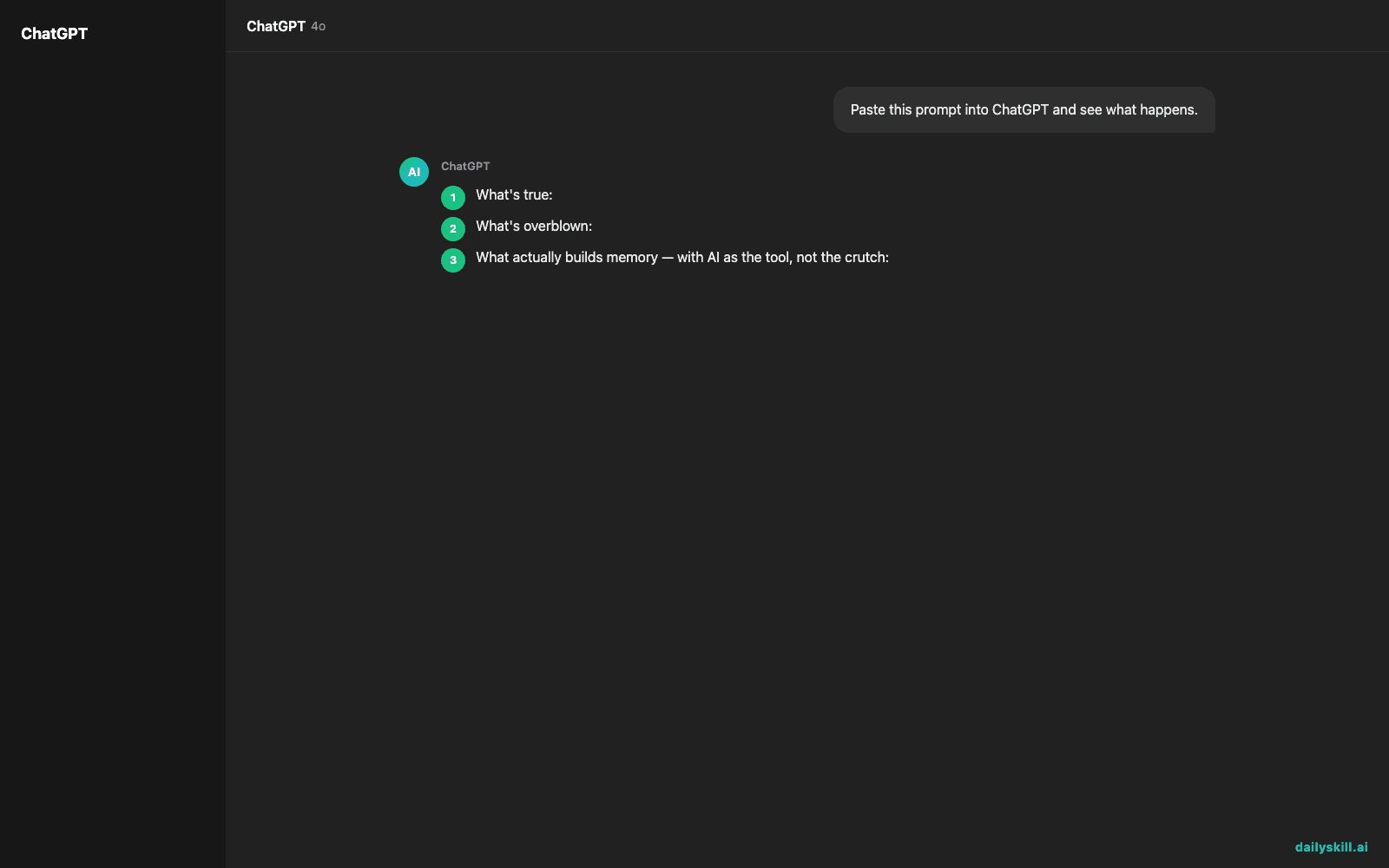
What’s true:
– If you use AI as an answer vending machine — ask, read, forget — your recall does get weaker. It’s the same effect as always using GPS instead of learning a route yourself.
– Passive reading, whether of AI answers or a textbook, is one of the weakest ways to build memory. Research on learning has shown this for decades, long before AI existed.
What’s overblown:
– The idea that “using AI at all” damages your memory. That’s like saying a calculator ruins your ability to think about math. It depends entirely on the task.
– The fear that AI is fundamentally different from other memory shortcuts like notebooks or search engines. It isn’t — it’s just faster and more conversational.
What actually builds memory — with AI as the tool, not the crutch:
1. Active recall, not answer-reading
Instead of asking AI “What is spaced repetition?” and reading the answer, ask it to quiz you on the concept after you’ve studied it once. Being asked to retrieve information is what makes it stick — reading about it again barely helps.
2. AI as a study partner
Tell it your role explicitly: “Act as my study partner. Quiz me on this chapter, one question at a time, and don’t give the answer until I guess.” This turns a chat tool into a tutor instead of an answer machine.
3. AI flashcard generation
Paste your notes and ask AI to turn them into flashcard-style question-and-answer pairs. This does two jobs at once: it organizes messy notes, and it converts passive material into active-recall prompts you can revisit.
4. Spaced repetition scheduling
Ask AI to build you a review schedule — day 1, day 3, day 7, day 14 — for whatever you’re learning. Spacing out recall attempts is one of the most well-established ways to move things into long-term memory.
5. Note organizing that keeps you thinking
Use AI to clean up and structure your raw notes into bullet points, summaries, or categories — but write the first draft yourself. The struggle of putting a thought into your own words is part of what encodes it in memory.
The line between “AI as memory tool” and “AI as memory replacement” is simple: are you retrieving, or just receiving?
What to do
- Do ask AI to quiz you instead of just explaining things to you.
- Do use AI to turn your own notes into flashcards or practice questions.
- Do ask for a spaced-repetition schedule for anything you need to remember long-term.
- Do write your first summary yourself, then have AI help refine it.
- Don’t ask AI a question and consider it “learned” just because you read the answer once.
- Don’t let AI take notes for you from scratch during a lecture or meeting — take your own first, then organize with AI.
- Don’t skip the retrieval step — rereading is not the same as remembering.
FAQ
Is it bad to rely on AI to remember facts instead of memorizing them myself?
For facts you can quickly look up, like a date or a formula, it’s fine — that’s what reference tools are for. For things you need to think with, like concepts, vocabulary, or skills, you still need retrieval practice, not just lookup.
Can AI actually create good flashcards, or do I need to write them myself?
AI is good at generating a first draft of flashcards from your notes, especially for volume. But reviewing and tweaking them yourself helps, since checking them is itself a bit of recall practice.
Does using AI as a study partner work for all subjects?
It works especially well for anything based on facts, definitions, or explainable concepts — languages, history, science, exam prep. For hands-on skills like playing an instrument, AI can help with the knowledge side but can’t replace practice.
Bottom line
AI can train your memory like a good coach or make it lazy like a crutch — the difference is whether you’re being quizzed or just being told.
What’s your experience — has AI helped you remember something better, or made you rely on it too much? Share your take in the comments. Tomorrow: why do you get different answers when you ask AI the exact same question twice?
You might also like:
- Get a Custom 15-Minute Workout Plan Built Just for You
- Grasp — Turn Any Study Notes Into Flashcards and Quizzes in Minutes
Master Everyday AI in 1 Minute a Day
Get our free 2026 Double-Blind AI Benchmark Scorecard & 20 Ready-to-Use Prompts, plus one honest, 60-second AI skill in your inbox every morning. Zero hype, plain English, cancel anytime.