

Which job offer should you actually take — the one with more money, or the one with less stress?
Here’s exactly how to answer that in under a minute: give Claude the details of both offers, and it hands you back a clean comparison table with scores — so you decide with your head, not just your gut.
Sound familiar?
Offer A pays more. Offer B has better benefits and a shorter commute. You’ve made a mental pros-and-cons list four times this week and you’re still stuck.
A proper job offer evaluation tool would help — but you don’t have one, and you don’t need to build one. Claude can be that tool right now, for free.
The 60-second fix
- Open Claude (the free version works fine — no paid plan needed).
- Paste in the details of both offers using the prompt below, filling in your real numbers.
- Read the table it gives you, then ask a follow-up like “which one wins on long-term growth?” to dig deeper.
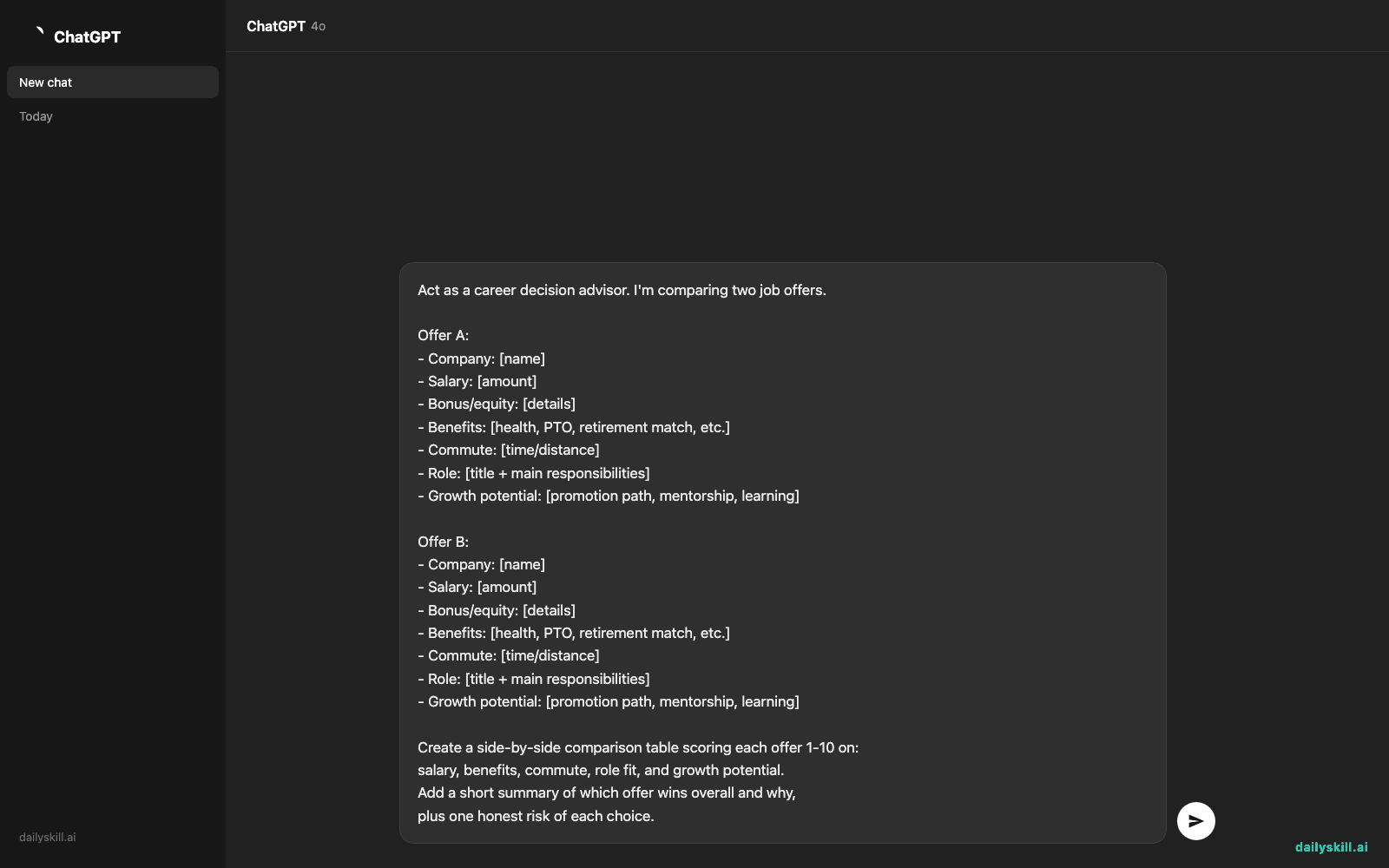
Copy-paste this prompt:
Act as a career decision advisor. I'm comparing two job offers.

Offer A:
- Company: [name]
- Salary: [amount]
- Bonus/equity: [details]
- Benefits: [health, PTO, retirement match, etc.]
- Commute: [time/distance]
- Role: [title + main responsibilities]
- Growth potential: [promotion path, mentorship, learning]

Offer B:
- Company: [name]
- Salary: [amount]
- Bonus/equity: [details]
- Benefits: [health, PTO, retirement match, etc.]
- Commute: [time/distance]
- Role: [title + main responsibilities]
- Growth potential: [promotion path, mentorship, learning]

Create a side-by-side comparison table scoring each offer 1-10 on:
salary, benefits, commute, role fit, and growth potential.
Add a short summary of which offer wins overall and why,
plus one honest risk of each choice.
Real example

Input: Offer A — $95k salary, hybrid schedule, 35-minute commute, “Software Engineer” title at a 12-person startup, no formal promotion path.
Offer B — $88k salary, full benefits, 10-minute commute, “Senior Engineer” title with a documented promotion track at a 200-person company.
Claude’s output looked like this:
Category Offer A Offer B Salary 9/10 7/10 Benefits 6/10 9/10 Commute 5/10 9/10 Role Fit 6/10 8/10 Growth Potential 6/10 9/10 Total 32/50 42/50 Verdict: Offer B wins overall — the shorter commute and clear promotion path likely outweigh the $7k salary gap within 1-2 years. Risk with A: startup instability. Risk with B: slower short-term pay growth.
That’s a real career decision matrix, built in the time it takes to make coffee.
Level up
- Add a third or fourth offer — just paste in more blocks the same way.
- Ask “adjust this for cost of living in [city] vs [city]” if the jobs are in different areas.
- Say “weight growth potential twice as much as salary” if long-term career matters more to you than this year’s paycheck.
FAQ
Is this basically a salary comparison calculator?
It’s more than that — it factors in benefits, commute, and growth too, not just the number on the paycheck.
Can AI really tell me which offer is “better”?
It gives you a structured, unbiased first opinion based on what you tell it. The final call is still yours — but now it’s an informed one.
Do I need to pay for Claude to do this?
No. The free version handles this task easily; no upgrade required.
Today’s check-in
Try this with your own offers (real or hypothetical) and drop your comparison table in the community — we’d love to see what won. Tomorrow: turning messy meeting notes into a clean action-item list with AI.