AI can genuinely help you brainstorm — but only if you prompt it well. Left alone, it defaults to the most common, average answer it can find, which feels recycled because it kind of is. Add real constraints and specifics about your actual project, and it starts generating angles you wouldn’t have thought of. The gap between “generic AI list” and “genuinely useful brainstorm” is almost always the prompt, not the tool.
Why this comes up
You’ve probably tried it: you ask for “marketing ideas” or “blog post topics” and get back a list that feels like it was written for everyone and no one. It’s a fair worry — if AI just remixes what’s already out there, why bother?
The answer is simple: vague prompts get vague output. Specific prompts get specific output.
The honest answer
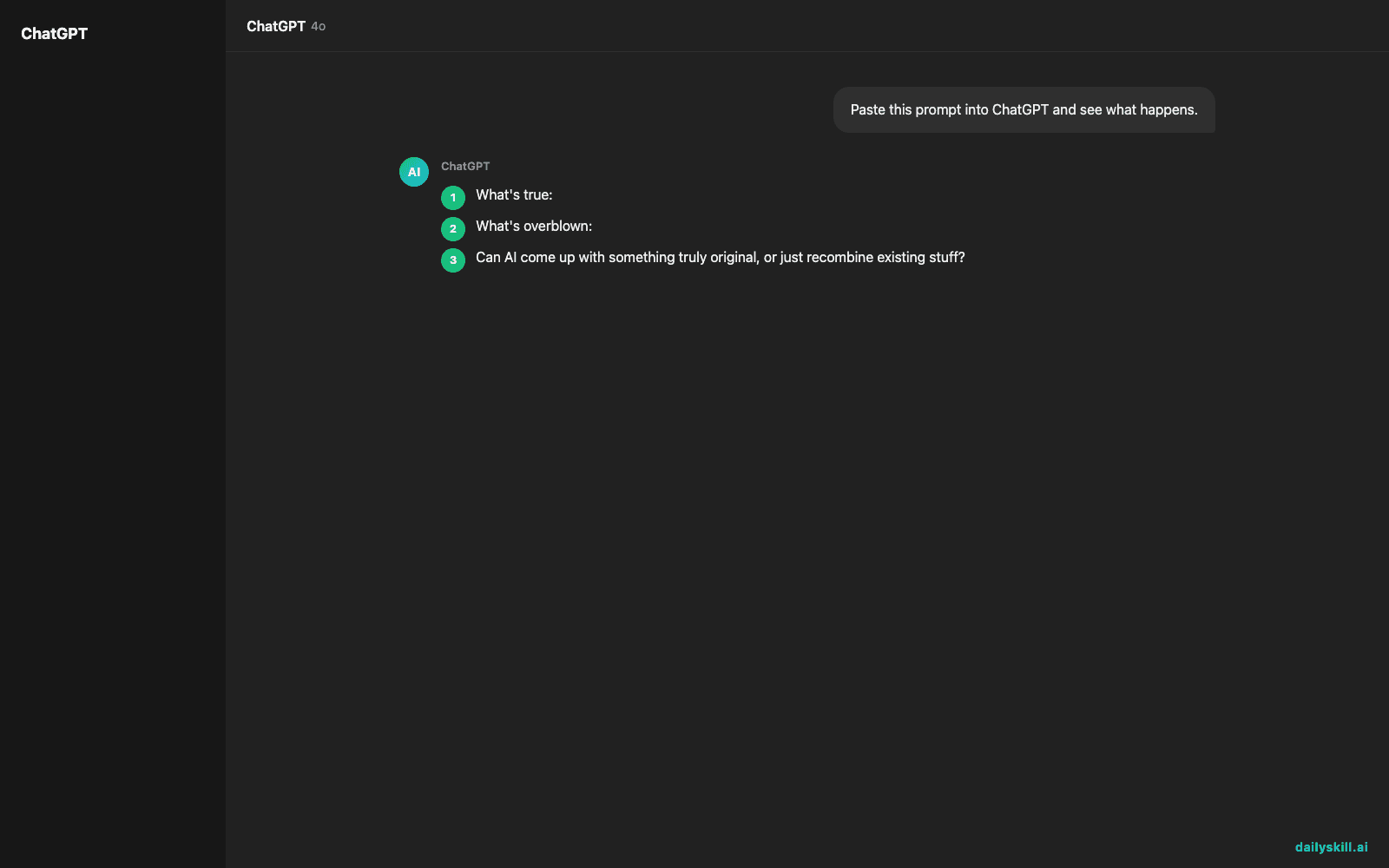
What’s true: a bare, open-ended prompt like “give me ideas for my bakery” will produce safe, generic suggestions — because that’s literally the average of everything online about bakeries. There’s no magic in a plain request.
What’s overblown: the idea that AI is fundamentally incapable of originality. It’s not pulling ideas from a filing cabinet — it’s generating new combinations based on patterns. The quality of the combination depends entirely on what you feed it.
The technique: constraints + specificity
This is the whole trick for AI brainstorming as a beginner. Generic prompts get generic answers. Specific, constrained prompts force the model off the well-worn path.
Compare these two:
“Give me ideas to promote my bakery.”
vs.
“I run a small bakery in a college town. My regulars are broke students who love novelty. I can’t spend money on ads. Give me 10 promotion ideas that cost under $20 and work even if only 5 people show up.”
The second prompt has:
– A real constraint (no ad budget, under $20)
– A specific audience (broke students, novelty-lovers)
– A defined success bar (works even with 5 people)
That forces the AI to stop giving you “run a social media contest” and start giving you things tailored to your actual situation, because generic answers literally don’t fit the constraints you gave it.
Why this works
Constraints eliminate the obvious answers. If you tell it “no budget,” it can’t suggest paid ads. If you tell it “must work for 5 people,” it can’t suggest a viral campaign.
Every constraint you add narrows the space of possible answers — and narrower spaces produce sharper, more original ideas. Specificity does the same thing from a different angle: “my bakery” is generic, “my bakery in a college town where students are broke but love novelty” gives the AI real material to build from.
What to do
Use this checklist next time you brainstorm with an AI assistant:
- Do name your real constraints: budget, time, audience size, tools you already have.
- Do describe your actual situation, not a generic version of it — specifics beat categories.
- Do ask for a number (“give me 12,” not “give me some”) — it forces variety instead of one safe answer repeated.
- Do ask it to build on the ideas you like: “Take idea #4 and give me 5 variations.”
- Don’t accept the first list as final — treat it as round one, then push back with “these feel generic, go weirder” or “assume I have zero budget.”
- Don’t ask one-shot broad questions and expect deep output — brainstorming with AI is a conversation, not a vending machine.
FAQ
Can AI come up with something truly original, or just recombine existing stuff?
Mostly recombination — but so does most human brainstorming. The value isn’t “never been thought of before,” it’s “surfaced faster and tailored to your exact constraints.”
How many rounds should I go before I get something useful?
Usually 2-3. Round one is generic, round two (after you add constraints or reject bad ones) gets sharper, round three often has the keeper.
Is this different for creative work vs. business ideas?
No — same principle either way. The more specific the brief, the less generic the output, whether you’re naming a novel or planning a product launch.
Bottom line
AI doesn’t hand you original ideas for free — it hands them over when you give it real constraints and real specifics to work with.
What’s your go-to brainstorming prompt? Share it in the comments — we might feature the best ones. Tomorrow: how do you ask AI to think deeper instead of giving you the surface-level answer?

You might also like:
- Build a Week of Meals From What’s Already In Your Kitchen
- Namelix — Get a Business Name You Actually Like, Fast
Master Everyday AI in 1 Minute a Day
Get our free 2026 Double-Blind AI Benchmark Scorecard & 20 Ready-to-Use Prompts, plus one honest, 60-second AI skill in your inbox every morning. Zero hype, plain English, cancel anytime.