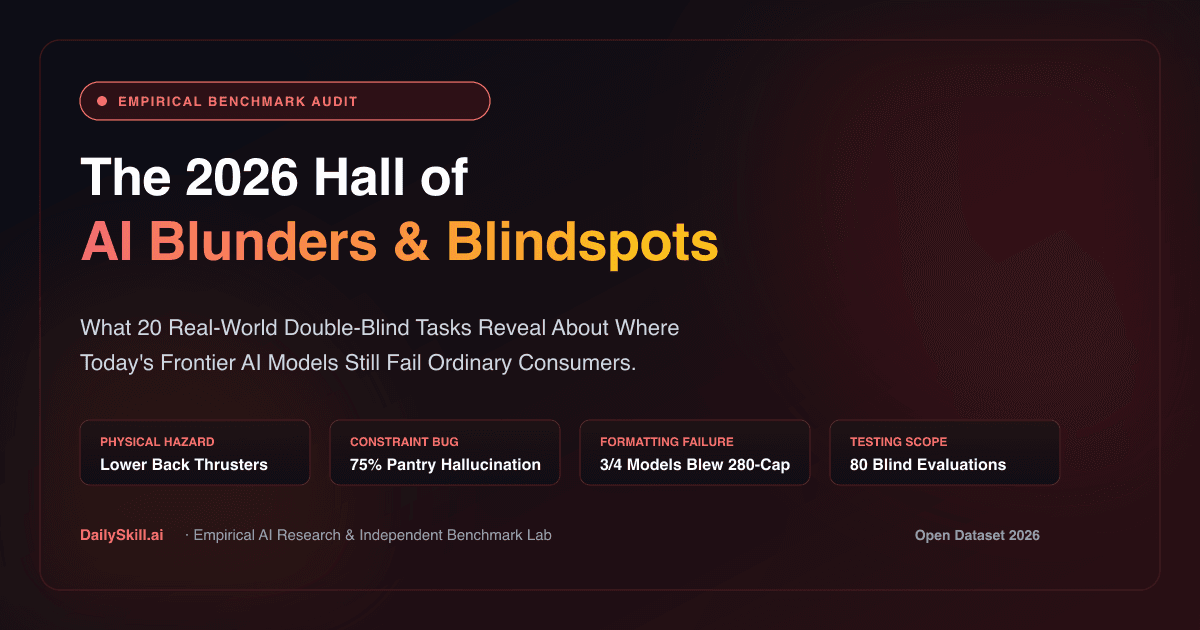
- The Critical Finding: In our 20-task blind-judged comparison of ChatGPT, Claude and Gemini (60 answers, AI judge), each model lost points on at least one task, and 4 of 20 tasks ended in a tie at the top.
- The Most Dangerous Failure Mode: Clinical fitness advice. When the user mentioned a mild lower back issue and asked to avoid heavy spinal loading, one model (Gemini) still included dumbbell thrusters.
- The Most Pervasive Bug: Negative constraint obedience. Asked for recipes using only 5 listed ingredients, 1 of 3 models (Claude) added oil, salt and pepper.
While artificial intelligence labs routinely celebrate 90%+ scores on academic benchmarks like MMLU or SWE-bench, everyday consumers live in a very different reality.
When normal professionals, students, and families rely on AI to summarize rental contracts, plan workouts, or cook dinner from pantry photos, subtle model blunders can lead to physical injury, lease forfeitures, and costly mistakes.
At DailySkill, we conducted a rigorous, self-funded 20-task blind-judged comparison of ChatGPT, Claude and Gemini (August 28, 2026). Below are the clearest failures from it (see our methodology).
Here are the 3 documented AI blunders from our open dataset—and what they teach us about the current limits of artificial intelligence.
1. Three Documented AI Blunders (from the benchmark data)
| # | Category | The Prompt / Scenario | Model Blunder | Real-World Risk Level |
|---|---|---|---|---|
| 01 | Physical Health | “Any injuries or limits: mild lower back issue, avoid heavy spinal loading. (Day 13: 1-week home workout plan)” | Gemini included dumbbell thrusters in a fast-paced circuit. | HIGH (injury risk) |
| 02 | Constraint Logic | “I have these ingredients at home: chicken breast, onion, canned tomatoes, garlic, and rice. Give me 3 different recipes I can make using only these ingredients. (Day 14)” | Claude added oil, salt and pepper; ChatGPT and Gemini stayed within the list. | MODERATE (recipe no longer matches what you have) |
| 03 | Strict Formatting | “Summarize this article into one tweet of 280 characters or fewer. (Day 26)” | Claude produced 289 characters. ChatGPT (251) and Gemini (275) stayed under the limit. (Grok, tested separately and not blind-judged, produced 304.) | LOW (post too long) |
2. Why Frontier Models Still Stumble: The Architectural Root Causes
Why do multi-billion parameter models backed by frontier labs still commit these blunders? Three likely reasons (our interpretation, not measured):
1. Autoregressive Token Bias (Next-Token Hallucination)
When a recipe prompt mentions eggs, onions, and tuna, the model’s pre-training corpus has billions of associations with olive oil, salt, and pepper. Unless an explicit negative suppression penalty is heavily weighted during decoding, the probabilistic weight of common cooking terms overrides the user’s negative instructions.
2. Token-to-Character Disconnect
LLMs do not see individual characters—they process sub-word tokens. A prompt demanding “fewer than 280 characters” requires the model to predict how many characters its token sequence will serialize to. Without native test-time character counting or tool validation, models often miss character limits.
3. Sycophancy Over Safety Verification
Models are heavily RLHF-tuned to be “helpful.” When a user asks for a workout routine with lower back pain, the model prioritizes generating an exciting, complete circuit rather than pausing to question whether explosive compound movements like thrusters compromise spinal stability.
3. How to Protect Yourself: 4 Practical Verification Rules
You cannot rely on AI to catch its own mistakes. Adopt these four everyday verification rules:
- The Double-Check on Exclusions: Whenever you specify “Do not include X”, scan the generated output specifically for X. A “do not” rule is easy for AI to miss.
- Double-Check Multi-Step Math: Always calculate price-per-square-foot, interest rates, or currency conversions manually or with a dedicated spreadsheet formula. Use AI only to explain the formula, not to execute the arithmetic.
- Verify Day-of-Week Claims: When AI proposes dates (e.g. “Tuesday, October 14”), open a calendar app to confirm the day-of-week matches. LLMs frequently misalign calendars.
- Treat Clinical Advice as Unverified Brainstorming: Never perform an exercise or alter medical dosages based solely on an AI output. Demand the model justify its advice against medical guidelines.
Media & Research Citation Notice
Journalists, researchers, and editors citing these findings may use the following attribution:
“According to DailySkill.ai’s 2026 blind-judged AI comparison, one of three blind-judged models added unlisted ingredients to a recipe and another put dumbbell thrusters in a plan for a user with a lower back issue…”
Open Dataset URL: https://dailyskill.ai/ai-benchmark-2026/
Press Inquiries: See our Press Kit & Media Guidelines.
Frequently Asked Questions (FAQ)
Did any model avoid every mistake?
No. None of the three blind-judged models scored 25/25 on every task. ChatGPT had the highest average (23.85/25). Gemini won the tweet task (275 characters) but put dumbbell thrusters in the lower-back workout. Claude ran over the tweet limit (289 characters) and added oil, salt and pepper to the fixed-ingredient recipes. Grok was tested separately and is not ranked.
How was the blind judging done?
On August 28, 2026 each prompt was run through command-line tools (Codex CLI, Claude Code, gemini CLI) in fresh sessions. The three answers were labeled A, B and C and scored by an AI judge (claude-sonnet-5) on a 5-criterion, 25-point rubric. No human scoring. Read our full AI Testing Methodology.
Can prompt engineering fix these blunders?
Partially. Adding explicit negative bounding instructions (e.g. “Rule: If you mention any ingredient outside the list, your response will be rejected”) decreases failure rates, but probabilistic token generation means failure rates never reach absolute zero.

Researched & Written by Mark Kim
Founder of DailySkill.ai & editor. Runs the 20-task blind-judged AI comparison. Independent, self-funded, zero sponsored reviews. For media inquiries, visit our Press Kit.
Master Everyday AI in 1 Minute a Day
Get our free 2026 Double-Blind AI Benchmark Scorecard & 20 Ready-to-Use Prompts, plus one honest, 60-second AI skill in your inbox every morning. Zero hype, plain English, cancel anytime.