Short answer: yes, but only if you give it real material. AI sounds robotic when you ask it to invent. It sounds like you when you hand it your own stories and the job’s actual requirements, then ask it to connect the two.
The formula: paste the job description, add two or three real career stories, tell it how you talk, and ask for a draft. Then edit that draft in your own voice.
Why this comes up
You’ve probably seen a cover letter that opens with “I am thrilled to apply for this exciting opportunity.” It reads like a template, and hiring managers notice. So you worry that using AI will make you look generic, or worse, like you didn’t care enough to write it yourself.
That worry is fair. But the robotic sound usually comes from the prompt, not the tool.
The honest answer
Why AI letters sound robotic
- You gave it nothing specific, so it fills the gaps with safe, generic phrases.
- You asked for “a professional cover letter,” so it wrote the most average one possible.
- You pasted its first draft without changing a word.
Why it can sound human
Modern AI tools are good at matching a tone and rearranging real details. What they can’t do is know that you once saved a client account by staying late on a Friday. Only you have that.
Your stories are the part that makes a letter yours.
What’s overblown
Using AI isn’t cheating, and it isn’t a giveaway on its own. Employers mostly react to letters that feel generic, whoever wrote them. A well-edited, specific letter reads as human. A lazy, unedited one reads as a template.
What’s still true
AI can still slip in a claim you never made, or a phrase you’d never say. That’s why the edit is not optional. You are the one signing the letter.
The tool supplies the structure. You supply the truth. The letter only sounds like you if both are in the prompt.
The prompt formula
Use this five-part structure for a custom cover letter prompt. Fill in the brackets.
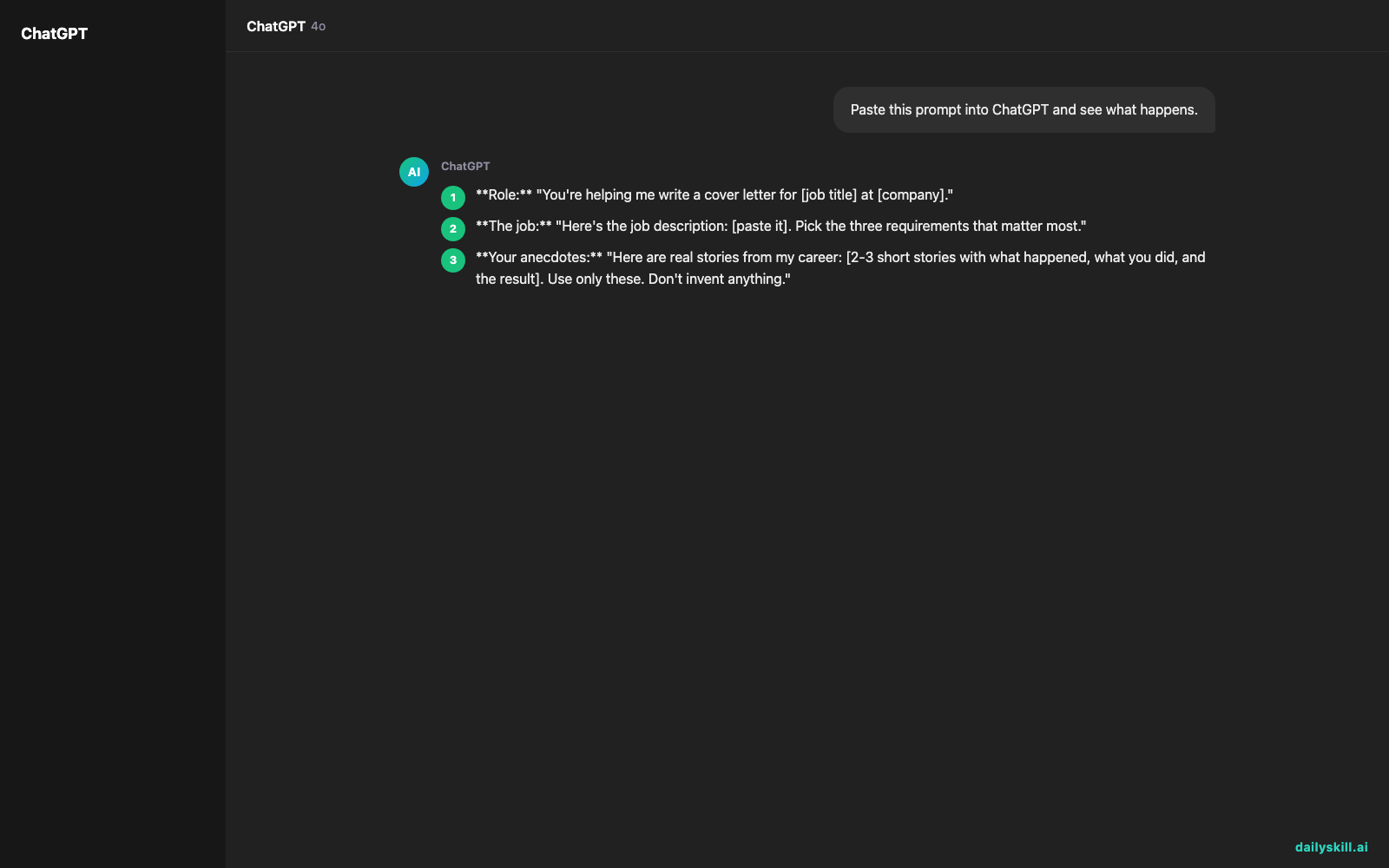
- Role: “You’re helping me write a cover letter for [job title] at [company].”
- The job: “Here’s the job description: [paste it]. Pick the three requirements that matter most.”
- Your anecdotes: “Here are real stories from my career: [2-3 short stories with what happened, what you did, and the result]. Use only these. Don’t invent anything.”
- Your voice: “I write plainly and warmly. Short sentences. No buzzwords like ‘passionate,’ ‘thrilled,’ or ‘leverage.’ Keep it under 250 words.”
- The match: “For each of the three requirements, connect it to one of my stories. Open with a specific detail, not a greeting line.”
A quick example of a good anecdote to paste in:
“At my last job, our weekly report took six hours. I rebuilt it in a spreadsheet template and cut it to one hour. My manager rolled it out to the whole team.”
Short and a bit messy is fine. The AI will tidy it, and you’ll tidy it again.
What to do
Do:
- Write your anecdotes in your own rough words first. Even three bullet points help.
- Say “don’t invent anything” in the prompt, then check every claim in the draft.
- Ask for two versions with different openings, then pick the one that feels most like you.
- Read the final letter out loud. If you wouldn’t say a sentence, rewrite it.
- Add at least one real detail about the company that you genuinely care about.
Don’t:
- Don’t send the first draft untouched.
- Don’t let it add skills, numbers, or achievements you don’t have.
- Don’t reuse the same letter for every application. Rerun the formula with each new job description.
- Don’t paste private details like your home address or ID numbers into the prompt.
FAQ
Will employers know I used AI?
Usually they can tell when a letter is generic, not whether AI touched it. If your letter has specific stories and your natural voice, it reads as an authentic job application.
How do I get rid of phrases that sound like AI?
Tell it which ones to avoid (“no ‘I am excited to,’ no ‘dynamic,’ no ‘proven track record’”). Then edit by hand. Cutting one or two stock phrases makes a big difference.
What if I don’t have impressive stories?
You do. Small, specific stories work best: a problem you noticed, a thing you fixed, a customer you helped. Volunteer work, school projects, and side gigs all count.
Bottom line
A personalized cover letter from AI works when the stories are yours and the edit is yours too.
Have you tried this? Tell us in the comments what worked, or share the line that made your letter sound most like you. Your tip might help someone else get unstuck.
Tomorrow’s question: How do I use AI to brainstorm gift ideas based on someone’s exact hobbies? We’ll look at how a few details about a person can turn into ideas they’ll actually love.
Master Everyday AI in 1 Minute a Day
Get our free 2026 Double-Blind AI Benchmark Scorecard & 20 Ready-to-Use Prompts, plus one honest, 60-second AI skill in your inbox every morning. Zero hype, plain English, cancel anytime.