Today’s AI tools — ChatGPT, Claude, Gemini — are a genuinely different category from the chatbots most of us grew up clicking on websites. The old bots followed a script. These new tools generate original responses, adapt to what you say, and handle tasks no one pre-programmed. Same word, completely different technology.
Why this comes up
You’ve probably hit a chat bubble on a bank’s website and thought, “isn’t this the same thing?” It’s a fair question, and the blurred language doesn’t help. Tech companies use “AI,” “chatbot,” and “assistant” almost interchangeably — which makes it hard to know what you’re actually dealing with, or what these newer tools can genuinely do for you.
The honest answer
Old-school chatbots: choose-your-own-adventure
Classic chatbots are decision trees dressed up with a friendly face. Someone built a flowchart of possible questions and answers, and the bot just navigates it.
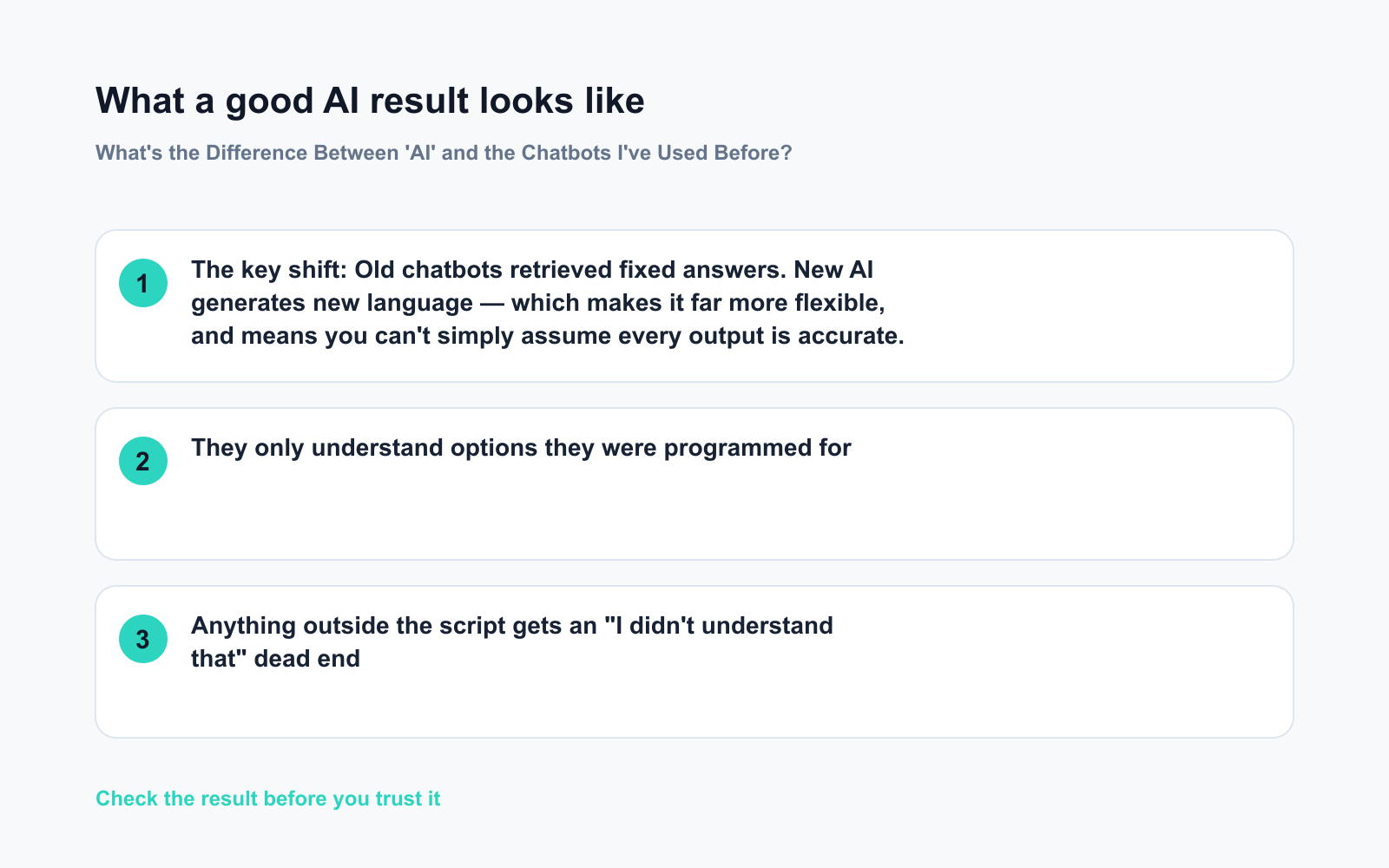
- They only understand options they were programmed for
- Anything outside the script gets an “I didn’t understand that” dead end
- Useful for narrow tasks: check an order status, reset a password, book an appointment
- Zero ability to reason, summarize, or create anything new
Today’s AI tools: generative AI explained simply
What makes today’s tools different is the word generative. These systems were trained on vast amounts of text and learned to produce language — not retrieve pre-written answers.
- You can ask in your own words, even messily, and they follow along
- They handle tasks no one specifically programmed: draft an email, explain a contract, debug code, brainstorm names
- They reason through new problems rather than pattern-match to a fixed list
- They remember context within a conversation and adjust as you go
What’s overblown
Generative AI is not a mind, and it’s not a database of verified facts. It can be confidently wrong. It generates plausible-sounding text based on patterns — which is powerful, but different from “looking things up” the way a search engine does.
That’s not a reason to avoid it. It’s just a reason to treat important outputs as a strong first draft, not a guaranteed fact.
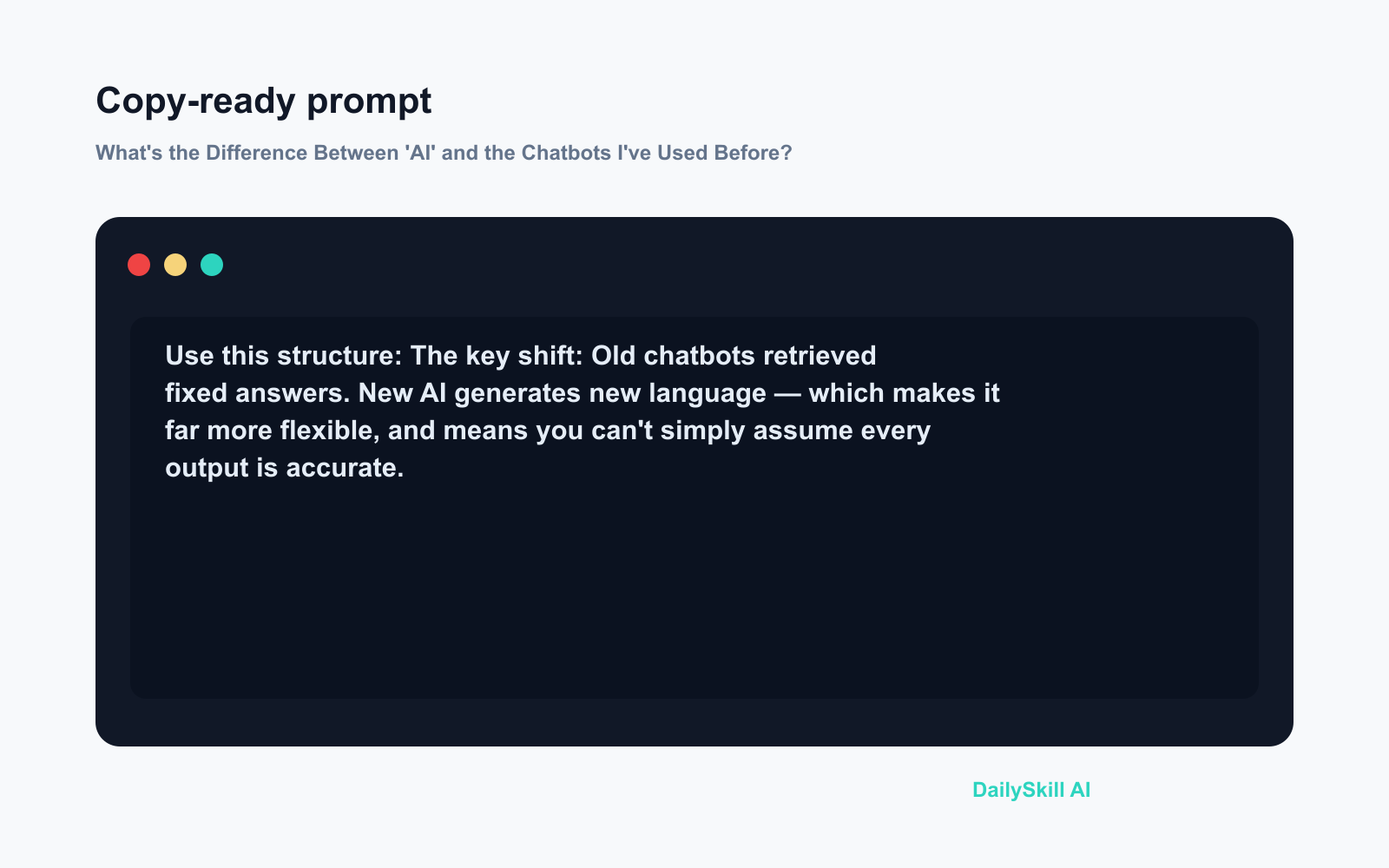
The key shift: Old chatbots retrieved fixed answers. New AI generates new language — which makes it far more flexible, and means you can’t simply assume every output is accurate.
A quick side-by-side
| Old chatbot | Generative AI | |
|---|---|---|
| Follows a script | ✅ Yes | ❌ No |
| Handles open-ended questions | ❌ Rarely | ✅ Yes |
| Creates original text | ❌ No | ✅ Yes |
| Can be wrong with confidence | ❌ Rarely | ✅ Sometimes |
| Useful for… | Fixed tasks | Open-ended thinking |
What to do
Do:
– Use old-style chatbots for what they’re built for — quick service tasks where the options are clear (order tracking, password resets)
– Use generative AI when you need something written, explained, summarized, or thought through
– Ask follow-up questions freely; these tools are built for back-and-forth conversation
– Verify any output that matters — a salary figure, a legal term, a medical detail — before you act on it
Don’t:
– Assume “chatbot” and “AI” mean the same thing when you read them in headlines
– Expect the new AI tools to be perfectly accurate just because they sound confident
– Feel like you need to phrase questions perfectly — natural, conversational language works fine
FAQ
Is Siri or Alexa the same as ChatGPT?
Not quite. Siri and Alexa were built mainly for commands and quick lookups — closer to enhanced old-school bots. Tools like ChatGPT are generative and handle open-ended conversation at a much deeper level. The gap is narrowing, but they’re still meaningfully different in practice.
Why do companies call everything “AI” then?
Marketing, mostly. “AI” sounds more impressive than “chatbot,” so the label gets stretched. A generative AI and a basic website bot are both technically running software — but so are a bicycle and a sports car. Same broad category, very different capability.
Do I need to pay to use the good AI tools?
Free tiers on ChatGPT, Claude, and Gemini are genuinely useful for everyday tasks. Paid tiers unlock faster responses and more advanced reasoning — worth it if you’re using AI heavily for work, but not necessary to get started.
Bottom line
Old chatbots follow a script. Today’s AI generates original responses — which is why it feels so different, and why it’s actually useful for real thinking tasks.
What’s your experience? Did you try one of today’s AI tools expecting an old-style chatbot and get surprised — good or bad? Tell us in the comments.
Tomorrow: Can you actually trust AI for health and medical questions? We’ll give you the honest answer — including when it helps and when it could genuinely mislead you.
You might also like:
- Day 17 — Compare 3 Apartment Listings into One Decision Table (AI 1-Minute Challenge)
- remove.bg / Photoroom — Clean Backgrounds, Zero Editing Skills Required
⭐ Want every prompt in one place?
All 136 tested prompts from our daily skills are free on
GitHub — DailySkill Prompt Library.
Star it to get new prompts as we publish.
More on Getting Started with AI (Beginner’s Guide):
- Can I Do All of This on Just My Phone?
- ChatGPT Explained: The Best First AI Tool for Absolute Beginners
- Complete Beginner’s Guide to AI in 2026: What It Is, How It Works, and Where to Start