Yes, and it’s one of the best low-stakes uses of AI. An AI assistant can be your practice partner. It plays your manager or a recruiter, pushes back, and lets you rehearse until your answers feel natural. It can also help you draft a counter-offer script and spot weak points in your pitch. What it can’t do is know your true market value for certain, or negotiate for you. You bring the facts and make the call.
Why this comes up
Most people dread this conversation. You worry about sounding greedy, freezing up, or saying the wrong thing in the moment.
The problem usually isn’t what you want. It’s that you’ve never said it out loud. Practice fixes that, and AI gives you a patient place to do it.
The honest answer
What AI does well
- Role-play. It can act as a tough hiring manager, a friendly recruiter, or a boss who says “the budget is tight.”
- Polishing your wording. It can turn a rambling answer into a calm, clear one.
- Anticipating objections. Ask it, “What are the five most likely pushbacks, and how would I answer each?”
- Drafting scripts. A first draft of your counter-offer email or talking points takes seconds.
- Building confidence. Answering a hard question ten times makes the eleventh feel easy.
What’s overblown
- “AI knows what you’re worth.” Many assistants can search the web, but pay varies by city, company size, and role. Treat any number as a starting point. Check it against salary surveys, job postings, and people in your field.
- “AI can predict your boss.” It can’t. Real people react in ways a practice partner won’t anticipate, so expect surprises.
- “AI scripts are ready to use.” A polished script that doesn’t sound like you will feel fake in the room. Rewrite it in your own voice.
What to do
Do
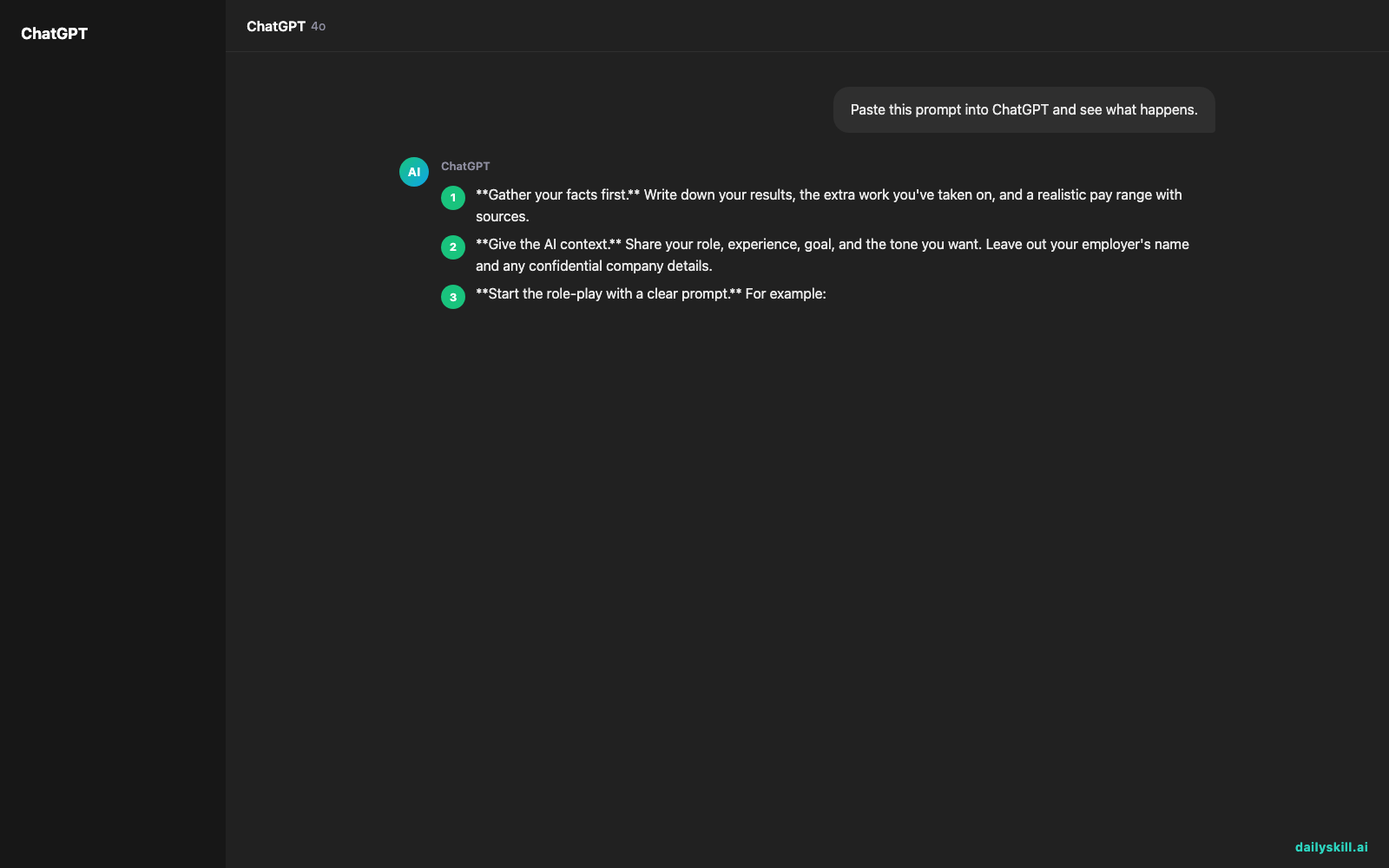
- Gather your facts first. Write down your results, the extra work you’ve taken on, and a realistic pay range with sources.
- Give the AI context. Share your role, experience, goal, and the tone you want. Leave out your employer’s name and any confidential company details.
- Start the role-play with a clear prompt. For example:
“Act as a hiring manager at a mid-sized company. I’m negotiating a job offer. Push back realistically, one message at a time, and don’t give in easily. After five rounds, tell me what I did well and what to improve.”
- Practice the raise conversation. Try: “I want to ask for a 10% raise. Here are my accomplishments: [list]. Play my manager and respond with ‘we can’t do that right now.’ Let me practice my reply.”
- Build your counter-offer script. Ask: “Write a short, warm salary counter-offer. The offer is [amount]. I’d like [amount], based on [reasons]. Keep it under 120 words.”
- Say it out loud. Read your final lines aloud, or use voice mode if your tool has it. Spoken words feel different from typed ones.
Don’t
- Don’t paste in private details like your exact contract, an ID number, or internal company documents.
- Don’t invent achievements. Stick to what’s true and provable.
- Don’t memorize word for word. Learn your key points, not a speech to recite.
- Don’t treat the AI’s numbers as final. Verify them.
FAQ
Can AI tell me how much to ask for?
It can help you think through a range, especially if it can search current data. Still, cross-check with at least two other sources, such as job listings and industry pay surveys.
What if the role-play gets too harsh and I lose confidence?
Tell it to soften up. Say, “Be a bit more friendly and give me feedback after each answer.” You control the difficulty. Start easy, then turn it up.
Is negotiating a new job offer different from asking for a raise?
A bit. With a new offer, you’re comparing against the market and your other options. With a raise, you lean on your track record at the company. Tell the AI which one you’re doing so it plays the right role.
Bottom line
AI won’t negotiate for you, but it’s a great place to practice until the real conversation feels familiar.
How did your last negotiation go, and what would you want to rehearse? Share your take in the comments. We’d love to hear what’s worked for you.
Tomorrow’s question: How do I use AI to transcribe and summarize podcast episodes?
You might also like:
- Summarize podcast episodes in 1 minute — with Perplexity
- Magic Eraser (Google Photos) — Erase Unwanted Objects From Any Photo in One Tap
Master Everyday AI in 1 Minute a Day
Get our free 2026 Double-Blind AI Benchmark Scorecard & 20 Ready-to-Use Prompts, plus one honest, 60-second AI skill in your inbox every morning. Zero hype, plain English, cancel anytime.