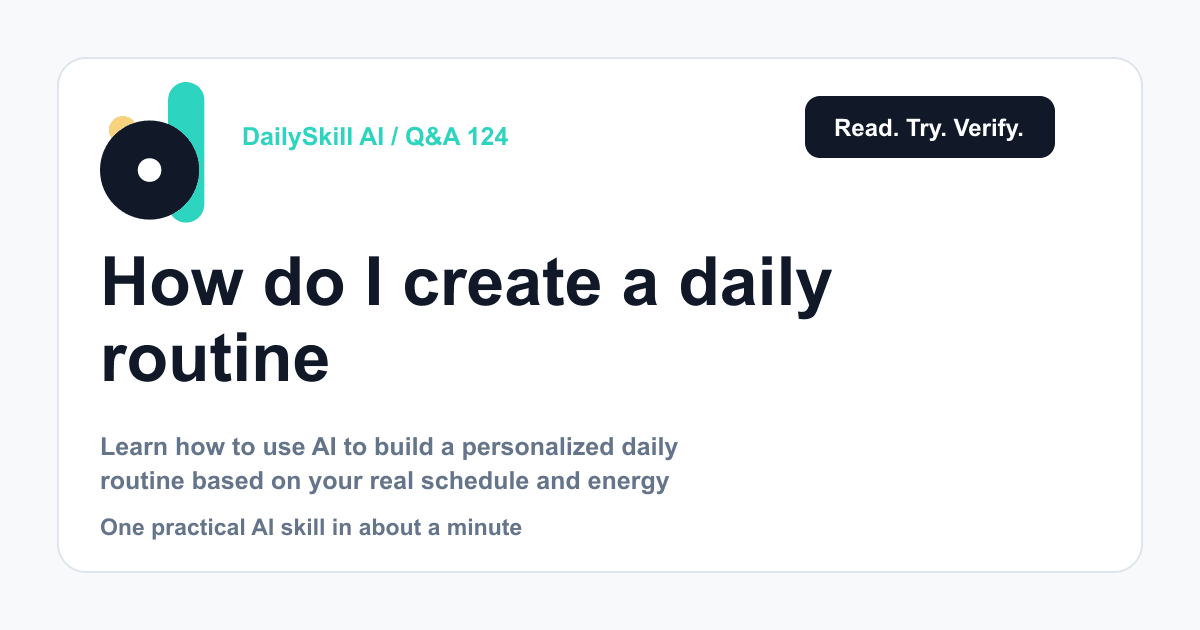
You create a routine that sticks by having AI build it around your actual life — your real wake time, your energy dips, your non-negotiables — instead of copying a 5am influencer schedule. Open any AI chat tool, describe your day honestly, and ask it to design around that. It works because the routine fits you, not the other way around.
Why this comes up
Most people don’t fail at routines because they’re lazy. They fail because the routine was designed for someone else’s life — a schedule copied from a book, an app, or a friend who has no kids, no commute, or a different sleep type.
The real worry underneath “how do I make a routine stick” is usually: I’ve tried before and quit, so maybe something’s wrong with me. It’s not. The routine was wrong.
The honest answer
What’s true
AI is genuinely useful here, and this is a case where the hype matches reality:
- It can take messy, rambling input (“I wake up tired, hit snooze twice, work is chaos till 10am, I crash around 3pm”) and turn it into a structured plan.
- It’s patient with iteration — you can say “that’s too early” or “I hate meal prep, remove it” as many times as you need, with zero judgment.
- It’s good at sequencing: putting your hardest task when your energy is highest, and your easy, low-stakes tasks when you’re flagging.
- It can build in realistic buffers instead of the back-to-back perfection most routine templates assume.
A routine designed around your actual energy, not your ideal self, is the one you’ll still be doing in three weeks.
What’s overblown
- AI can’t make you follow the routine. It designs the plan; you still do the walking.
- It doesn’t know your body — if you tell it you’re a night owl who’s sharp at 9pm, it’ll believe you. Garbage in, garbage out. Be honest, not aspirational.
- A routine from a 10-minute chat still needs a trial run. Treat week one as a draft, not a contract.
- It’s not therapy or a substitute for addressing why you avoid certain tasks — it’s a scheduling tool, not a motivation injection.
What to do
Do:
– Tell the AI your real schedule — actual wake/sleep times, actual energy dips, not the ones you wish you had.
– Mention your constraints up front: kids, commute, shift work, chronic fatigue, whatever’s real.
– Ask for a morning or evening routine first, not both — smaller changes stick better.
– Ask it to flag your 1-2 highest-energy windows and put your most important task there.
– Review the draft and push back: “too many steps,” “I’ll never do this at 6am,” “swap this for Tuesdays only.”
– Run it for 3-5 days before judging it. Then go back and tell the AI what broke.
Don’t:
– Don’t ask for a “perfect” or “ideal” routine — ask for a realistic one.
– Don’t copy someone else’s AI-generated routine wholesale; your energy patterns aren’t theirs.
– Don’t add more than 3-4 new habits at once. A daily schedule generator can list ten things; your life can’t absorb ten at once.
– Don’t treat day-one friction as proof it failed — treat it as feedback to feed back in.
FAQ
Can AI actually know my energy patterns, or do I have to tell it?
You have to tell it — at least at first. Describe a typical day honestly (when you drag, when you’re sharp) and it’ll use that. Over a few conversations, as you report back what worked, it gets noticeably better tailored to you.
What’s the easiest way to start if I’ve never used AI for this?
Pick one AI chat tool, open it, and write one honest paragraph about your current morning or evening — what time things happen and how you actually feel. Ask it for a simple version with no more than 4 steps. That’s the whole starting move.
Should I use a dedicated routine or habit app instead of AI chat?
Either can work, and some habit apps now build in AI schedule makers for this exact job. The advantage of starting in a plain AI chat is flexibility — you can describe nuance an app’s form fields can’t capture, and revise instantly by just talking.
Bottom line
A routine sticks when it’s built from your real schedule, not a borrowed one — and that’s exactly the kind of personalized time management AI is good at helping with.
What’s the one habit you’ve tried (and dropped) the most times? Tell us in the comments — we’ll feature a few in an upcoming Q&A.
Tomorrow: can AI help you write a short story from scratch — even if you’ve never written fiction in your life?
You might also like:
- Turn “I Want to Learn X” Into a Real 4-Week Plan
- Grammarly — the email writing assistant that catches tone before you hit send
Master Everyday AI in 1 Minute a Day
Get our free 2026 Double-Blind AI Benchmark Scorecard & 20 Ready-to-Use Prompts, plus one honest, 60-second AI skill in your inbox every morning. Zero hype, plain English, cancel anytime.