Yes, and more than you might expect. AI tools like ChatGPT, Gemini, and Claude make genuinely useful language practice partners — available 24/7, endlessly patient, and solid for drilling conversation, grammar, and vocabulary. They won’t replace a human teacher or full immersion. But for most beginners and intermediates, they’re one of the most accessible practice tools you can pick up today, for free.
Why this comes up
You’ve probably tried a language app and hit a wall — it drills vocab but never feels like real conversation. You wonder if AI could fill that gap, or if it’s just another gimmick. The real worry is whether it’s worth your time, and whether you’ll pick up bad habits along the way.
The honest answer
What AI does really well
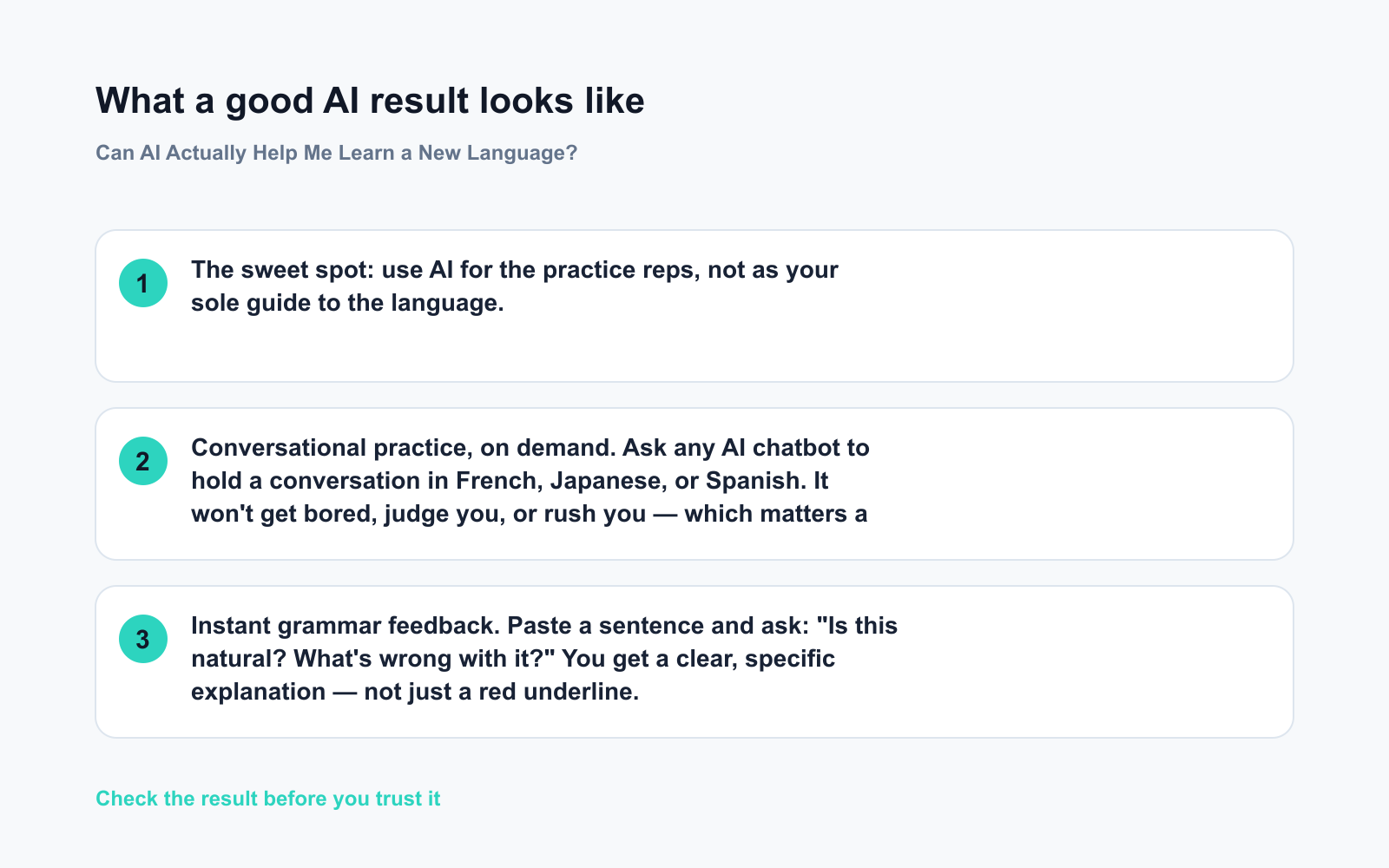
- Conversational practice, on demand. Ask any AI chatbot to hold a conversation in French, Japanese, or Spanish. It won’t get bored, judge you, or rush you — which matters a lot if you’re too nervous to speak with a native speaker yet.
- Instant grammar feedback. Paste a sentence and ask: “Is this natural? What’s wrong with it?” You get a clear, specific explanation — not just a red underline.
- Vocabulary in context. Instead of memorizing word lists, ask the AI to use a new word in five different sentences, or explain the difference between two similar words. That sticks better.
- Roleplay scenarios. Ask it to play a hotel receptionist, a job interviewer, or a café server. You practice the exact phrases you’ll actually need.
- Breaking down grammar rules. AI is patient at explaining why a rule works, in plain language, as many times as you need.
Where AI falls short
- It can’t hear you. Most text-based sessions give no pronunciation feedback. If speaking clearly is your goal, you still need a voice tool, a human tutor, or a dedicated speech app.
- It’s too agreeable. AI sometimes lets small errors slide to keep conversation flowing. If you want strict correction, ask for it explicitly: “Correct every mistake I make, even small ones.”
- It doesn’t track your progress. It won’t notice you keep confusing ser and estar. You have to spot and log your own weak points.
- Slang and regional accents are hit or miss. It knows textbook language well. Street expressions and local dialects are less reliable — always verify those with a native source.
The sweet spot: use AI for the practice reps, not as your sole guide to the language.
What to do
Do:
– ✅ Open a session with: “Let’s have a conversation in [language]. I’m a beginner. Keep sentences short and correct every mistake I make.”
– ✅ Ask it to explain each correction — so you learn the rule, not just fix the typo.
– ✅ Practice 10–15 minutes daily. Consistency beats the occasional hour-long marathon.
– ✅ Try voice mode in ChatGPT or Gemini if you want to practice speaking out loud — both support real-time voice conversation.
– ✅ Pair AI with one other source: a podcast, a class, or a native speaker friend. It works best as a supplement, not a standalone course.
Don’t:
– ❌ Trust it blindly on slang or regional dialects — verify those with a native speaker.
– ❌ Skip asking for corrections — it won’t push back unless you ask it to.
– ❌ Expect it to build a lesson plan or remember last week’s session. You drive the learning; it’s the practice partner.
FAQ
Can I really practice speaking with AI?
Yes. ChatGPT and Gemini both offer voice modes where you speak and listen in real time. Pronunciation feedback is still basic, but it’s far better than typing only — and great for building confidence before talking to an actual person.
What if I’m a complete beginner with no vocabulary yet?
That’s actually a good time to start. Ask the AI to teach you the 20 most useful phrases for one specific situation — ordering food, introducing yourself — then roleplay that situation immediately after. You go from zero to practicing in a single session.
Is AI better than Duolingo for language learning?
Different tools, different strengths. Duolingo is structured and gamified — good for building a habit from scratch. AI chatbots are better for open-ended conversation practice and grammar questions. Most people who stick with language learning use both.
Bottom line
AI won’t make you fluent on its own — but it gives you an always-available, judgment-free practice partner that most language learners simply didn’t have access to before. Use it for daily conversation reps, grammar questions, and scenario practice, then bring in real human input when you can.
What’s your experience? Have you tried practicing a language with AI? Did it actually help — or did something frustrate you? Share in the comments below.
Tomorrow’s question: “What’s the difference between ‘AI’ and the chatbots I’ve used before?” — turns out the answer is more interesting than you’d think.
You might also like:
- Day 16 — Write a Resume Summary That Gets Noticed (60-Second AI)
- CapCut — Turn Raw Clips Into Share-Ready Videos Without Touching a Timeline
⭐ Want every prompt in one place?
All 136 tested prompts from our daily skills are free on
GitHub — DailySkill Prompt Library.
Star it to get new prompts as we publish.
👉 Related: ChatGPT for Students: 6 AI Techniques to Study Faster.
More on AI for Students & Learning:
- Best AI Tools for Students in 2026 (Free, Practical, Actually Useful)
- Can AI Just Write My Whole Essay or Report for Me?
- Day 15 — Solve Your Kid’s Homework in Seconds — AI Explains It Too (AI 1-Minute Challenge)