A reader once told us: “I read this sleep study paragraph four times and I still don’t know if blackout curtains would even help me.” Here’s the fix: paste any dense paragraph into Claude, and in under 60 seconds you get a 3-sentence plain-English summary, plus a real-life example that makes it click instantly.
Sound familiar?
You’re trying to understand something — a new supplement, a parenting study, a climate report. You find the actual research, but it’s a wall of jargon: “statistically significant,” “confounding variables,” “effect size.”
You skim it, understand nothing, and just trust the headline instead. That’s backwards — you deserve to know what the actual science says, not just the clickbait version of it.
The 60-second fix
Step 1: Find the dense paragraph
Grab the part of the paper you’re stuck on — usually the Abstract or the Results section has the densest language.
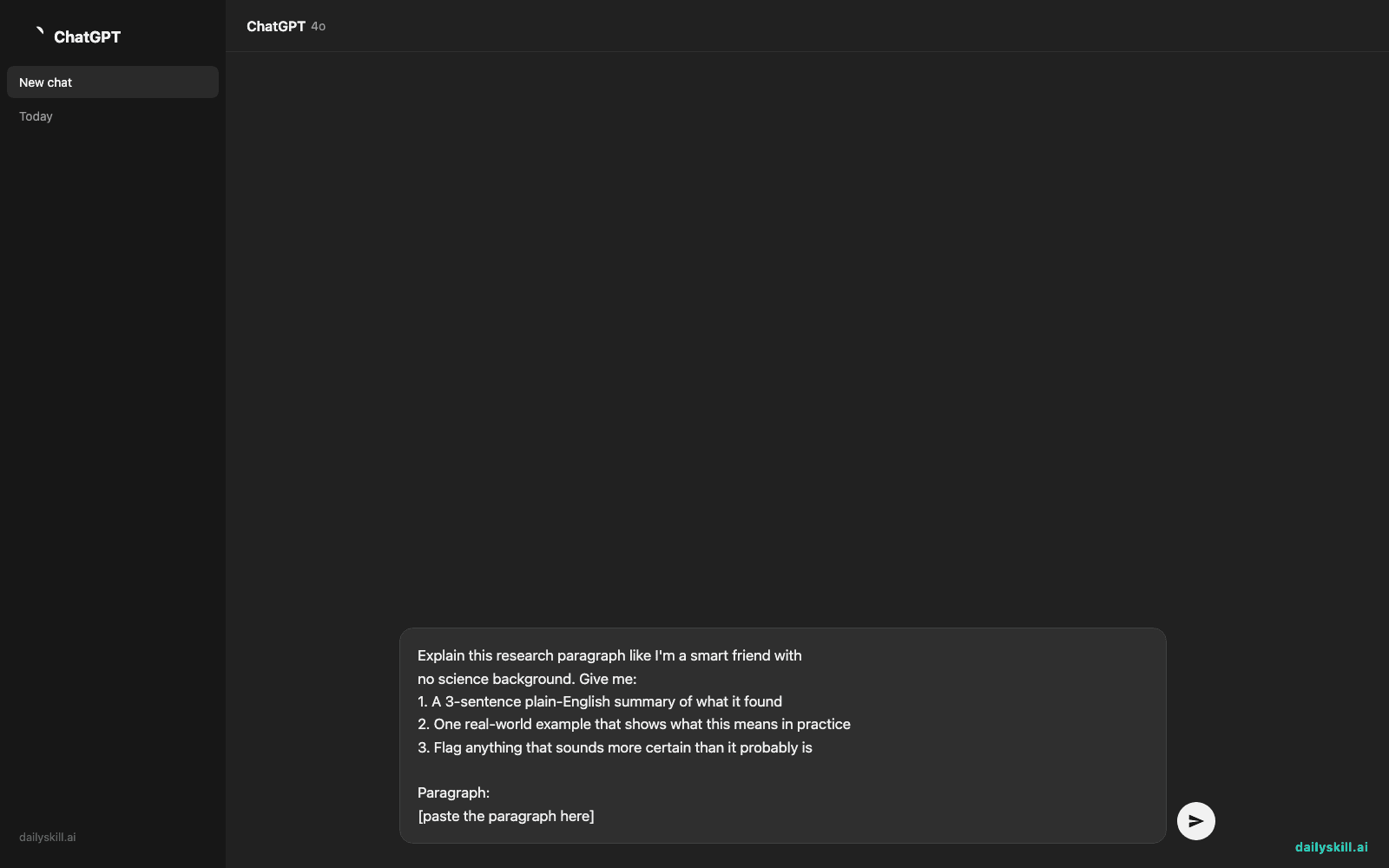
Step 2: Paste it into Claude with this prompt
Explain this research paragraph like I'm a smart friend with
no science background. Give me:
1. A 3-sentence plain-English summary of what it found
2. One real-world example that shows what this means in practice
3. Flag anything that sounds more certain than it probably is

Paragraph:
[paste the paragraph here]
Step 3: Ask a follow-up if anything’s still fuzzy
Just type: “Explain that one part again, even simpler.” It adjusts automatically — no need to re-explain your whole question.
Real example
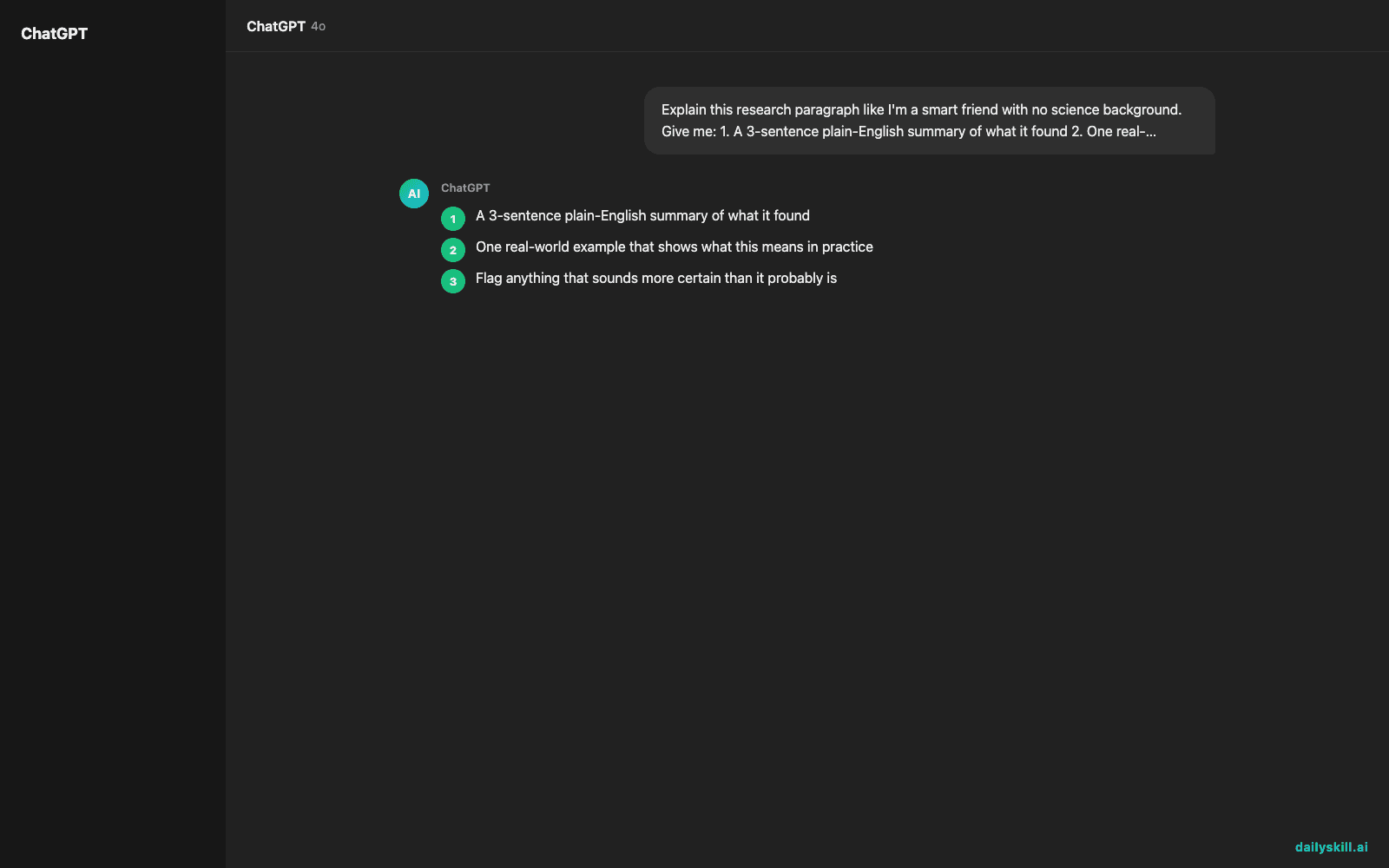
Input paragraph (from a sleep study):
“Participants exhibited a statistically significant reduction in sleep onset latency (M = 14.2 min, SD = 3.1) following a 20-minute pre-sleep screen-free period, relative to controls (M = 26.7 min, SD = 4.8), p < .01, suggesting a moderate effect of blue-light exposure reduction on sleep initiation.”
AI output:
- People who avoided screens for 20 minutes before bed fell asleep about twice as fast (around 14 minutes) compared to people who kept using screens (around 27 minutes).
- The difference was big enough that it’s unlikely to be random chance — something about the screen-free time really helped.
- Real-world example: if you normally scroll your phone in bed and take 25+ minutes to doze off, swapping that for 20 minutes of reading a physical book or just lying in the dark might cut that time roughly in half.
One thing to flag: this is one study with likely a small group of people, so “moderate effect” means promising, not proven for everyone.
Level up
- Compare two papers: Paste both abstracts and ask, “Do these two studies agree or contradict each other?”
- Check your own understanding: After reading the summary, write back “Is it fair to say X?” and let it correct you.
- Go deeper on method: Ask “What would make this study more trustworthy?” to learn to spot shaky research yourself.
FAQ
Is this a free way to simplify academic research papers?
Yes — any AI chat tool with a text box works for this, no special academic text summarizer app needed. Just paste and ask.
Will the AI get the science wrong?
It can occasionally oversimplify, which is why step 3 of the prompt (“flag anything too certain”) matters — it’s built to catch its own overconfidence.
Can I paste a whole paper instead of one paragraph?
You can, but start with the hardest paragraph first — asking for help on dense text one chunk at a time usually gives a more careful, accurate explanation than rushing the whole document at once.
Today’s check-in
Tried it on a paper you’ve been avoiding? Drop the “before jargon / after plain English” comparison in the community — it’s oddly satisfying to see side by side.
Tomorrow: Day 124 — build a full 4-week learning roadmap for any skill you’ve been meaning to pick up, in one AI prompt.
You might also like:
- What if my favorite AI tool changes or goes away?
- Runway — the AI video editor that erases, extends, and reimagines your footage
Master Everyday AI in 1 Minute a Day
Get our free 2026 Double-Blind AI Benchmark Scorecard & 20 Ready-to-Use Prompts, plus one honest, 60-second AI skill in your inbox every morning. Zero hype, plain English, cancel anytime.