The problem is almost never the AI — it’s the prompt. When AI produces generic, overly formal, or “corporate-sounding” text, it’s usually because you asked for content without giving it any signal about how you actually write.
Here’s a method that works reliably: show it examples of your writing, then ask it to match the style.
The Voice Sample Method
The most effective way to get AI to write like you is to give it examples of your actual writing and explicitly ask it to learn from them.
Step 1: Collect 2-3 samples
Find 2-3 pieces of writing that sound like you at your best. This could be emails you’re proud of, blog posts, social media captions, a newsletter — whatever fits the type of content you want to create.
Step 2: Give them to the AI with instructions
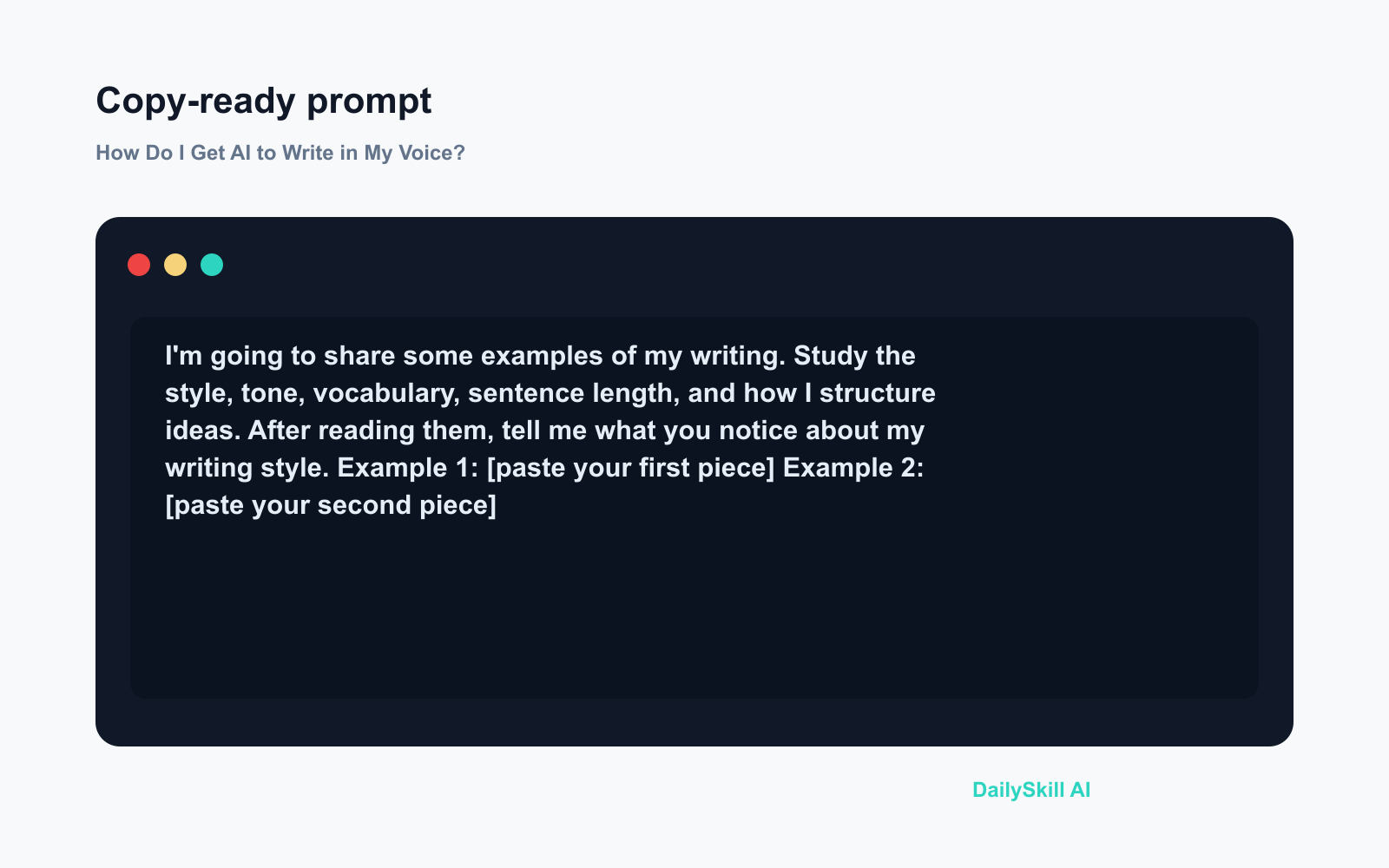
I'm going to share some examples of my writing.
Study the style, tone, vocabulary, sentence length, and how I structure ideas.
After reading them, tell me what you notice about my writing style.

Example 1:
[paste your first piece]

Example 2:
[paste your second piece]
Step 3: Let it describe your style back to you
The AI will describe patterns it noticed — things like “you write in short sentences, use direct language, avoid jargon, and often start with the main point before explaining it.” This description is useful: it both confirms the AI understood your style and helps you articulate it for future prompts.
Step 4: Ask it to write in that style
Now write [what you need] in my writing style, based on the examples above.
The Shortcut: A Style Brief
If you want to use this across multiple sessions without pasting examples each time, write a brief description of your style that you can reuse:
My writing style:
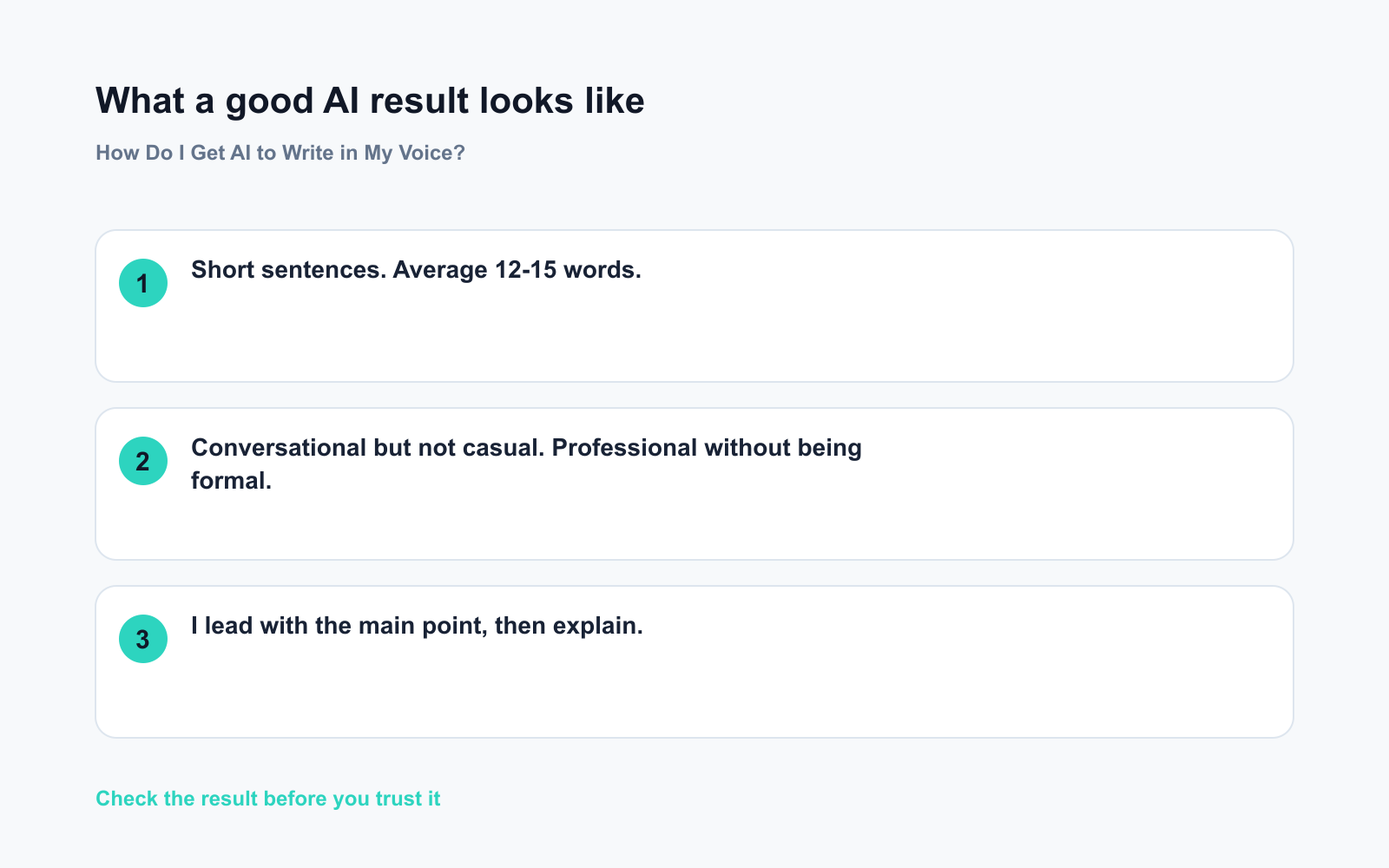
- Short sentences. Average 12-15 words.
- Conversational but not casual. Professional without being formal.
- I lead with the main point, then explain.
- I don't use filler words or hedging ("it's important to note that", "it goes without saying").
- I use "you" and "your" to address the reader directly.
- I avoid metaphors and analogies.
Paste this at the start of any session where you want AI to write like you. You can refine it over time as you notice what’s working.
Specific Fixes for Common Problems
If it sounds too formal:
Add to your prompt: “Use conversational language, not corporate. Write like you’re explaining this to a smart friend.”
If the sentences are too long:
“Use shorter sentences. Maximum 15 words per sentence on average. Vary the length — some very short (5-7 words), some medium (12-15).”
If it uses too many clichés:
“Avoid these words and phrases: leverage, synergy, game-changer, it’s important to note, in conclusion, furthermore, additionally.”
If it sounds too enthusiastic or salesy:
“Keep the tone calm and direct. Don’t oversell. No exclamation points.”
If it starts every paragraph with “In today’s…”:
“Don’t open with ‘In today’s world’ or ‘In recent years.’ Start with the main point.”
For Social Media Posts Specifically
Social posts have a tight format where voice matters most. Give AI not just your style but your typical post structure:
Here are 3 examples of my Twitter posts:
[post 1]
[post 2]
[post 3]

Write a post about [topic] that follows this format and tone.
If you want it to vary the format while keeping the voice:
Write 3 different versions — one short (under 50 words), one that poses a question, one that uses a list format.
The Reality Check
AI won’t perfectly replicate your voice from examples alone — it’ll get close. The last 10-20% of making it sound truly like you requires editing. That editing is faster than writing from scratch, and it forces you to refine your own sense of what “your voice” actually means.
Over time, your style brief gets more specific, and the AI’s drafts get closer. After 5-10 sessions of refinement, you’ll have a prompt that consistently produces drafts you only need to lightly edit.
FAQ
Can I give it a link to my website or blog to learn my style?
In ChatGPT Plus (with web browsing) or Claude, yes — paste the URL and ask it to read the content and identify your writing style. On free tiers, copy-paste is more reliable.
Does this work for email, blog posts, and social media?
Yes, but you’ll need slightly different style briefs for different formats — your email style and your Twitter style may be quite different. It’s worth having separate brief documents for each.
What if I don’t have examples because I’m just starting out?
Describe the voice you want rather than showing it. “Write like a practical, no-nonsense person who teaches things clearly and doesn’t waste the reader’s time” is a workable brief even without examples.
Related: Can AI help write a better resume? · How to write prompts that get good results
You might also like:
More on Writing Better AI Prompts:
- How Do I Stop AI Writing From Sounding Robotic and Obviously AI?
- How Do I Write Prompts That Actually Get Good Results?
- How to Use AI to Improve Your Writing (Without Losing Your Voice)