Yes — kids can and will use AI, so your job isn’t to block it but to be there when they do. Use it together first, ask questions about what it says, and check important answers. That one habit protects them and teaches them something school probably won’t.
Why this comes up
Most parents feel caught between two fears at once — that AI will do their child’s thinking for them, or that keeping kids away from it will leave them behind. Both fears make sense. What’s harder to find is a middle path that actually works at home.
The honest answer
AI is already in your kids’ world
Kids encounter AI in search engines, homework helpers, and writing tools. Pretending it isn’t there doesn’t make them safer — it just means they use it without you.
What’s genuinely worth watching
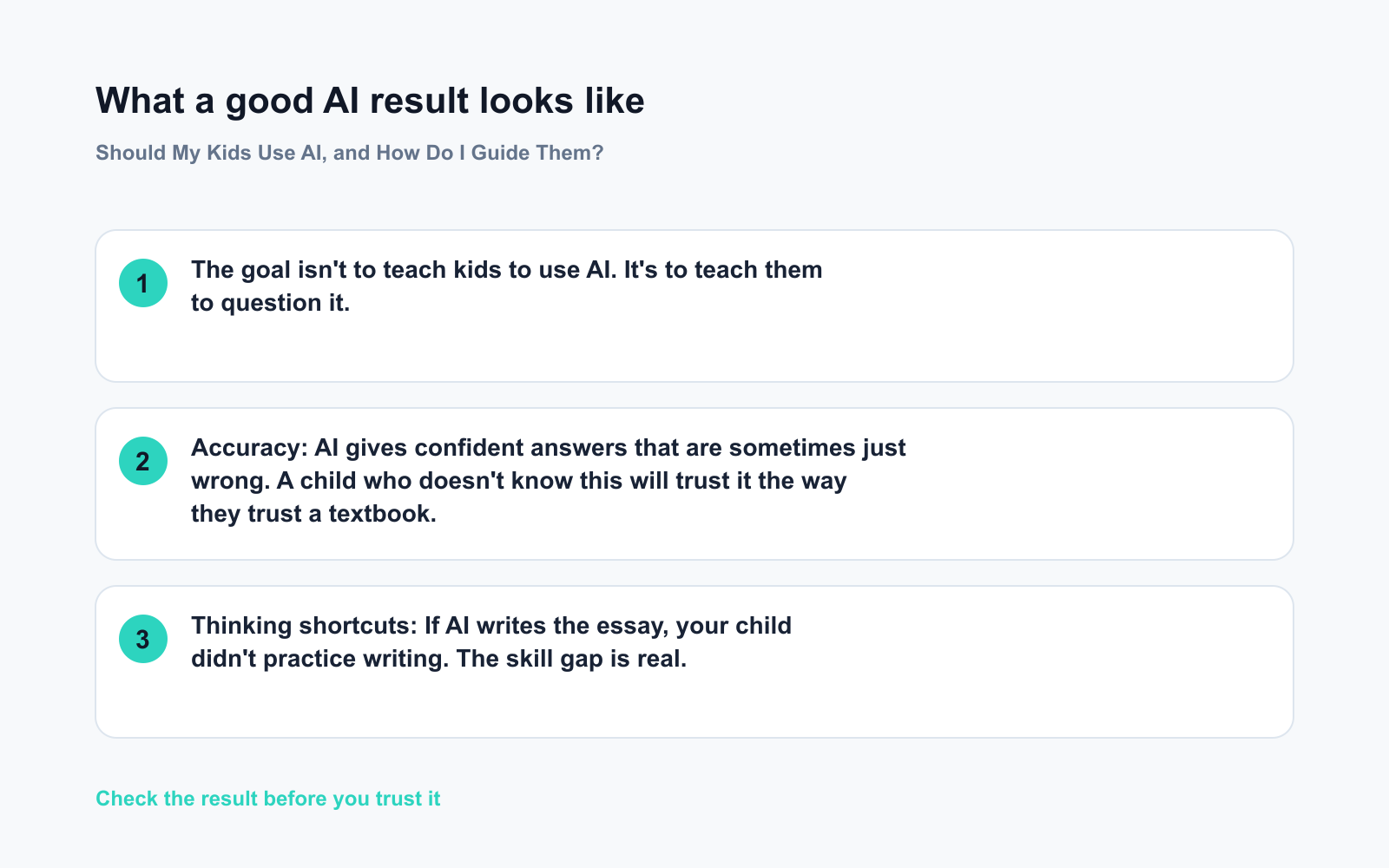
- Accuracy: AI gives confident answers that are sometimes just wrong. A child who doesn’t know this will trust it the way they trust a textbook.
- Thinking shortcuts: If AI writes the essay, your child didn’t practice writing. The skill gap is real.
- Content: Open-ended AI chats can go unexpected places. Know what your child is asking.
What’s overblown
- “AI will make kids lazy forever” — Tools have always changed how we work. Calculators didn’t kill math skills; poor habits did.
- “It’s too complicated for young children” — A curious eight-year-old can use AI responsibly with ten minutes of guidance from you.
The goal isn’t to teach kids to use AI. It’s to teach them to question it.
A simple framework that actually works
Using AI together beats any rule you write. Sit beside your child and say: “Let’s ask it — then check if that’s really true.”
That one sentence models the most important skill: thinking critically about a new tool, not just accepting what it says.
What to do
Do:
– ✅ Try an AI tool together before your child uses it alone — ask it something you both already know the answer to
– ✅ Make “let’s check that” a household phrase, not a punishment
– ✅ Encourage your child to use AI to start a project, then add their own ideas on top
– ✅ Ask what they’re using AI for — with curiosity, not interrogation
Don’t:
– ❌ Ban it without a conversation — bans just move the behavior out of your sight
– ❌ Let AI replace the thinking step entirely (writing, solving, deciding)
– ❌ Assume the school has this covered — most don’t yet
– ❌ Treat every AI use as cheating — knowing how to use a tool well is its own skill
FAQ
At what age can kids start using AI?
Maturity matters more than age. Kids who can read well and naturally ask “but why?” are usually ready to explore AI with a parent nearby. Most AI platforms set 13+ as the minimum for independent use — that’s worth respecting.
How do I stop my child from using AI to cheat on homework?
Talk about it directly. Ask: “Did you write this, or did AI write it?” Most kids respond better to honest conversation than surveillance. Find out your school’s policy too — then you’re both working from the same page.
Are there AI tools made specifically for children?
Yes. Several platforms offer child-safe environments with content filters and simpler interfaces. Search “AI tools for students” and prioritize ones your child’s school already recommends — those tend to have appropriate guardrails built in.
Bottom line
Use AI with your kids before they use it without you — that single habit covers most of what parenting AI looks like right now.
What’s your family’s current rule around AI? Share it in the comments — your approach might be exactly what another parent needs to hear.
Tomorrow’s question: Does AI actually remember your past conversations, or do you start over from scratch every time? The answer might surprise you.
You might also like:
- Day 10 — AI Review Summary: Get Pros, Cons & a Buy Decision in 60 Seconds (AI 1-Minute Challenge)
- Otter.ai — Never Take a Meeting Note by Hand Again
⭐ Want every prompt in one place?
All 136 tested prompts from our daily skills are free on
GitHub — DailySkill Prompt Library.
Star it to get new prompts as we publish.
More on AI Safety, Privacy & Cost:
- Are Free AI Tools Good Enough, or Will I Eventually Have to Pay?
- Can AI Help Me Understand a Legal Document? (What’s Safe, What’s Not)
- Can AI Help With My Taxes or Finances? (What’s Safe and What Isn’t)
Master Everyday AI in 1 Minute a Day
Get our free 2026 Double-Blind AI Benchmark Scorecard & 20 Ready-to-Use Prompts, plus one honest, 60-second AI skill in your inbox every morning. Zero hype, plain English, cancel anytime.