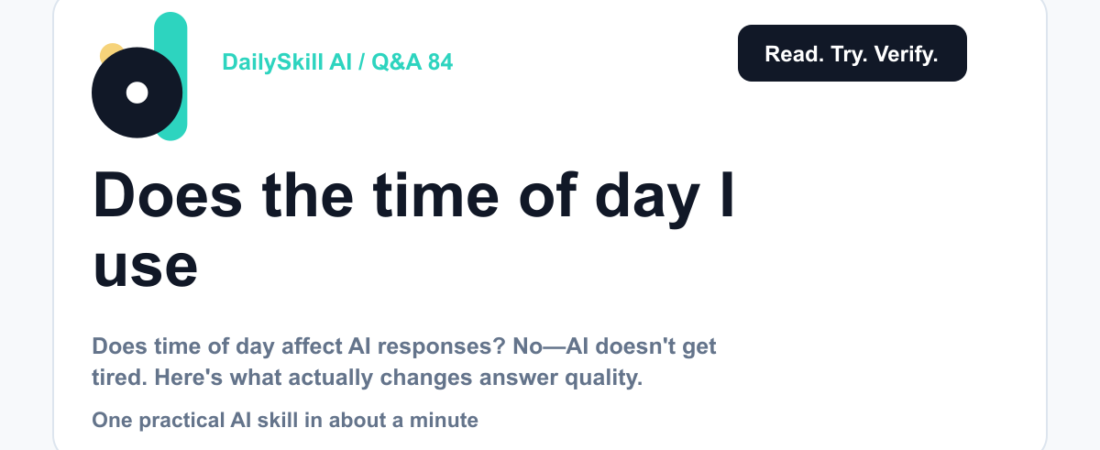
No. AI doesn’t get tired, distracted, or sharper at certain hours. It runs on servers, not sleep cycles, so a 6am question and an 11pm question get the same underlying model and the same effort. If your answers feel better or worse at different times, the difference is you, your prompt, or which tool you picked — not the clock.
Why this comes up
People notice their own late-night questions feel rushed or their morning ones feel clearer, and it’s easy to assume the AI is “waking up” too. There’s also a common mental model — AI as a tired coworker — that just doesn’t match how it works. It’s a reasonable guess, just not how these systems run.
The honest answer
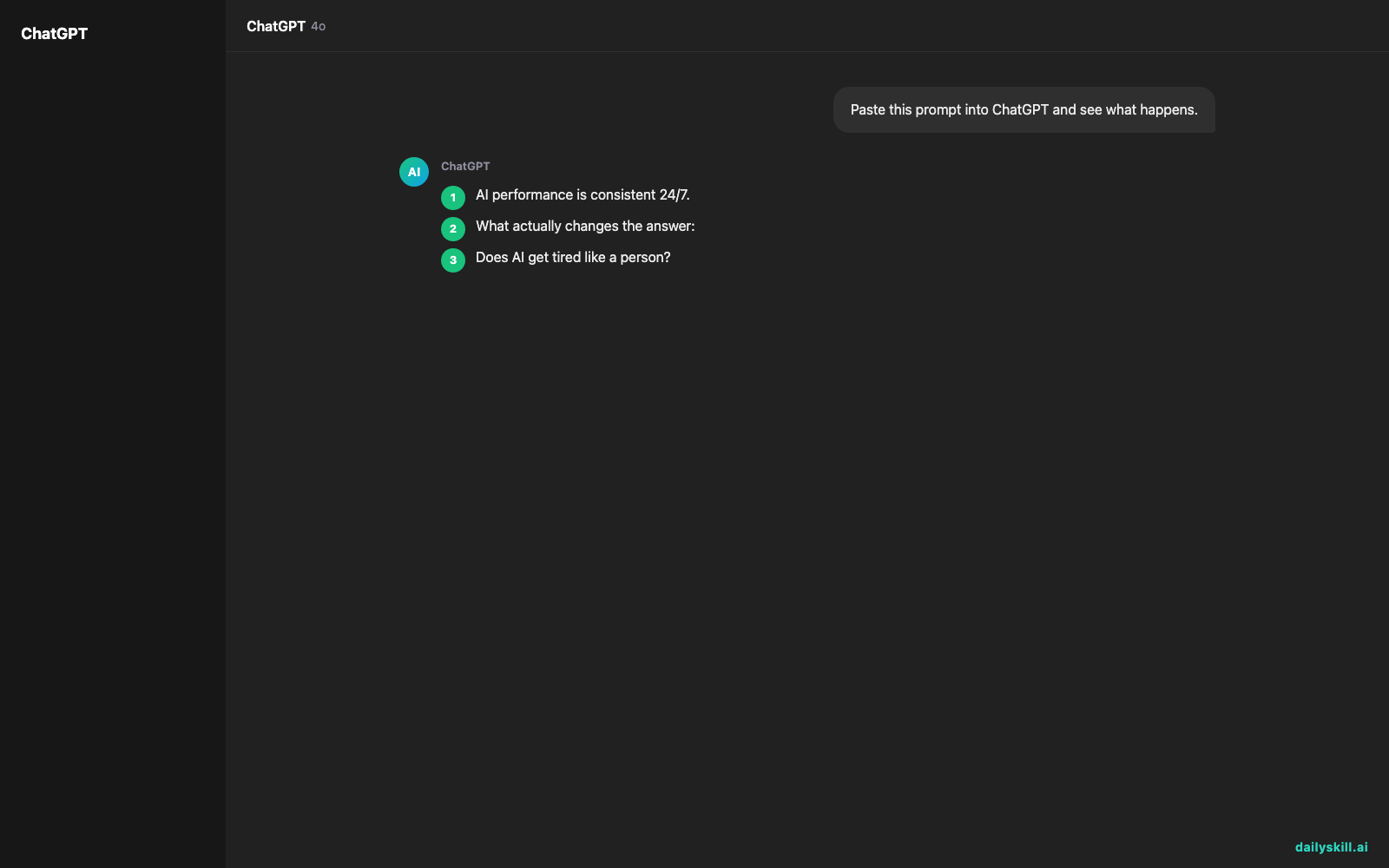
AI performance is consistent 24/7. There’s no “morning vs evening” version of a major assistant that thinks better or worse. The model behind your question is the same one at 3pm and 3am. Time of day is basically a non-issue for quality.
What actually changes the answer:
- Your own focus. Tired, rushed, or half-typed questions produce vague prompts — and vague prompts produce vague answers. That’s on you, not the AI.
- How specific your prompt is. “Help me write an email” gets a generic reply any hour of the day. “Write a 3-sentence email declining a meeting, friendly but firm” gets a sharp one — morning or midnight.
- Which tool you’re using. Different assistants have different strengths, and some are better tuned for coding, writing, or research. That gap is real and matters far more than timing.
- Server load, rarely. During busy periods, responses can come back a little slower. That’s a delay, not a drop in answer quality — the AI isn’t thinking less, it’s just queued.
The AI doesn’t clock in and out. You do.
What to do
- Do write your prompt like you’d explain it to a smart stranger — specific goal, context, format.
- Do re-read your question before sending if you’re tired; that’s the real quality control.
- Do try a different tool if answers feel consistently weak for a certain task — that’s a tool-fit issue, not a timing issue.
- Don’t assume asking again “later” or “earlier” will magically improve a bad answer — fix the prompt instead.
- Don’t blame slow responses on the AI being “off.” Check if it’s a busy period, then wait or retry.
FAQ
Does AI get tired like a person?
No. It doesn’t accumulate fatigue, mood, or attention drift across a day. Every request starts fresh.
Is there an ideal time to use AI for best results?
There’s no ideal hour. The “best time” is whenever you can write a clear, specific prompt and actually review the answer.
Why did my answer seem worse at night?
Almost always a rushed or vague prompt, not the AI itself. Try the same question again, worded more precisely, and compare.
Bottom line
Timing is a myth — your prompt and your tool choice are what actually move the needle. Have you ever blamed a bad AI answer on the hour? Tell us in the comments. Tomorrow: can you actually use AI as a proofreader or fact-checker for your own work?
You might also like:
- Turn Your Bank Statement Into a Spending Breakdown in 60 Seconds
- BookWise — Get the Key Ideas From Any Book Without Reading the Whole Thing