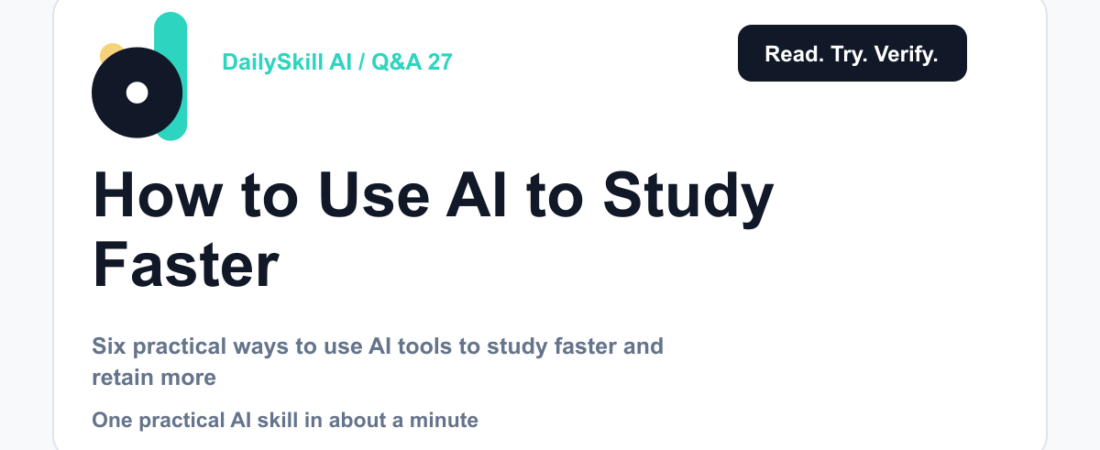
For students, AI tools like ChatGPT have changed how effective studying can be — but most people use them in exactly the wrong way. They ask it to summarize their notes or explain a topic, read the response once, and move on. That’s not studying; that’s reading.
The techniques below use AI in ways that actually improve retention: active recall, practice testing, and the kind of back-and-forth that forces understanding rather than passive consumption.
1. Use It as an On-Demand Tutor (That Never Gets Tired)
The single best use of AI for studying: ask it to explain anything you don’t understand, in exactly the way that makes sense to you.
Explain [concept] like I’ve never heard of it before.
Then give me one concrete real-world example.
If that’s still unclear:
That’s still confusing. Try explaining it using a different analogy.You can do this as many times as it takes. Unlike a teacher or tutor, AI has infinite patience for rephrasing the same concept until it clicks.
2. Generate Practice Questions
Don’t just read material — test yourself on it. Paste in your notes or a section of your textbook and ask:
Generate 10 practice questions from this material.
Mix easy, medium, and hard questions.
Include 3 multiple-choice and 7 short-answer questions.
Don’t include the answers yet — I want to try them first.
Then attempt the questions, and ask for answers and explanations only after you’ve tried.
This is active recall — the most evidence-backed study technique for long-term retention.
3. The Feynman Technique (AI as Your Test Audience)
The Feynman Technique: if you can explain something simply, you understand it. If you can’t, you don’t.
Use AI as your test audience:
I’m going to explain [concept] to you as if you’re a 12-year-old
who’s never heard of it. Tell me where my explanation breaks down
or where I’m being vague.
Explain it. The AI will identify the gaps in your understanding — exactly the parts you haven’t actually grasped, just memorised.
4. Turn Notes Into a Study Guide
If you have messy notes from a lecture or chapter, AI can restructure them into something more useful:
Here are my rough notes from a lecture on [topic].
Turn these into a structured study guide with:
– Key concepts and definitions
– The most important relationships between ideas
– 3 likely exam questions with brief model answers
Paste your notes (even if they’re messy and incomplete) and it’ll organize them into a revision-ready format.
5. Create a Custom Explanation for Your Learning Style
Generic explanations aren’t always the fastest path to understanding. Tell AI how you learn:
I understand things best through [stories / visual diagrams described in text /
step-by-step processes / historical examples / analogies to cooking/sport/etc.]
Explain [concept] using that approach.
Customizing the explanation style to match how your brain works cuts the time to understanding significantly.
6. Quiz Yourself Conversationally
Set up a back-and-forth quiz session:
Quiz me on [topic]. Ask me one question at a time.
After I answer, tell me if I’m right, correct any mistakes,
and then ask the next question.
Don’t give me the answers until I’ve attempted each one.
This is more engaging than flashcards and adapts based on your answers — if you get something wrong, you can ask for a deeper explanation before moving on.
The Most Common Mistake: Using AI Passively
Reading AI explanations doesn’t make you learn — it just makes you feel like you’ve learned. The techniques above work because they force active engagement: generating questions, testing recall, explaining out loud.
If you’re using AI to study and it doesn’t feel effortful, you’re probably not actually learning.
Which AI Tool to Use for Studying
ChatGPT (free) handles all these techniques well. Good for explanations, quizzes, and practice questions.
NotebookLM is the best tool if you have specific documents (lecture notes, textbook chapters, research papers) you want to study from — it reads your materials and answers questions only from what you’ve uploaded.
Claude (free) handles the longest documents and is excellent for reading dense academic papers.
→ Full guide: NotebookLM — study smarter from your own notes
FAQ
Can I just ask AI to write my essay or assignment for me?
You can, but you won’t learn anything — which defeats the purpose of studying. There’s also significant risk if your school has AI policies. Using AI to understand material is genuinely helpful; using it to do the work entirely isn’t studying, it’s outsourcing.
Is using AI to study considered cheating?
Using AI to understand concepts, generate practice questions, or explain material you then learn yourself is generally fine. Using it to complete graded work is a different question that depends on your institution’s policy.
→ Is using AI considered cheating?
Related: Can AI read and summarize a document for me? · Best free AI tools 2026
You might also like:
- Suno: Make AI-Generated Songs in Seconds (No Music Skills Required)
- Day 22 — Translate Any Video’s Subtitles Into Your Language (AI 1-Minute Challenge)
⭐ Want every prompt in one place?
All 136 tested prompts from our daily skills are free on
GitHub — DailySkill Prompt Library.
Star it to get new prompts as we publish.
More on AI for Students & Learning:
- Best AI Tools for Students in 2026 (Free, Practical, Actually Useful)
- Can AI Actually Help Me Learn a New Language?
- Can AI Just Write My Whole Essay or Report for Me?