AI is a solid first stop for understanding health topics — think of it as a well-read friend who can explain what a diagnosis means, what questions to ask your doctor, or whether a symptom is commonly linked to something minor. It is not a doctor, it cannot examine you, and for anything urgent, personal, or serious, a real professional is always the right call.
Why this comes up
You’ve probably typed a symptom into an AI at midnight and wondered whether to trust what came back. The real worry isn’t just accuracy — it’s the risk of acting on that answer instead of getting proper care.
Or the opposite: feeling like you’re bothering a doctor when a quick AI explanation would have saved everyone’s time. Both concerns are completely fair.
The honest answer
Where AI genuinely helps
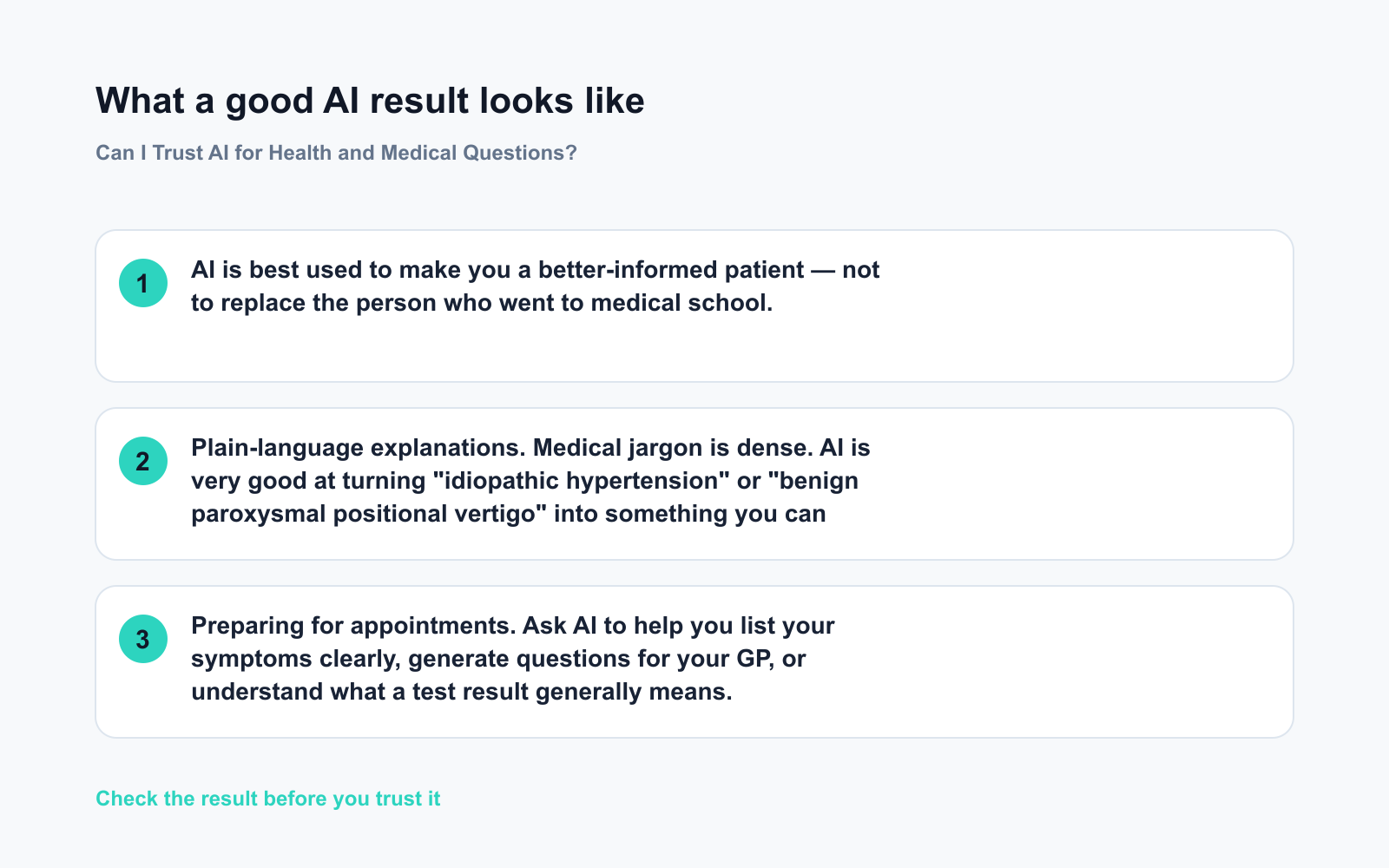
- Plain-language explanations. Medical jargon is dense. AI is very good at turning “idiopathic hypertension” or “benign paroxysmal positional vertigo” into something you can actually understand.
- Preparing for appointments. Ask AI to help you list your symptoms clearly, generate questions for your GP, or understand what a test result generally means.
- General health literacy. How does a medication class work? What’s the difference between Type 1 and Type 2 diabetes? AI handles these well.
- Low-stakes context. “Is a mild sore throat with no fever usually something to wait out?” — AI can give you the kind of reasonable context a pharmacist might offer over the counter.
Where AI falls short — and it matters
- It cannot examine you. A rash that “sounds like” one thing in text might look completely different in person. AI has no access to your actual body.
- It doesn’t know your full history. Your other conditions, current medications, and past reactions all change the picture. AI works only with what you type.
- It can be confidently wrong. AI models don’t always signal uncertainty clearly. A plausible-sounding answer is not the same as a diagnosis.
- It is not a licensed clinician. Even the most capable AI tools are explicit about this in their own terms of service.
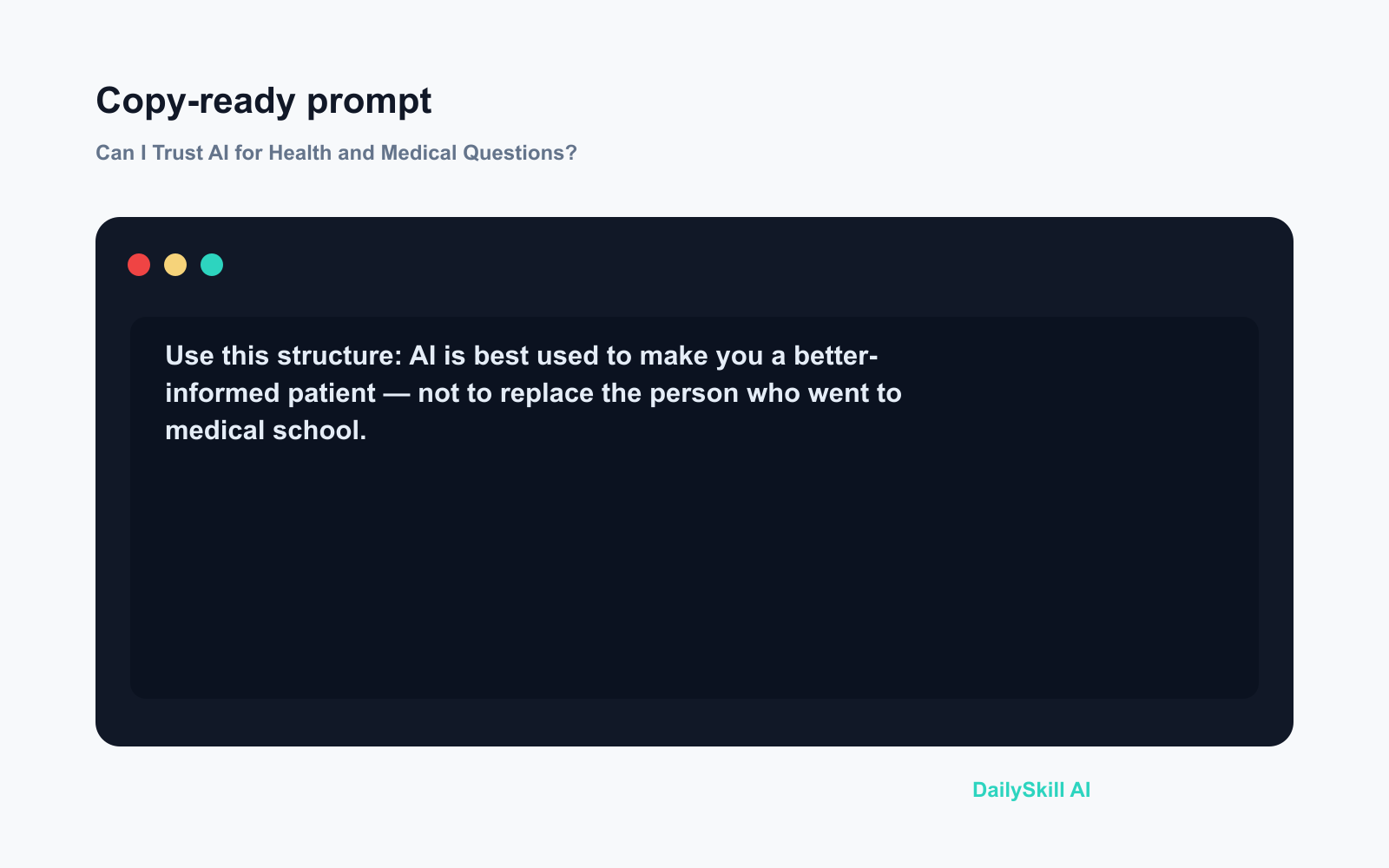
AI is best used to make you a better-informed patient — not to replace the person who went to medical school.
What’s overblown
The fear that AI will routinely tell sick people to rest when they should be in hospital is largely overblown. Most mainstream AI tools now err on the side of caution and flag serious symptoms for professional review.
The real risk is subtler: over-relying on a reassuring answer and not following up when you should.
What to do
Do:
– ✅ Use AI to decode medical terminology before or after an appointment
– ✅ Ask it to help you prepare a clear list of symptoms and questions for your doctor
– ✅ Use it for general context on a condition, medication class, or procedure
– ✅ Treat its answer as a starting point, then verify with a qualified professional
Don’t:
– ❌ Use AI to decide whether an urgent symptom needs emergency care — when in doubt, call or go
– ❌ Adjust or stop medications based on AI output without speaking to a pharmacist or doctor first
– ❌ Assume a confident-sounding answer is a safe answer — watch for hedging and ask follow-ups
– ❌ Skip a professional visit because AI said it’s probably nothing
FAQ
Is AI useful for mental health questions too?
AI can be a non-judgmental space to process feelings or learn about conditions like anxiety or depression. It is not a therapist. If you’re in crisis or struggling significantly, contact a mental health professional or a crisis line — not a chatbot.
Can an AI-powered health app replace a telehealth visit?
No. Some apps use AI to triage symptoms or take histories, but the actual medical judgment and any prescribing still come from a licensed clinician. AI assists the process; it doesn’t replace the professional behind it.
What if AI gets my symptoms wrong and I act on it?
That’s the core risk — and it’s why the rule is simple: use AI to get informed, use a professional to get treated. Never let a confident tone substitute for a real evaluation.
Bottom line
AI is a genuinely useful health companion for learning, preparing, and understanding — just never your last line of defense when something feels wrong.
What’s your experience? Have you ever used AI for a health question and found it helpful — or not? Share your story in the community below.
Tomorrow: How do you use AI without letting it do all your thinking for you? It’s a more important question than it sounds — and the answer might change how you work with AI every day.
You might also like:
- Day 18 — Compare 3 Books’ Core Ideas in 60 Seconds (AI 1-Minute Challenge)
- Speechify — Stop Reading, Start Listening
⭐ Want every prompt in one place?
All 136 tested prompts from our daily skills are free on
GitHub — DailySkill Prompt Library.
Star it to get new prompts as we publish.
More on AI Safety, Privacy & Cost:
- Are Free AI Tools Good Enough, or Will I Eventually Have to Pay?
- Can AI Help Me Understand a Legal Document? (What’s Safe, What’s Not)
- Can AI Help With My Taxes or Finances? (What’s Safe and What Isn’t)
Master Everyday AI in 1 Minute a Day
Get our free 2026 Double-Blind AI Benchmark Scorecard & 20 Ready-to-Use Prompts, plus one honest, 60-second AI skill in your inbox every morning. Zero hype, plain English, cancel anytime.