Ask ChatGPT, Gemini, and Claude the same question back to back and you’ll often get three noticeably different answers. That’s completely normal — and once you understand why, you can use the disagreement as a tool instead of a source of confusion.
Why this comes up
You’re wondering which answer to trust, or whether AI is just guessing at random. The worry makes sense: if the tools disagree, at least some of them must be wrong — so how do you know when to believe any of them? The disagreement usually has a logical reason, and most of the time it’s less alarming than it looks.
The honest answer
They were trained on different data
Each AI tool learned from a different mix of text — web pages, books, code, and more — curated differently by each company. That alone means they bring different “background knowledge” to the same question, before any other factor kicks in.
They’re optimized for different goals
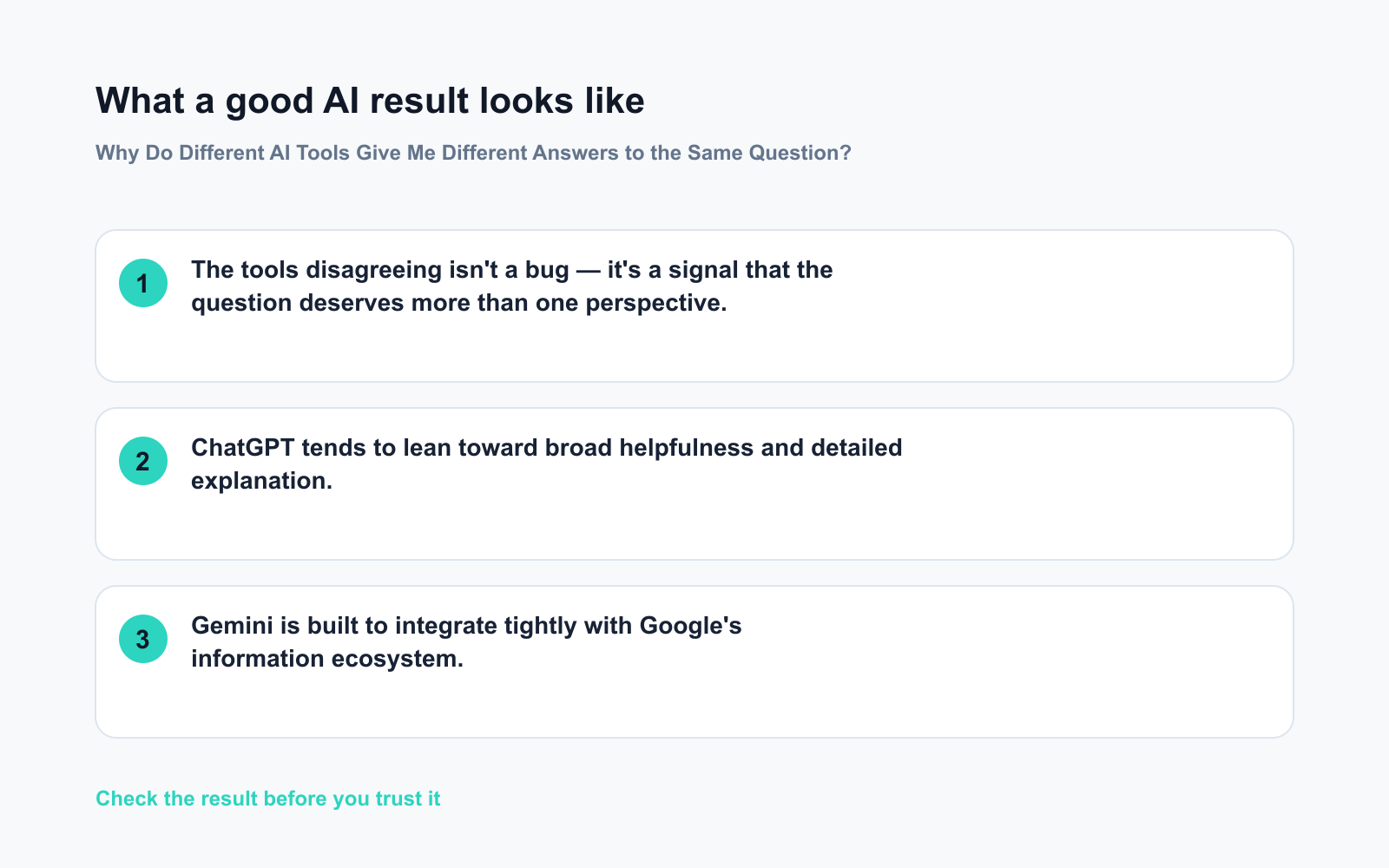
- ChatGPT tends to lean toward broad helpfulness and detailed explanation.
- Gemini is built to integrate tightly with Google’s information ecosystem.
- Claude places a strong emphasis on careful, nuanced reasoning and caution.
Same question, different priorities — different answer shapes.
They reason, not just retrieve
AI tools don’t look facts up in a database. They generate answers by predicting what a useful response looks like. Two tools can reach different conclusions from the same starting point, the same way two smart colleagues might give you different recommendations on the same problem.
Many differences are style, not substance
Often the facts largely agree but the framing differs. One tool uses bullet points; another writes paragraphs. One hedges heavily; another is direct. A difference in tone is not the same as a difference in accuracy — check that distinction before you get worried.
What’s actually overblown
Disagreement does not mean AI is unreliable across the board. On well-established topics — how a law works, what a medical term means, how to write a formula — the tools usually converge.
Disagreement clusters on opinion-heavy, nuanced, or fast-moving topics. Those are exactly the areas where any single source deserves scrutiny, AI or not.
The tools disagreeing isn’t a bug — it’s a signal that the question deserves more than one perspective.
What to do
Do:
– ✅ Treat disagreement as a flag: dig deeper before acting on either answer
– ✅ Ask “what’s the evidence for this?” to pressure-test a single answer
– ✅ On high-stakes questions (medical, legal, financial), compare two tools the way you’d check two news sources
– ✅ Pinpoint where they disagree — on facts, on recommendations, or just on wording?
Don’t:
– ❌ Assume the longest or most confident-sounding answer is the most accurate
– ❌ Default to whichever answer confirms what you already believed
– ❌ Write off AI entirely because answers vary — variation is normal in any expert conversation
FAQ
Which AI tool is most accurate?
It depends on the topic. Tools tend to perform differently across domains — one may be stronger on coding, another on nuanced writing. For anything important, comparing two tools takes under two minutes and is worth making a habit.
Should I show one AI what another tool said and ask it to respond?
Yes — this works well. Paste the other answer and ask “do you agree with this, and where would you push back?” You’ll often surface the most useful nuance that way.
Does asking the same tool the same question twice give different answers?
It can. AI tools use a setting that introduces variability to keep responses from feeling robotic. The fix: be more specific in your prompt. The more precise your question, the more consistent the answers.
Bottom line
Different AI tools give different answers because they were built differently — and that’s actually useful information you can work with, not a reason to distrust them all.
What about you? Have you ever caught two AI tools clearly contradicting each other? Share what the question was in the comments — we’d love to see the examples.
Tomorrow: Is your data being used to train the AI? What actually happens when you type something into ChatGPT or Claude — and what you can do about it.
You might also like:
- Day 13 — Get a Full 1-Week Workout Plan from AI in Under a Minute (AI 1-Minute Challenge)
- Microsoft Copilot — Your Free AI Assistant Already on Your Windows PC
⭐ Want every prompt in one place?
All 136 tested prompts from our daily skills are free on
GitHub — DailySkill Prompt Library.
Star it to get new prompts as we publish.
More on Getting Started with AI (Beginner’s Guide):
- Can I Do All of This on Just My Phone?
- ChatGPT Explained: The Best First AI Tool for Absolute Beginners
- Complete Beginner’s Guide to AI in 2026: What It Is, How It Works, and Where to Start