Probably not the way you picture it. AI is replacing specific tasks, not whole jobs — and the people getting ahead right now aren’t fighting that shift, they’re using AI as a skill multiplier to do more than they could before. The real risk isn’t AI taking your job; it’s someone who uses AI well doing it instead.
Why this comes up
The headlines are loud and the fear is real. You see stories about layoffs and automation and it’s hard to know what’s signal and what’s noise. The worry underneath is simple: Will I still have a livelihood in five years? That’s worth taking seriously — just with accurate information, not panic.
The honest answer
AI is changing work. It is not ending it.
Tasks are being automated faster than ever — writing first drafts, sorting data, answering routine questions, generating images. If your job is mostly one of those tasks repeated all day, that role is under real pressure.
But most jobs are bundles of tasks, not just one. AI handles the repetitive ones poorly when they require:
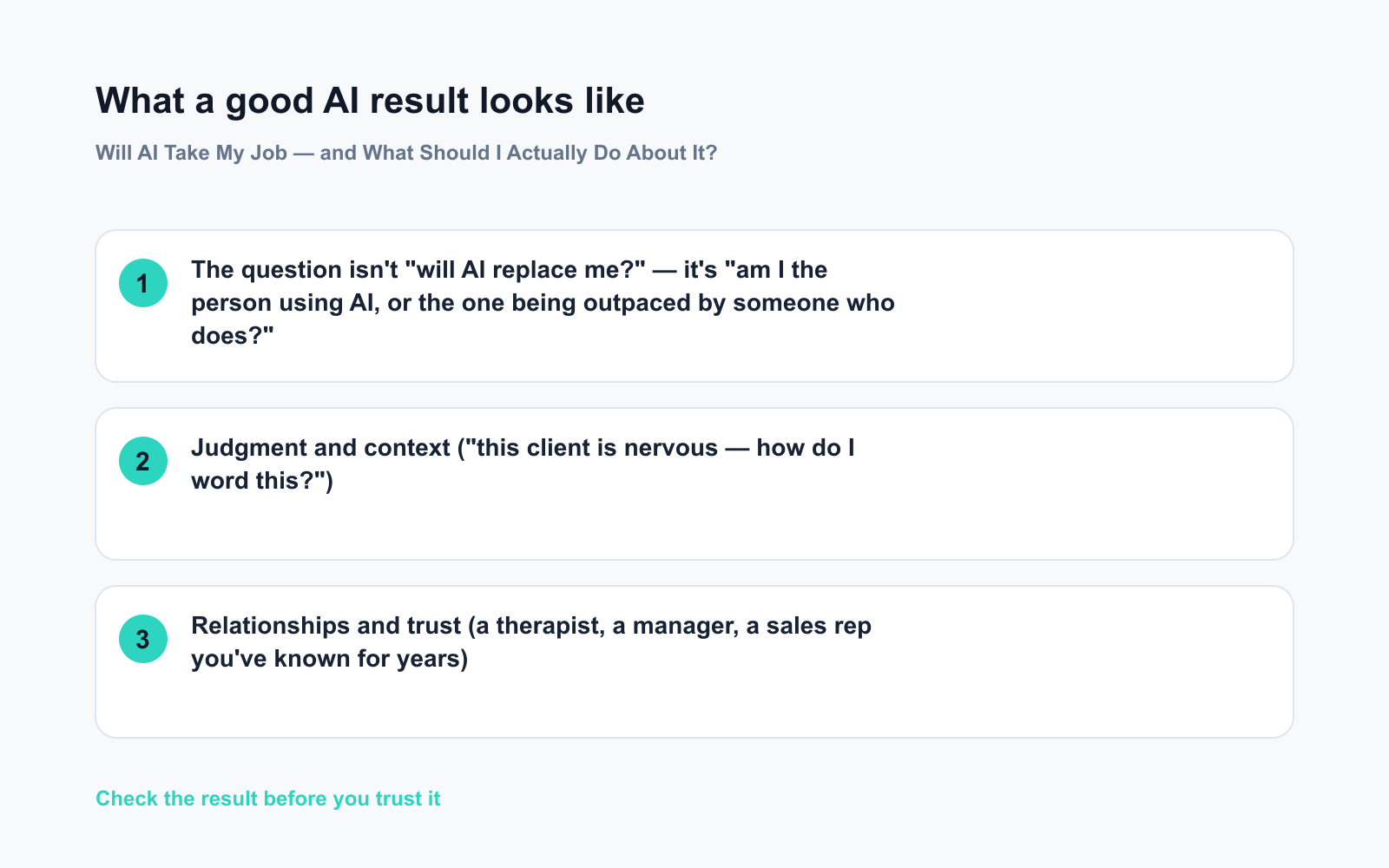
- Judgment and context (“this client is nervous — how do I word this?”)
- Relationships and trust (a therapist, a manager, a sales rep you’ve known for years)
- Physical presence (a plumber, a nurse, a teacher in a classroom)
- Creative direction — knowing what to make, not just making it
The shift that’s already happening
One pattern keeps showing up across industries: people who use AI tools are outperforming people who don’t. A marketer using AI produces more content in less time. A developer using an AI coding assistant ships faster. A small business owner using AI handles tasks that used to require a whole team.
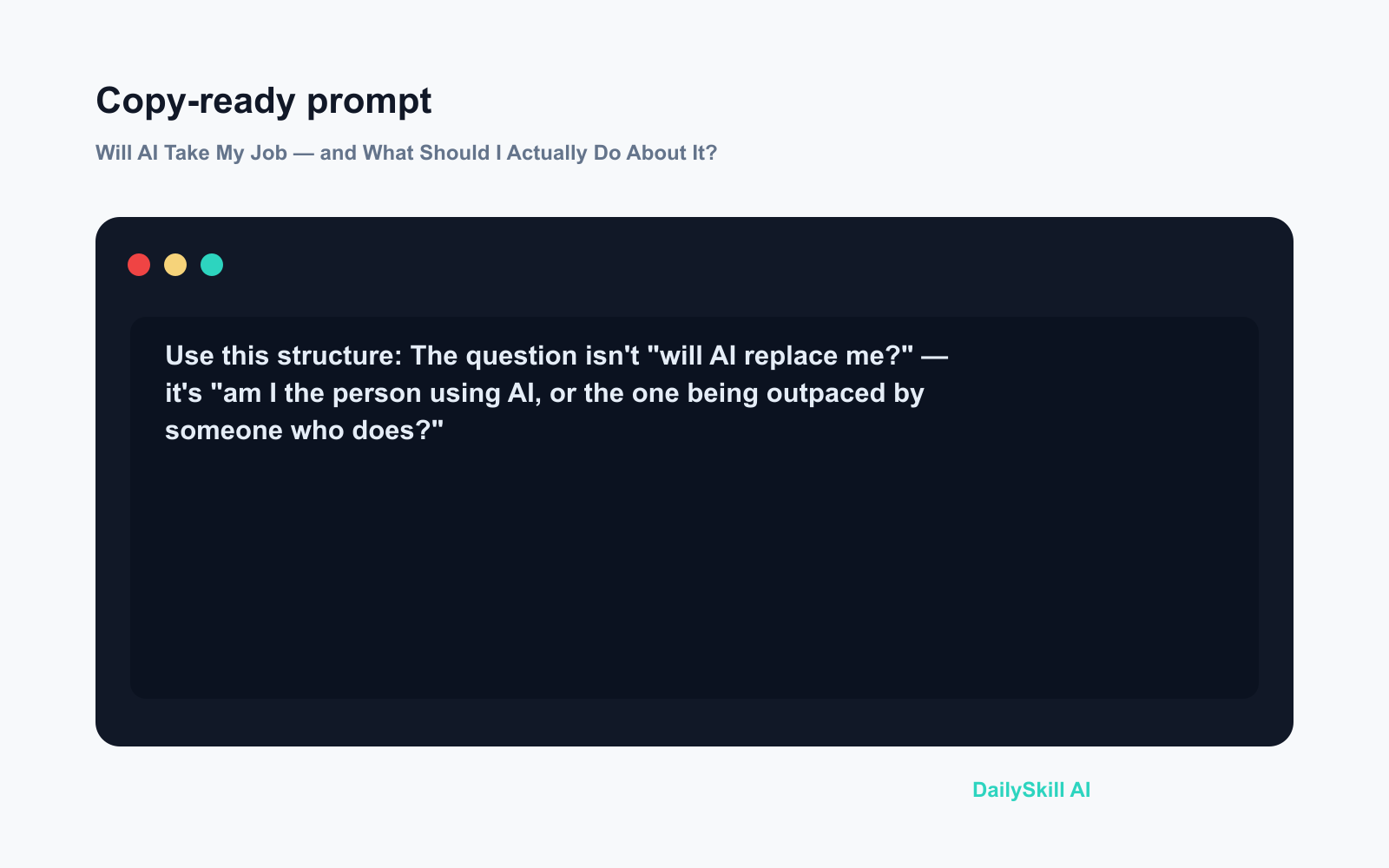
The question isn’t “will AI replace me?” — it’s “am I the person using AI, or the one being outpaced by someone who does?”
What’s overblown
Mass overnight unemployment is not happening. Adoption is patchy and slow in most industries. Most AI tools still require significant human checking, editing, and direction. New roles are being created too — AI trainers, automation consultants, prompt specialists — and most of them didn’t exist a few years ago.
What to do
Do:
– Pick one AI tool relevant to your actual work this week — ChatGPT, Gemini, Copilot, whatever fits. Use it on a real task, not just to play around.
– Build one small daily habit: spend 15 minutes using AI for something you currently do manually — drafting emails, summarizing documents, researching a topic.
– Map your job tasks. Write down your main responsibilities, then mark which ones AI can assist with and which ones only you can do. That second list is your leverage.
– Stay curious rather than avoidant. Consistent, low-stakes practice now beats a rushed scramble later.
Don’t:
– Don’t panic-pivot your whole career based on headlines. Steady upskilling beats dramatic overreaction every time.
– Don’t assume you’re safe because your field “isn’t tech.” Law, healthcare, education, and the trades are all being touched.
– Don’t lean on AI output before you know what good looks like in your field. You need enough expertise to catch its mistakes.
FAQ
Which jobs are safest from AI disruption?
Roles built around physical presence, emotional intelligence, or unpredictable real-world problem-solving are most resilient — nursing, skilled trades, social work, teaching, complex sales. Even those roles are gaining AI-assisted tools, though, so adaptability matters more than picking one “safe” career.
Do I need to learn to code to stay relevant?
No. Most AI tools today are built for everyday users — no coding required. What matters more is knowing how to ask clear questions, evaluate AI output critically, and apply the tools to your specific work. That’s a learnable habit, not a technical degree.
What’s the single most future-proof skill I can build right now?
Learning to direct AI well — giving it clear context, checking its output, and combining its speed with your own judgment. That skill transfers across almost every job and industry.
Bottom line
AI will change your job. Whether that becomes a threat or an advantage depends almost entirely on one habit: start using it now, on real work, consistently.
Does AI feel like a tool you can use, or a threat you’re not sure how to face? Share your take in the community — we read every response.
Tomorrow: Can you do all of this on just your phone? You might be surprised how much is possible without a laptop.
You might also like:
- Day 7 — Translate Any Foreign Menu in Seconds — with AI Camera (AI 1-Minute Challenge)
- ElevenLabs — Hear Your Words Out Loud in Under 5 Minutes
⭐ Want every prompt in one place?
All 136 tested prompts from our daily skills are free on
GitHub — DailySkill Prompt Library.
Star it to get new prompts as we publish.
👉 Related: Can ChatGPT Help Me Write a Better Resume?
More on AI for Work & Productivity:
- AI for Small Business Owners: 8 Practical Ways to Save Time in 2026
- Can AI Actually Help You Make Money? (Realistic Ways That Work in 2026)
- Can AI Help Me With Excel Formulas and Spreadsheets? (Yes, Here’s How)
Master Everyday AI in 1 Minute a Day
Get our free 2026 Double-Blind AI Benchmark Scorecard & 20 Ready-to-Use Prompts, plus one honest, 60-second AI skill in your inbox every morning. Zero hype, plain English, cancel anytime.